



 Chat with AI
Exam 28: Unemployment and Its Natural Rate

Exam 1: Ten Principles of Economics455 Questions
Exam 2: Thinking Like an Economist643 Questions
Exam 3: Interdependence and the Gains From Trade547 Questions
Exam 4: The Market Forces of Supply and Demand693 Questions
Exam 5: Elasticity and Its Application626 Questions
Exam 6: Supply, Demand, and Government Policies668 Questions
Exam 7: Consumers, Producers, and the Efficiency of Markets547 Questions
Exam 8: Applications: the Costs of Taxation509 Questions
Exam 9: Application: International Trade521 Questions
Exam 10: Externalities543 Questions
Exam 11: Public Goods and Common Resources452 Questions
Exam 12: The Design of the Tax System664 Questions
Exam 13: The Costs of Production649 Questions
Exam 14: Firms in Competitive Markets604 Questions
Exam 15: Monopoly662 Questions
Exam 16: Monopolistic Competition649 Questions
Exam 17: Oligopoly522 Questions
Exam 18: The Markets for the Factors of Production592 Questions
Exam 19: Earnings and Discrimination511 Questions
Exam 20: Income Inequality and Poverty478 Questions
Exam 21: The Theory of Consumer Choice570 Questions
Exam 22: Frontiers in Microeconomics461 Questions
Exam 23: Measuring a Nation S Income547 Questions
Exam 24: Measuring the Cost of Living565 Questions
Exam 25: Production and Growth527 Questions
Exam 26: Saving, Investment, and the Financial System637 Questions
Exam 27: Tools of Finance534 Questions
Exam 28: Unemployment and Its Natural Rate701 Questions
Exam 29: The Monetary System540 Questions
Exam 30: Money Growth and Inflation504 Questions
Exam 31: Open-Economy Macroeconomics: Basic Concepts540 Questions
Exam 32: A Macroeconomic Theory of the Open Economy511 Questions
Exam 33: Aggregate Demand and Aggregate Supply572 Questions
Exam 34: The Influence of Monetary and Fiscal Policy on Aggregate Demand523 Questions
Exam 35: The Short-Run Tradeoff Between Inflation and Unemployment536 Questions
Exam 36: Six Debates Over Macroeconomic Policy354 Questions
Select questions type


The Bureau of Labor Statistics produces data on unemployment by using data on claims filed for unemployment insurance.
(True/False)
4.9/5  (76)
(76) The Bureau of Labor Statistics divides the adult population into three categories: employed, unemployed, and not in the labor force.
(True/False)
4.9/5 (79)
(79) Government-run employment agencies and public training programs both seek to reduce frictional unemployment.
(True/False)
5.0/5 (72)
(72) Figure 28-3 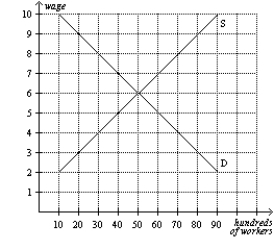 -Refer to Figure 28-3. If the government imposes a minimum wage of $8, then unemployment will increase by
 (Multiple Choice)
4.9/5 (79)
(79) Write the formula for calculating the labor force participation rate.
(Essay)
4.8/5 (68)
(68) Within the U.S. population, women of prime working age (ages 25-54) have higher rates of unemployment than men of prime working age (ages 25-54), regardless of race.
(True/False)
4.9/5 (78)
(78) Within the U.S. population, teenagers (ages 16-19) have higher rates of unemployment than adults of prime working age (ages 25-54), regardless of race or gender.
(True/False)
4.8/5 (75)
(75) If people who report being unemployed are not, in fact, trying hard to find a job, then the reported unemployment rate will be biased upward.
(True/False)
4.9/5 (83)
(83) Table 28-11
2015 Labor Data for Tajnia  -Refer to Table 28-11. The unemployment rate in Tajnia in 2015 is about 7.5 percent.
 (True/False)
4.9/5 (89)
(89) Buddy is the owner of a firm that bottles beer in St. Louis, Missouri. There are many other such firms in the area. Buddy decides that if he pays his workers a wage higher than the going market wage, his profits will increase. Which of the following is a likely explanation for his decision?
(Multiple Choice)
4.9/5 (83)
(83) Suppose that medical technicians and nurses' aides are not unionized. If the nurses' aides unionize, then the wages of
(Multiple Choice)
4.8/5 (81)
(81) The Bureau of Labor Statistics' U-1 measure of joblessness includes only very long-term unemployed.
(True/False)
4.8/5 (71)
(71) If an unemployed person quits looking for work, then, eventually the unemployment rate
(Multiple Choice)
4.9/5 (79)
(79) Table 28-4
2010 Labor Data for Adults (ages 16 and older) in Meditor 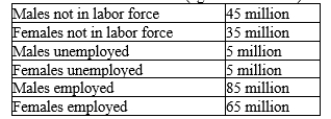 -Refer to Table 28-4. What is the adult female labor force in Meditor?
 (Multiple Choice)
4.8/5 (86)
(86) People who report being not in the labor force but who, in fact, want to work but have given up trying to find a job after an unsuccessful search cause the reported unemployment rate to be lower than it would otherwise be.
(True/False)
4.9/5 (85)
(85) The Bureau of Labor Statistics' U-5 measure of joblessness is the official unemployment rate.
(True/False)
4.9/5 (83)
(83) 
Filters
- Essay(0)
- Multiple Choice(0)
- Short Answer(0)
- True False(0)
- Matching(0)