



 Chat with AI
Exam 28: Unemployment and Its Natural Rate

Exam 1: Ten Principles of Economics455 Questions
Exam 2: Thinking Like an Economist643 Questions
Exam 3: Interdependence and the Gains From Trade547 Questions
Exam 4: The Market Forces of Supply and Demand693 Questions
Exam 5: Elasticity and Its Application626 Questions
Exam 6: Supply, Demand, and Government Policies668 Questions
Exam 7: Consumers, Producers, and the Efficiency of Markets547 Questions
Exam 8: Applications: the Costs of Taxation509 Questions
Exam 9: Application: International Trade521 Questions
Exam 10: Externalities543 Questions
Exam 11: Public Goods and Common Resources452 Questions
Exam 12: The Design of the Tax System664 Questions
Exam 13: The Costs of Production649 Questions
Exam 14: Firms in Competitive Markets604 Questions
Exam 15: Monopoly662 Questions
Exam 16: Monopolistic Competition649 Questions
Exam 17: Oligopoly522 Questions
Exam 18: The Markets for the Factors of Production592 Questions
Exam 19: Earnings and Discrimination511 Questions
Exam 20: Income Inequality and Poverty478 Questions
Exam 21: The Theory of Consumer Choice570 Questions
Exam 22: Frontiers in Microeconomics461 Questions
Exam 23: Measuring a Nation S Income547 Questions
Exam 24: Measuring the Cost of Living565 Questions
Exam 25: Production and Growth527 Questions
Exam 26: Saving, Investment, and the Financial System637 Questions
Exam 27: Tools of Finance534 Questions
Exam 28: Unemployment and Its Natural Rate701 Questions
Exam 29: The Monetary System540 Questions
Exam 30: Money Growth and Inflation504 Questions
Exam 31: Open-Economy Macroeconomics: Basic Concepts540 Questions
Exam 32: A Macroeconomic Theory of the Open Economy511 Questions
Exam 33: Aggregate Demand and Aggregate Supply572 Questions
Exam 34: The Influence of Monetary and Fiscal Policy on Aggregate Demand523 Questions
Exam 35: The Short-Run Tradeoff Between Inflation and Unemployment536 Questions
Exam 36: Six Debates Over Macroeconomic Policy354 Questions
Select questions type


Most people rely primarily on income other than their labor earnings to maintain their standard of living.
(True/False)
4.7/5  (74)
(74) Suppose that the adult population in the country of Atlantis is 115 million. If 80 million people are employed and 5 million are unemployed, then
(Multiple Choice)
4.9/5 (80)
(80) Give a few examples of how sectoral shifts temporarily cause unemployment.
(Essay)
4.7/5 (83)
(83) Within the U.S. population, teenagers (ages 16-19) have similar rates of labor-force participation than adults of prime working age (ages 25-54), regardless of race or gender.
(True/False)
4.8/5 (96)
(96) Briefly summarize the advantages and disadvantages of unemployment insurance.
(Essay)
4.9/5 (69)
(69) If a union raises the wage in its industry above equilibrium then employment in that industry
(Multiple Choice)
4.7/5 (70)
(70) Over the past several decades, the difference between the labor-force participation rates of men and women in the U.S. has
(Multiple Choice)
5.0/5 (74)
(74) In an ideal labor market, wages would adjust to balance the quantity of labor supplied and the quantity of labor demanded, ensuring that all workers are always fully employed.
(True/False)
4.9/5 (70)
(70) Long-run unemployment arises from a single problem that has a single solution.
(True/False)
4.9/5 (65)
(65) Some degree of unemployment is inevitable in a complex economy.
(True/False)
4.9/5 (97)
(97) When a union bargains successfully with employers, in that industry,
(Multiple Choice)
4.8/5 (86)
(86) If the number of people unemployed rose but the number of people employed and the adult population stayed the same, then the labor force participation rate would rise.
(True/False)
4.8/5 (89)
(89) Suppose that some country had an adult population of about 46 million, a labor-force participation rate of 75 percent, and an unemployment rate of 8 percent. How many people were unemployed?
(Multiple Choice)
4.7/5 (81)
(81) Which famous company executive introduced an innovative pay system that is consistent with the theory of efficiency wages?
(Multiple Choice)
4.8/5 (84)
(84) Table 28-6 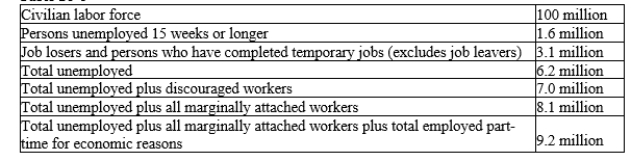 -Refer to Table 28-6. What is the U-5 measure of labor underutilization?
 (Multiple Choice)
4.8/5 (74)
(74) Suppose that roofers are not unionized. If roofers unionize, then the supply of labor in other sectors of the economy will
(Multiple Choice)
4.8/5 (83)
(83) 
Filters
- Essay(0)
- Multiple Choice(0)
- Short Answer(0)
- True False(0)
- Matching(0)