



 Chat with AI
Exam 28: Unemployment and Its Natural Rate

Exam 1: Ten Principles of Economics455 Questions
Exam 2: Thinking Like an Economist643 Questions
Exam 3: Interdependence and the Gains From Trade547 Questions
Exam 4: The Market Forces of Supply and Demand693 Questions
Exam 5: Elasticity and Its Application626 Questions
Exam 6: Supply, Demand, and Government Policies668 Questions
Exam 7: Consumers, Producers, and the Efficiency of Markets547 Questions
Exam 8: Applications: the Costs of Taxation509 Questions
Exam 9: Application: International Trade521 Questions
Exam 10: Externalities543 Questions
Exam 11: Public Goods and Common Resources452 Questions
Exam 12: The Design of the Tax System664 Questions
Exam 13: The Costs of Production649 Questions
Exam 14: Firms in Competitive Markets604 Questions
Exam 15: Monopoly662 Questions
Exam 16: Monopolistic Competition649 Questions
Exam 17: Oligopoly522 Questions
Exam 18: The Markets for the Factors of Production592 Questions
Exam 19: Earnings and Discrimination511 Questions
Exam 20: Income Inequality and Poverty478 Questions
Exam 21: The Theory of Consumer Choice570 Questions
Exam 22: Frontiers in Microeconomics461 Questions
Exam 23: Measuring a Nation S Income547 Questions
Exam 24: Measuring the Cost of Living565 Questions
Exam 25: Production and Growth527 Questions
Exam 26: Saving, Investment, and the Financial System637 Questions
Exam 27: Tools of Finance534 Questions
Exam 28: Unemployment and Its Natural Rate701 Questions
Exam 29: The Monetary System540 Questions
Exam 30: Money Growth and Inflation504 Questions
Exam 31: Open-Economy Macroeconomics: Basic Concepts540 Questions
Exam 32: A Macroeconomic Theory of the Open Economy511 Questions
Exam 33: Aggregate Demand and Aggregate Supply572 Questions
Exam 34: The Influence of Monetary and Fiscal Policy on Aggregate Demand523 Questions
Exam 35: The Short-Run Tradeoff Between Inflation and Unemployment536 Questions
Exam 36: Six Debates Over Macroeconomic Policy354 Questions
Select questions type


Over the past several decades in the United States, the labor-force participation rate of women has increased and the labor-force participation rate of men had remained steady.
(True/False)
4.9/5  (73)
(73) Figure 28-4
 -Refer to Figure 28-4. If 8,000 workers are unemployed, then the minimum wage must be
 (Multiple Choice)
4.8/5 (94)
(94) Following the recession of 2001, there was a month in which employment and the unemployment rate both rose. Assuming the computations were correct, how is it possible for both to have increased?
(Essay)
4.8/5 (88)
(88) Table 28-2
Labor Data for Aridia  -Refer to Table 28-2. The labor force of Aridia in 2012 was
 (Multiple Choice)
4.9/5 (80)
(80) Briefly compare the structural unemployment that arises from minimum-wage laws to the frictional unemployment that arises from the process of job search.
(Essay)
4.8/5 (89)
(89) Someone who is without work but is not looking for work is included in the Bureau of Labor Statistics' "unemployed" category.
(True/False)
4.9/5 (73)
(73) Which of the following is not a reason economies experience structural unemployment?
(Multiple Choice)
4.9/5 (88)
(88) Advocates of government-run employment agencies and public training programs believe they make job search more efficient.
(True/False)
4.9/5 (82)
(82) Suppose that florists and landscape workers are not unionized. If florists unionize, then the wages of
(Multiple Choice)
4.9/5 (79)
(79) Structural unemployment is often thought to explain relatively short spells of unemployment.
(True/False)
4.9/5 (80)
(80) Scenario 28-1
Suppose that the Bureau of Labor Statistics reports that the entire adult population of Mankiwland can be categorized as follows: 25 million people employed, 3 million people unemployed, 1 million discouraged workers, and 1 million people who are either students, homemakers, retirees, or other people not seeking employment.
-Refer to Scenario 28-1. What is the labor-force participation rate?
(Multiple Choice)
4.9/5 (84)
(84) Government policy can do nothing about the natural rate of unemployment.
(True/False)
4.7/5 (64)
(64) Figure 28-4
-Refer to Figure 28-4. If the government imposes a minimum wage of $4, how many workers will be unemployed?
-Refer to Figure 28-4. If the government imposes a minimum wage of $4, how many workers will be unemployed? (Multiple Choice)
4.9/5 (86)
(86) Workers waiting for jobs to open up is most closely associated with
(Multiple Choice)
4.8/5 (78)
(78) A minimum wage that is below the equilibrium wage rate does not raise unemployment.
(True/False)
4.9/5 (75)
(75) Unpaid stay-at-home fathers are included in the Bureau of Labor Statistics' "unemployed" category.
(True/False)
4.8/5 (78)
(78) Table 28-7
Below is data about the labor market in the city of Productionville. 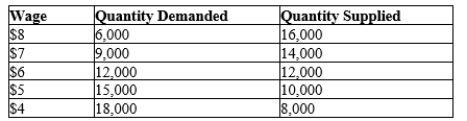 -Refer to Table 28-7. If the local government imposed a minimum wage of $8 in Productionville, how many people would be unemployed?
 (Multiple Choice)
4.9/5 (77)
(77) 
Filters
- Essay(0)
- Multiple Choice(0)
- Short Answer(0)
- True False(0)
- Matching(0)