



 Chat with AI
Exam 28: Unemployment and Its Natural Rate

Exam 1: Ten Principles of Economics455 Questions
Exam 2: Thinking Like an Economist643 Questions
Exam 3: Interdependence and the Gains From Trade547 Questions
Exam 4: The Market Forces of Supply and Demand693 Questions
Exam 5: Elasticity and Its Application626 Questions
Exam 6: Supply, Demand, and Government Policies668 Questions
Exam 7: Consumers, Producers, and the Efficiency of Markets547 Questions
Exam 8: Applications: the Costs of Taxation509 Questions
Exam 9: Application: International Trade521 Questions
Exam 10: Externalities543 Questions
Exam 11: Public Goods and Common Resources452 Questions
Exam 12: The Design of the Tax System664 Questions
Exam 13: The Costs of Production649 Questions
Exam 14: Firms in Competitive Markets604 Questions
Exam 15: Monopoly662 Questions
Exam 16: Monopolistic Competition649 Questions
Exam 17: Oligopoly522 Questions
Exam 18: The Markets for the Factors of Production592 Questions
Exam 19: Earnings and Discrimination511 Questions
Exam 20: Income Inequality and Poverty478 Questions
Exam 21: The Theory of Consumer Choice570 Questions
Exam 22: Frontiers in Microeconomics461 Questions
Exam 23: Measuring a Nation S Income547 Questions
Exam 24: Measuring the Cost of Living565 Questions
Exam 25: Production and Growth527 Questions
Exam 26: Saving, Investment, and the Financial System637 Questions
Exam 27: Tools of Finance534 Questions
Exam 28: Unemployment and Its Natural Rate701 Questions
Exam 29: The Monetary System540 Questions
Exam 30: Money Growth and Inflation504 Questions
Exam 31: Open-Economy Macroeconomics: Basic Concepts540 Questions
Exam 32: A Macroeconomic Theory of the Open Economy511 Questions
Exam 33: Aggregate Demand and Aggregate Supply572 Questions
Exam 34: The Influence of Monetary and Fiscal Policy on Aggregate Demand523 Questions
Exam 35: The Short-Run Tradeoff Between Inflation and Unemployment536 Questions
Exam 36: Six Debates Over Macroeconomic Policy354 Questions
Select questions type


The demand for labor by a certain firm is independent of the demand for that firm's product.
(True/False)
4.9/5  (77)
(77) In 2016 the Bureau of Labor Statistics reported that there were 57.1 million people over age 25 whose highest level of education was some college or an associate degree. Of these, 36.4 million were employed and 1.5 million were unemployed. What were the labor-force participation rate and the unemployment rate for this group?
(Multiple Choice)
4.8/5 (83)
(83) The unemployment rate reported by the Bureau of Labor Statistics clearly understates the true unemployment rate.
(True/False)
4.8/5 (98)
(98) Table 28-10
The table below lists the number of people by labor force classification for the country of Springfield. 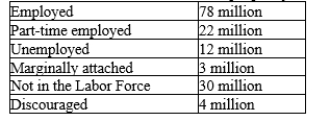 -Refer to Table 28-10. Calculate the U-4 unemployment rate.
 (Short Answer)
4.9/5 (91)
(91) Within the U.S. population, teenagers (ages 16-19) have similar rates of unemployment to adults of prime working age (ages 25-54), regardless of race or gender.
(True/False)
4.9/5 (78)
(78) Adam is looking for a job in marketing. He has had some offers and his prospects are promising, but he has not yet accepted a job. Amanda lost her job working for Mercury Bicycles because many customers decided they prefer bicycles manufactured by Ultimate Bicycles instead. Who is frictionally unemployed?
(Multiple Choice)
4.9/5 (62)
(62) Table 28-11
2015 Labor Data for Tajnia  -Refer to Table 28-11. The labor force of Tajnia in 2015 is 10,000.
 (True/False)
4.8/5 (81)
(81) If all workers and all jobs were the same such that all workers were equally well suited for all jobs, then job search would not be a problem.
(True/False)
4.8/5 (71)
(71) Almost nine-tenths of all spells of unemployment end when the unemployed person finds a job.
(True/False)
4.8/5 (76)
(76) Which of the following is an example of an efficiency wage?
(Multiple Choice)
4.7/5 (84)
(84) Most spells of unemployment are long, and most unemployment observed at any given time is long-term.
(True/False)
5.0/5 (93)
(93) Briefly describe how labor unions can affect wages in non-unionized industries.
(Essay)
4.8/5 (67)
(67) What is the theory of efficiency wages? Provide four reasons that employers might pay efficiency wages.
(Essay)
4.7/5 (75)
(75) One explanation for long-run unemployment is that it takes time for workers to search for the jobs that are best suited for them.
(True/False)
4.8/5 (72)
(72) The theory of efficiency wages provides a possible explanation as to why
(Multiple Choice)
4.8/5 (96)
(96) The Bureau of Labor Statistics' U-2 measure of joblessness includes job losers and job leavers.
(True/False)
4.9/5 (83)
(83) 
Filters
- Essay(0)
- Multiple Choice(0)
- Short Answer(0)
- True False(0)
- Matching(0)