



 Chat with AI
Exam 28: Unemployment and Its Natural Rate

Exam 1: Ten Principles of Economics455 Questions
Exam 2: Thinking Like an Economist643 Questions
Exam 3: Interdependence and the Gains From Trade547 Questions
Exam 4: The Market Forces of Supply and Demand693 Questions
Exam 5: Elasticity and Its Application626 Questions
Exam 6: Supply, Demand, and Government Policies668 Questions
Exam 7: Consumers, Producers, and the Efficiency of Markets547 Questions
Exam 8: Applications: the Costs of Taxation509 Questions
Exam 9: Application: International Trade521 Questions
Exam 10: Externalities543 Questions
Exam 11: Public Goods and Common Resources452 Questions
Exam 12: The Design of the Tax System664 Questions
Exam 13: The Costs of Production649 Questions
Exam 14: Firms in Competitive Markets604 Questions
Exam 15: Monopoly662 Questions
Exam 16: Monopolistic Competition649 Questions
Exam 17: Oligopoly522 Questions
Exam 18: The Markets for the Factors of Production592 Questions
Exam 19: Earnings and Discrimination511 Questions
Exam 20: Income Inequality and Poverty478 Questions
Exam 21: The Theory of Consumer Choice570 Questions
Exam 22: Frontiers in Microeconomics461 Questions
Exam 23: Measuring a Nation S Income547 Questions
Exam 24: Measuring the Cost of Living565 Questions
Exam 25: Production and Growth527 Questions
Exam 26: Saving, Investment, and the Financial System637 Questions
Exam 27: Tools of Finance534 Questions
Exam 28: Unemployment and Its Natural Rate701 Questions
Exam 29: The Monetary System540 Questions
Exam 30: Money Growth and Inflation504 Questions
Exam 31: Open-Economy Macroeconomics: Basic Concepts540 Questions
Exam 32: A Macroeconomic Theory of the Open Economy511 Questions
Exam 33: Aggregate Demand and Aggregate Supply572 Questions
Exam 34: The Influence of Monetary and Fiscal Policy on Aggregate Demand523 Questions
Exam 35: The Short-Run Tradeoff Between Inflation and Unemployment536 Questions
Exam 36: Six Debates Over Macroeconomic Policy354 Questions
Select questions type


Over the past several decades in the United States, the labor-force participation rate of women has increased and the labor-force participation rate of men had decreased.
(True/False)
4.8/5  (67)
(67) Every month, the Bureau of Labor Statistics surveys 160,000 business establishments to help determine the
(Multiple Choice)
4.8/5 (82)
(82) The destruction of manufacturing jobs and workers leaving their jobs to find better ones both contribute to frictional unemployment.
(True/False)
4.8/5 (85)
(85) Just after World War II, the labor-force participation rate of men was
(Multiple Choice)
4.9/5 (84)
(84) Three possible reasons for an above-equilibrium wage are minimum-wage laws, unions, and efficiency wages.
(True/False)
4.9/5 (77)
(77) U.S. Department of Labor data show that minimum-wage workers tend to be young, less educated, more likely to be working part time, and concentrated in the leisure and hospitality industry.
(True/False)
4.9/5 (81)
(81) Who in the adult population is counted as "employed" in U.S. labor statistics?
(Multiple Choice)
4.8/5 (85)
(85) Minimum wages create unemployment in markets where they create a
(Multiple Choice)
4.9/5 (90)
(90) If the minimum wage is currently above the equilibrium wage, then a decrease in the minimum wage
(Multiple Choice)
4.9/5 (80)
(80) The efficiency-wage theory of worker turnover suggests that firms with higher turnover will have
(Multiple Choice)
4.8/5 (80)
(80) Tatiana is waiting to be recalled to a job from which she was laid off. Ivan was fired but has not looked for work during the last two months. Who does the Bureau of Labor Statistics count as "unemployed"?
(Multiple Choice)
4.7/5 (89)
(89) The Bureau of Labor Statistics produces data on unemployment
(Multiple Choice)
4.9/5 (79)
(79) The unemployment rate is computed as the number of unemployed
(Multiple Choice)
4.7/5 (85)
(85) Table 28-2
Labor Data for Aridia 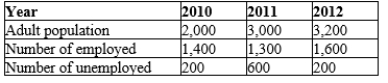 -Refer to Table 28-2. The labor force of Aridia
 (Multiple Choice)
4.7/5 (83)
(83) Octavia does not currently have a job, but she has applied for several jobs in the previous week. Eve is an unpaid stay-at-home mom who has not searched for work in recent years. Who does the Bureau of Labor Statistics count as "out of the labor force"?
(Multiple Choice)
5.0/5 (72)
(72) The Bureau of Labor Statistics defines the unemployment rate as the percentage of
(Multiple Choice)
4.9/5 (76)
(76) Suppose that consumers decide to walk to work more frequently and drive cars less. Companies that make walking shoes hire workers, while automobile companies lay off workers. This is an example of
(Multiple Choice)
4.8/5 (89)
(89) Jamarcus works part-time as a pizza delivery person in a college town. The Bureau of Labor Statistics counts Jamarcus as
(Multiple Choice)
4.9/5 (87)
(87) 
Filters
- Essay(0)
- Multiple Choice(0)
- Short Answer(0)
- True False(0)
- Matching(0)