



 Chat with AI
Exam 28: Unemployment and Its Natural Rate

Exam 1: Ten Principles of Economics455 Questions
Exam 2: Thinking Like an Economist643 Questions
Exam 3: Interdependence and the Gains From Trade547 Questions
Exam 4: The Market Forces of Supply and Demand693 Questions
Exam 5: Elasticity and Its Application626 Questions
Exam 6: Supply, Demand, and Government Policies668 Questions
Exam 7: Consumers, Producers, and the Efficiency of Markets547 Questions
Exam 8: Applications: the Costs of Taxation509 Questions
Exam 9: Application: International Trade521 Questions
Exam 10: Externalities543 Questions
Exam 11: Public Goods and Common Resources452 Questions
Exam 12: The Design of the Tax System664 Questions
Exam 13: The Costs of Production649 Questions
Exam 14: Firms in Competitive Markets604 Questions
Exam 15: Monopoly662 Questions
Exam 16: Monopolistic Competition649 Questions
Exam 17: Oligopoly522 Questions
Exam 18: The Markets for the Factors of Production592 Questions
Exam 19: Earnings and Discrimination511 Questions
Exam 20: Income Inequality and Poverty478 Questions
Exam 21: The Theory of Consumer Choice570 Questions
Exam 22: Frontiers in Microeconomics461 Questions
Exam 23: Measuring a Nation S Income547 Questions
Exam 24: Measuring the Cost of Living565 Questions
Exam 25: Production and Growth527 Questions
Exam 26: Saving, Investment, and the Financial System637 Questions
Exam 27: Tools of Finance534 Questions
Exam 28: Unemployment and Its Natural Rate701 Questions
Exam 29: The Monetary System540 Questions
Exam 30: Money Growth and Inflation504 Questions
Exam 31: Open-Economy Macroeconomics: Basic Concepts540 Questions
Exam 32: A Macroeconomic Theory of the Open Economy511 Questions
Exam 33: Aggregate Demand and Aggregate Supply572 Questions
Exam 34: The Influence of Monetary and Fiscal Policy on Aggregate Demand523 Questions
Exam 35: The Short-Run Tradeoff Between Inflation and Unemployment536 Questions
Exam 36: Six Debates Over Macroeconomic Policy354 Questions
Select questions type


Daniel goes on vacation for four weeks. When he returns the company puts him on layoff for four weeks during which he waits to be recalled. In which weeks is Daniel counted as unemployed, if any?
(Multiple Choice)
4.9/5  (80)
(80) Table 28-8
Below is data about the labor market in the state of Northwoods. 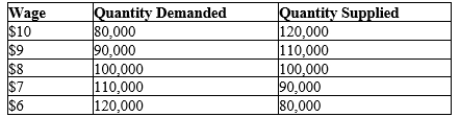 -Refer to Table 28-8. If the state government imposed a minimum wage of $8, how many people would be unemployed?
 (Multiple Choice)
4.9/5 (85)
(85) Which of the following causes of unemployment is not associated with a wage rate above the market equilibrium level?
(Multiple Choice)
4.9/5 (83)
(83) Table 28-2
Labor Data for Aridia  -Refer to Table 28-2. The labor-force participation rate of Aridia
 (Multiple Choice)
4.8/5 (93)
(93) Do economists believe that labor unions are good or bad for the U.S. economy?
(Essay)
4.8/5 (82)
(82) Between 2002 and 2014 the number of workers employed in construction fell while the number of workers employed in food services rose.
(True/False)
4.9/5 (86)
(86) The labor force equals the sum of the employed and the unemployed.
(True/False)
4.7/5 (78)
(78) Table 28-2
Labor Data for Aridia
-Refer to Table 28-2. The labor force of Aridia in 2010 was
-Refer to Table 28-2. The labor force of Aridia in 2010 was (Multiple Choice)
4.9/5 (74)
(74) Who of the following are included in the Bureau of Labor Statistics' "employed" category?
(Multiple Choice)
4.8/5 (86)
(86) Josh is a full-time college student who is not working or looking for a job. The Bureau of Labor Statistics counts Josh as
(Multiple Choice)
4.7/5 (84)
(84) The unemployment that results from the quantity of labor supplied exceeding the quantity demanded is called frictional unemployment.
(True/False)
5.0/5 (77)
(77) Critics of government-run employment agencies and public training programs argue that the private market is better at matching workers and jobs than the government is.
(True/False)
4.8/5 (76)
(76) Jai Li just lost her job, and she has not yet started looking for a new one. The Bureau of Labor Statistics counts Jai Li as
(Multiple Choice)
4.8/5 (83)
(83) The Bureau of Labor Statistics divides the adult population into two categories: those who are employed and those who are unemployed.
(True/False)
4.7/5 (86)
(86) Table 28-2
Labor Data for Aridia
-Refer to Table 28-2. The unemployment rate in Aridia in 2010 was
-Refer to Table 28-2. The unemployment rate in Aridia in 2010 was (Multiple Choice)
4.9/5 (76)
(76) If the wage is kept above the equilibrium level for any reason, the result is unemployment.
(True/False)
4.8/5 (95)
(95) In the 1940s and 1950s, about one-third of U.S. workers belonged to unions, but today, only about one-fifth of U.S. workers belong to unions.
(True/False)
5.0/5 (73)
(73) 
Filters
- Essay(0)
- Multiple Choice(0)
- Short Answer(0)
- True False(0)
- Matching(0)