



 Chat with AI
Exam 28: Unemployment and Its Natural Rate

Exam 1: Ten Principles of Economics455 Questions
Exam 2: Thinking Like an Economist643 Questions
Exam 3: Interdependence and the Gains From Trade547 Questions
Exam 4: The Market Forces of Supply and Demand693 Questions
Exam 5: Elasticity and Its Application626 Questions
Exam 6: Supply, Demand, and Government Policies668 Questions
Exam 7: Consumers, Producers, and the Efficiency of Markets547 Questions
Exam 8: Applications: the Costs of Taxation509 Questions
Exam 9: Application: International Trade521 Questions
Exam 10: Externalities543 Questions
Exam 11: Public Goods and Common Resources452 Questions
Exam 12: The Design of the Tax System664 Questions
Exam 13: The Costs of Production649 Questions
Exam 14: Firms in Competitive Markets604 Questions
Exam 15: Monopoly662 Questions
Exam 16: Monopolistic Competition649 Questions
Exam 17: Oligopoly522 Questions
Exam 18: The Markets for the Factors of Production592 Questions
Exam 19: Earnings and Discrimination511 Questions
Exam 20: Income Inequality and Poverty478 Questions
Exam 21: The Theory of Consumer Choice570 Questions
Exam 22: Frontiers in Microeconomics461 Questions
Exam 23: Measuring a Nation S Income547 Questions
Exam 24: Measuring the Cost of Living565 Questions
Exam 25: Production and Growth527 Questions
Exam 26: Saving, Investment, and the Financial System637 Questions
Exam 27: Tools of Finance534 Questions
Exam 28: Unemployment and Its Natural Rate701 Questions
Exam 29: The Monetary System540 Questions
Exam 30: Money Growth and Inflation504 Questions
Exam 31: Open-Economy Macroeconomics: Basic Concepts540 Questions
Exam 32: A Macroeconomic Theory of the Open Economy511 Questions
Exam 33: Aggregate Demand and Aggregate Supply572 Questions
Exam 34: The Influence of Monetary and Fiscal Policy on Aggregate Demand523 Questions
Exam 35: The Short-Run Tradeoff Between Inflation and Unemployment536 Questions
Exam 36: Six Debates Over Macroeconomic Policy354 Questions
Select questions type


Table 28-3
2009 Labor Data for Baltivia 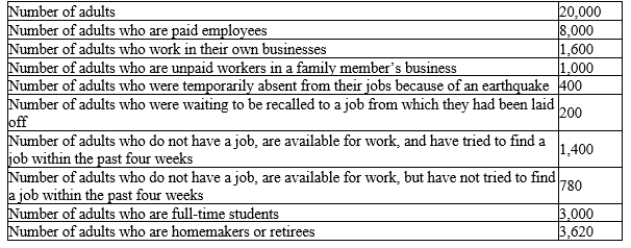 -Refer to Table 28-3. How many people were employed in Baltivia in 2009?
 (Multiple Choice)
4.9/5  (86)
(86) Which of the following is an example of an efficiency wage?
(Multiple Choice)
4.8/5 (79)
(79) Table 28-4
2010 Labor Data for Adults (ages 16 and older) in Meditor 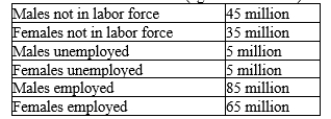 -Refer to Table 28-4. What is the adult female unemployment rate in Meditor?
 (Multiple Choice)
4.9/5 (90)
(90) More than three-fourths of the unemployed are recent entrants into the labor force.
(True/False)
4.9/5 (89)
(89) The BLS reports the U-6 measure of labor underutilization. Which of the following is how it computes U-6?
(Multiple Choice)
4.8/5 (88)
(88) It is only among the least skilled and least experienced members of the labor force that minimum-wage laws cause unemployment.
(True/False)
4.9/5 (84)
(84) Table 28-5
Labor Force Statistics by Age
Suppose people in the adult population in a small country are classified based on their age.  -Refer to Table 28-5. Suppose that the natural rate of unemployment is 5% for those under 55 and 3% for those 55 and older. The cyclical unemployment rate for those under 55 is
 (Multiple Choice)
5.0/5 (76)
(76) Most U.S. workers have wages well above the legal minimum, so minimum-wage laws do not prevent the wage from adjusting to balance supply and demand.
(True/False)
4.9/5 (81)
(81) In the U.S., the National Labor Relations Board is the government agency that enforces workers' right to unionize.
(True/False)
4.9/5 (68)
(68) The adult population in the town of Shelbyville is 150 thousand. If 100 thousand people are employed and 20 thousand are unemployed, then the labor force participation rate is approximately
(Multiple Choice)
4.7/5 (69)
(69) Causes of the changing role of women in American society over the past several decades include new technologies that have reduced the amount of time required to complete routine household tasks, improved birth control, and changing political and social attitudes.
(True/False)
4.8/5 (68)
(68) Table 28-9
The table below lists the number of people by labor force classification for the country of Shelbyville. 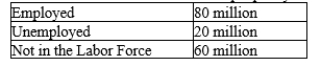 -Refer to Table 28-9. What is the labor force participation rate?
 (Short Answer)
4.8/5 (85)
(85) All else equal, which of the following would increase the unemployment rate?
(i)an increase in the number of women who return to work after being stay-at-home mothers
(ii)a preference among older men to retire early
(iii)an increase in the maximum number of weeks for which someone can receive government unemployment benefits
(iv)an increase in the number of previously unemployed women who stop looking for work and become discouraged workers
(Multiple Choice)
4.8/5 (82)
(82) Frictional unemployment is often thought to explain relatively short spells of unemployment.
(True/False)
4.8/5 (91)
(91) Economists have found that union workers earn about 30 to 40 percent more than similar workers who do not belong to unions.
(True/False)
4.9/5 (89)
(89) Wanda quit her job because she was unhappy at work. Arnold was fired from his landscaping job because his company was downsizing. Who is eligible for unemployment insurance benefits?
(Multiple Choice)
4.7/5 (78)
(78) 
Filters
- Essay(0)
- Multiple Choice(0)
- Short Answer(0)
- True False(0)
- Matching(0)