



 Chat with AI
Exam 28: Unemployment and Its Natural Rate

Exam 1: Ten Principles of Economics455 Questions
Exam 2: Thinking Like an Economist643 Questions
Exam 3: Interdependence and the Gains From Trade547 Questions
Exam 4: The Market Forces of Supply and Demand693 Questions
Exam 5: Elasticity and Its Application626 Questions
Exam 6: Supply, Demand, and Government Policies668 Questions
Exam 7: Consumers, Producers, and the Efficiency of Markets547 Questions
Exam 8: Applications: the Costs of Taxation509 Questions
Exam 9: Application: International Trade521 Questions
Exam 10: Externalities543 Questions
Exam 11: Public Goods and Common Resources452 Questions
Exam 12: The Design of the Tax System664 Questions
Exam 13: The Costs of Production649 Questions
Exam 14: Firms in Competitive Markets604 Questions
Exam 15: Monopoly662 Questions
Exam 16: Monopolistic Competition649 Questions
Exam 17: Oligopoly522 Questions
Exam 18: The Markets for the Factors of Production592 Questions
Exam 19: Earnings and Discrimination511 Questions
Exam 20: Income Inequality and Poverty478 Questions
Exam 21: The Theory of Consumer Choice570 Questions
Exam 22: Frontiers in Microeconomics461 Questions
Exam 23: Measuring a Nation S Income547 Questions
Exam 24: Measuring the Cost of Living565 Questions
Exam 25: Production and Growth527 Questions
Exam 26: Saving, Investment, and the Financial System637 Questions
Exam 27: Tools of Finance534 Questions
Exam 28: Unemployment and Its Natural Rate701 Questions
Exam 29: The Monetary System540 Questions
Exam 30: Money Growth and Inflation504 Questions
Exam 31: Open-Economy Macroeconomics: Basic Concepts540 Questions
Exam 32: A Macroeconomic Theory of the Open Economy511 Questions
Exam 33: Aggregate Demand and Aggregate Supply572 Questions
Exam 34: The Influence of Monetary and Fiscal Policy on Aggregate Demand523 Questions
Exam 35: The Short-Run Tradeoff Between Inflation and Unemployment536 Questions
Exam 36: Six Debates Over Macroeconomic Policy354 Questions
Select questions type


Table 28-10
The table below lists the number of people by labor force classification for the country of Springfield. 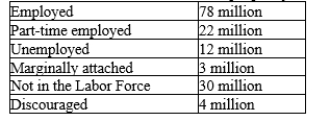 -Refer to Table 28-10. Calculate the number in the adult population, and the labor force participation rate.
 (Essay)
4.8/5  (92)
(92) The amount of unemployment varies little over time and across countries.
(True/False)
4.9/5 (90)
(90) Give an historical example of an efficiency wage that was considered by the firm to be "one of the finest cost-cutting moves we ever made."
(Essay)
4.7/5 (101)
(101) In June 2009 the Bureau of Labor Statistics reported an adult population of 234.9 million, unemployment of 12.4 million, and employment of 141.6 million. Based on these numbers the labor-force participation rate was
(Multiple Choice)
5.0/5 (92)
(92) Table 28-3
2009 Labor Data for Baltivia 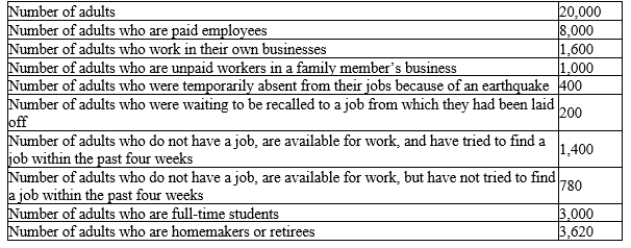 -Refer to Table 28-3. How many people were unemployed in Baltivia in 2009?
 (Multiple Choice)
4.8/5 (71)
(71) There is a clear consensus among economists that unions are
(Multiple Choice)
4.9/5 (75)
(75) Which of the following is not a reason that paying efficiency wages may increase a firm's profit?
(Multiple Choice)
4.8/5 (88)
(88) Discuss the labor-force participation trends for men and women since 1950.
(Essay)
4.8/5 (72)
(72) The labor-force participation rate tells us the fraction of the population that
(Multiple Choice)
4.7/5 (72)
(72) The Bureau of Labor Statistics defines marginally attached workers as persons who currently are neither working nor looking for work but indicate that they want and are available for a job and have looked for work sometime in the recent past.
(True/False)
4.8/5 (84)
(84) Suppose the demand for hard-wood flooring increases, while the demand for wall-to-wall carpeting decreases. Based on this change in consumer tastes, the demand for hard-wood-flooring factory workers in North Carolina increases, while the demand for carpet factory workers in Georgia decreases. This is an example of
(Multiple Choice)
4.9/5 (73)
(73) Just after World War II, the labor-force participation rate of women was
(Multiple Choice)
4.7/5 (88)
(88) Full-time students and homemakers are included in the Bureau of Labor Statistics' "unemployed" category.
(True/False)
4.8/5 (76)
(76) The designation "natural" implies that the natural rate of unemployment
(Multiple Choice)
4.9/5 (89)
(89) The labor force minus the number of employed equals the number of unemployed.
(True/False)
4.9/5 (86)
(86) Of the following groups, who is eligible for unemployment insurance benefits?
(Multiple Choice)
4.9/5 (71)
(71) 
Filters
- Essay(0)
- Multiple Choice(0)
- Short Answer(0)
- True False(0)
- Matching(0)