



 Chat with AI
Exam 28: Unemployment and Its Natural Rate

Exam 1: Ten Principles of Economics455 Questions
Exam 2: Thinking Like an Economist643 Questions
Exam 3: Interdependence and the Gains From Trade547 Questions
Exam 4: The Market Forces of Supply and Demand693 Questions
Exam 5: Elasticity and Its Application626 Questions
Exam 6: Supply, Demand, and Government Policies668 Questions
Exam 7: Consumers, Producers, and the Efficiency of Markets547 Questions
Exam 8: Applications: the Costs of Taxation509 Questions
Exam 9: Application: International Trade521 Questions
Exam 10: Externalities543 Questions
Exam 11: Public Goods and Common Resources452 Questions
Exam 12: The Design of the Tax System664 Questions
Exam 13: The Costs of Production649 Questions
Exam 14: Firms in Competitive Markets604 Questions
Exam 15: Monopoly662 Questions
Exam 16: Monopolistic Competition649 Questions
Exam 17: Oligopoly522 Questions
Exam 18: The Markets for the Factors of Production592 Questions
Exam 19: Earnings and Discrimination511 Questions
Exam 20: Income Inequality and Poverty478 Questions
Exam 21: The Theory of Consumer Choice570 Questions
Exam 22: Frontiers in Microeconomics461 Questions
Exam 23: Measuring a Nation S Income547 Questions
Exam 24: Measuring the Cost of Living565 Questions
Exam 25: Production and Growth527 Questions
Exam 26: Saving, Investment, and the Financial System637 Questions
Exam 27: Tools of Finance534 Questions
Exam 28: Unemployment and Its Natural Rate701 Questions
Exam 29: The Monetary System540 Questions
Exam 30: Money Growth and Inflation504 Questions
Exam 31: Open-Economy Macroeconomics: Basic Concepts540 Questions
Exam 32: A Macroeconomic Theory of the Open Economy511 Questions
Exam 33: Aggregate Demand and Aggregate Supply572 Questions
Exam 34: The Influence of Monetary and Fiscal Policy on Aggregate Demand523 Questions
Exam 35: The Short-Run Tradeoff Between Inflation and Unemployment536 Questions
Exam 36: Six Debates Over Macroeconomic Policy354 Questions
Select questions type


Table 28-1
Sample Population  -Refer to Table 28-1. How many in the sample are unemployed?
 (Multiple Choice)
4.9/5  (76)
(76) Sheila is on a temporary layoff from her automobile factory job but has not looked for work in the last four weeks. The Bureau of Labor Statistics counts Sheila as
(Multiple Choice)
4.8/5 (76)
(76) Unions are often thought to cause conflict between different groups of workers -- between the insiders who benefit from high union wages and the outsiders who do not get the union jobs.
(True/False)
4.8/5 (87)
(87) Most economists believe unions are bad for the economy as a whole.
(True/False)
4.8/5 (83)
(83) Unemployment insurance causes workers to be less likely to seek guarantees of job security when they negotiate with employers over the terms of employment.
(True/False)
4.9/5 (89)
(89) Every week, the Bureau of Labor Statistics produces data on unemployment.
(True/False)
4.9/5 (87)
(87) If all workers and all jobs were the same such that all workers were equally well suited for all jobs, then there would be no
(Multiple Choice)
4.9/5 (74)
(74) Suppose that there is an excess supply of economics professors. Should universities necessarily reduce salaries? What does standard economic theory suggest? What does efficiency-wage theory suggest?
(Essay)
4.8/5 (82)
(82) Policies that reduce the time it takes unemployed workers to find new jobs
(Multiple Choice)
4.8/5 (78)
(78) In the 1990's Ireland made unemployment benefits less generous. This change would likely have reduced
(Multiple Choice)
4.8/5 (70)
(70) Figure 28-3 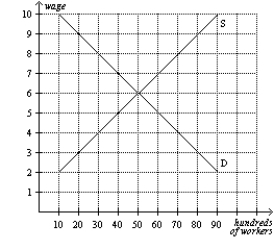 -Refer to Figure 28-3. If unemployment is 2,000 workers, then the minimum wage must be
 (Multiple Choice)
4.7/5 (70)
(70) The Bureau of Labor Statistics' U-3 measure of joblessness is the official unemployment rate.
(True/False)
4.8/5 (71)
(71) When a union raises the wage above the equilibrium level, it reduces the quantity of labor supplied and raises the quantity of labor demanded, resulting in unemployment.
(True/False)
4.8/5 (81)
(81) Retirees are included in the Bureau of Labor Statistics' "not in the labor force" category.
(True/False)
4.8/5 (72)
(72) Table 28-2
Labor Data for Aridia  -Refer to Table 28-2. The unemployment rate of Aridia in 2012 was
 (Multiple Choice)
4.8/5 (91)
(91) 
Filters
- Essay(0)
- Multiple Choice(0)
- Short Answer(0)
- True False(0)
- Matching(0)