



 Chat with AI
Exam 28: Unemployment and Its Natural Rate

Exam 1: Ten Principles of Economics455 Questions
Exam 2: Thinking Like an Economist643 Questions
Exam 3: Interdependence and the Gains From Trade547 Questions
Exam 4: The Market Forces of Supply and Demand693 Questions
Exam 5: Elasticity and Its Application626 Questions
Exam 6: Supply, Demand, and Government Policies668 Questions
Exam 7: Consumers, Producers, and the Efficiency of Markets547 Questions
Exam 8: Applications: the Costs of Taxation509 Questions
Exam 9: Application: International Trade521 Questions
Exam 10: Externalities543 Questions
Exam 11: Public Goods and Common Resources452 Questions
Exam 12: The Design of the Tax System664 Questions
Exam 13: The Costs of Production649 Questions
Exam 14: Firms in Competitive Markets604 Questions
Exam 15: Monopoly662 Questions
Exam 16: Monopolistic Competition649 Questions
Exam 17: Oligopoly522 Questions
Exam 18: The Markets for the Factors of Production592 Questions
Exam 19: Earnings and Discrimination511 Questions
Exam 20: Income Inequality and Poverty478 Questions
Exam 21: The Theory of Consumer Choice570 Questions
Exam 22: Frontiers in Microeconomics461 Questions
Exam 23: Measuring a Nation S Income547 Questions
Exam 24: Measuring the Cost of Living565 Questions
Exam 25: Production and Growth527 Questions
Exam 26: Saving, Investment, and the Financial System637 Questions
Exam 27: Tools of Finance534 Questions
Exam 28: Unemployment and Its Natural Rate701 Questions
Exam 29: The Monetary System540 Questions
Exam 30: Money Growth and Inflation504 Questions
Exam 31: Open-Economy Macroeconomics: Basic Concepts540 Questions
Exam 32: A Macroeconomic Theory of the Open Economy511 Questions
Exam 33: Aggregate Demand and Aggregate Supply572 Questions
Exam 34: The Influence of Monetary and Fiscal Policy on Aggregate Demand523 Questions
Exam 35: The Short-Run Tradeoff Between Inflation and Unemployment536 Questions
Exam 36: Six Debates Over Macroeconomic Policy354 Questions
Select questions type


Fred operates his own business, Fred would be counted as employed
(Multiple Choice)
4.9/5  (84)
(84) Table 28-6 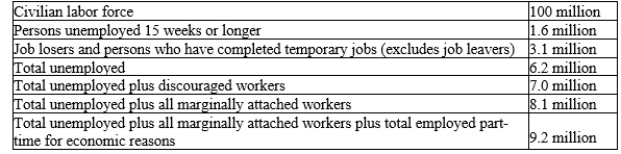 -Refer to Table 28-6. What is the U-6 measure of labor underutilization?
 (Multiple Choice)
4.8/5 (91)
(91) Even though the difference in labor-force participation rates of U.S. males and females has narrowed, the labor-force participation rate of males remains higher than that of females.
(True/False)
4.7/5 (82)
(82) Which of the following is the correct formula for calculating the unemployment rate?
(Multiple Choice)
4.9/5 (90)
(90) Figure 28-1 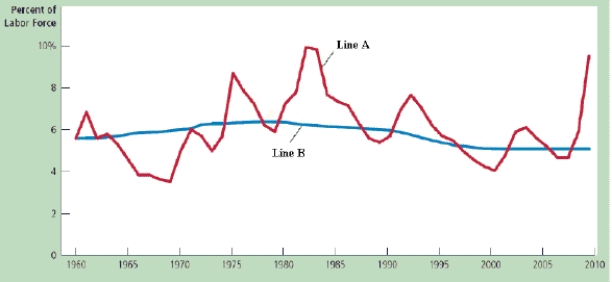 -Refer to Figure 28-1. Which of the following correctly identifies lines A and B?
 (Multiple Choice)
4.8/5 (78)
(78) Data on the unemployment rate in the U.S. since 1960 show that the unemployment rate sometimes is close to zero.
(True/False)
4.7/5 (79)
(79) Minimum-wage laws and unions are similar to each other but different from efficiency wages in that minimum-wage law and unions
(Multiple Choice)
4.9/5 (76)
(76) Economists have found that union workers earn what percent more than similar nonunion workers?
(Multiple Choice)
5.0/5 (77)
(77) Duane owns his own real estate company. The Bureau of Labor Statistics counts Duane as
(Multiple Choice)
4.9/5 (87)
(87) Adults who were waiting to be recalled to a job from which they had been laid off are included in the Bureau of Labor Statistics' "employed" category.
(True/False)
4.9/5 (86)
(86) Other things the same, countries that offer more generous and longer-lasting unemployment insurance benefits are likely to have higher unemployment rates.
(True/False)
4.9/5 (87)
(87) The deviation of unemployment from its natural rate is called
(Multiple Choice)
4.9/5 (90)
(90) Sam has no job but keeps applying to get a job with a business that is unionized. He is qualified and he finds the pay attractive, but the firm is not hiring. Sam is
(Multiple Choice)
4.9/5 (79)
(79) The table below uses data for the year 2003 provided by the Bureau of Labor Statistics and adjusted to be comparable to U.S. data. All values are in thousands. Fill in the blank entries in the table. 
(Essay)
4.9/5 (79)
(79) In the U.S., it is illegal for employers to interfere when workers try to organize unions.
(True/False)
4.9/5 (70)
(70) Suppose that some country had an adult population of about 50 million, a labor-force participation rate of 60 percent, and an unemployment rate of 5 percent. How many people were unemployed?
(Multiple Choice)
4.7/5 (80)
(80) Right-to-work laws allow striking union members to be permanently replaced.
(True/False)
4.9/5 (67)
(67) When job search is the explanation for unemployment, workers are searching for the jobs that best suit their tastes and skills, but when the wage is above the equilibrium level, the quantity of labor supplied exceeds the quantity of labor demanded, and workers are unemployed because they are waiting for jobs to open up.
(True/False)
4.8/5 (72)
(72) Table 28-4
2010 Labor Data for Adults (ages 16 and older) in Meditor 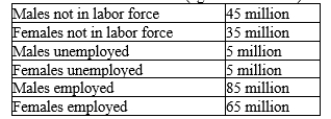 -Refer to Table 28-4. What is the adult labor-force participation rate in Meditor?
 (Multiple Choice)
4.9/5 (91)
(91) Some long-run unemployment may be explained by the fact that the number of jobs available in some labor markets may be insufficient to give a job to everyone who wants one.
(True/False)
4.8/5 (87)
(87) 
Filters
- Essay(0)
- Multiple Choice(0)
- Short Answer(0)
- True False(0)
- Matching(0)