



 Chat with AI
Exam 28: Unemployment and Its Natural Rate

Exam 1: Ten Principles of Economics455 Questions
Exam 2: Thinking Like an Economist643 Questions
Exam 3: Interdependence and the Gains From Trade547 Questions
Exam 4: The Market Forces of Supply and Demand693 Questions
Exam 5: Elasticity and Its Application626 Questions
Exam 6: Supply, Demand, and Government Policies668 Questions
Exam 7: Consumers, Producers, and the Efficiency of Markets547 Questions
Exam 8: Applications: the Costs of Taxation509 Questions
Exam 9: Application: International Trade521 Questions
Exam 10: Externalities543 Questions
Exam 11: Public Goods and Common Resources452 Questions
Exam 12: The Design of the Tax System664 Questions
Exam 13: The Costs of Production649 Questions
Exam 14: Firms in Competitive Markets604 Questions
Exam 15: Monopoly662 Questions
Exam 16: Monopolistic Competition649 Questions
Exam 17: Oligopoly522 Questions
Exam 18: The Markets for the Factors of Production592 Questions
Exam 19: Earnings and Discrimination511 Questions
Exam 20: Income Inequality and Poverty478 Questions
Exam 21: The Theory of Consumer Choice570 Questions
Exam 22: Frontiers in Microeconomics461 Questions
Exam 23: Measuring a Nation S Income547 Questions
Exam 24: Measuring the Cost of Living565 Questions
Exam 25: Production and Growth527 Questions
Exam 26: Saving, Investment, and the Financial System637 Questions
Exam 27: Tools of Finance534 Questions
Exam 28: Unemployment and Its Natural Rate701 Questions
Exam 29: The Monetary System540 Questions
Exam 30: Money Growth and Inflation504 Questions
Exam 31: Open-Economy Macroeconomics: Basic Concepts540 Questions
Exam 32: A Macroeconomic Theory of the Open Economy511 Questions
Exam 33: Aggregate Demand and Aggregate Supply572 Questions
Exam 34: The Influence of Monetary and Fiscal Policy on Aggregate Demand523 Questions
Exam 35: The Short-Run Tradeoff Between Inflation and Unemployment536 Questions
Exam 36: Six Debates Over Macroeconomic Policy354 Questions
Select questions type


Table 28-3
2009 Labor Data for Baltivia 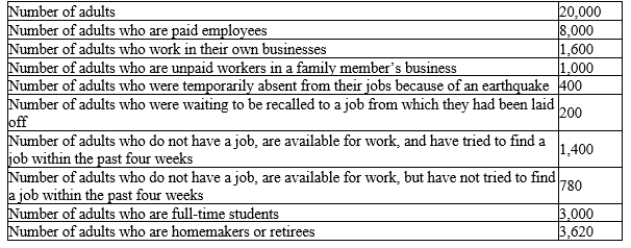 -Refer to Table 28-3. How many adults were not in Baltivia's labor force in 2009?
 (Multiple Choice)
4.9/5  (68)
(68) Table 28-5
Labor Force Statistics by Age
Suppose people in the adult population in a small country are classified based on their age.  -Refer to Table 28-5. In the proper order, which age group has the highest unemployment rate and which has the highest participation rate?
 (Multiple Choice)
4.9/5 (85)
(85) Most spells of unemployment are short, and most unemployment observed at any given time is long-term.
(True/False)
4.8/5 (75)
(75) Suppose that an anti-smoking campaign in Moscow, Russia, is successful so that Muscovites smoke less and chew gum more. Tobacco companies lay off workers, while chewing gum manufacturers employ more workers. This is an example of
(Multiple Choice)
4.9/5 (65)
(65) When a minimum-wage law forces the wage to remain above the level that balances supply and demand, the result is a shortage of labor.
(True/False)
4.8/5 (88)
(88) Discouraged workers are people who want to work but have given up trying to find a job after an unsuccessful search.
(True/False)
4.7/5 (75)
(75) Suppose that garbage collectors and landscaping workers have no unions. Now suppose that garbage collectors form unions. What does this do to the labor supply and wages of landscaping workers?
(Multiple Choice)
4.8/5 (89)
(89) When a minimum-wage law forces the wage to remain above the level that balances supply and demand, there are more workers willing to work than there are jobs, so some workers are unemployed.
(True/False)
4.8/5 (78)
(78) Most economists agree that eliminating unemployment insurance would increase the nation's overall level of well-being.
(True/False)
4.8/5 (76)
(76) Every adult who was not employed during the previous four weeks is included in the Bureau of Labor Statistics' "unemployed" category.
(True/False)
4.9/5 (76)
(76) Someone who has a job but is absent from work because she is on vacation is counted as "employed."
(True/False)
4.9/5 (95)
(95) A person who is counted as "unemployed" by the Bureau of Labor Statistics
(Multiple Choice)
4.9/5 (63)
(63) Adults who were not working but who had jobs from which they were temporarily absent are included in the Bureau of Labor Statistics' "employed" category.
(True/False)
4.7/5 (78)
(78) Efficiency wages, minimum-wage laws, and unions all keep wages
(Multiple Choice)
4.8/5 (78)
(78) Ignoring the differences across states, explain the benefit provided to the typical worker in the United States from unemployment insurance.
(Essay)
4.8/5 (90)
(90) Table 28-3
2009 Labor Data for Baltivia
-Refer to Table 28-3. What was Baltivia's labor-force participation rate in 2009?
-Refer to Table 28-3. What was Baltivia's labor-force participation rate in 2009? (Multiple Choice)
4.8/5 (89)
(89) 
Filters
- Essay(0)
- Multiple Choice(0)
- Short Answer(0)
- True False(0)
- Matching(0)