



 Chat with AI
Exam 14: Firms in Competitive Markets

Exam 1: Ten Principles of Economics455 Questions
Exam 2: Thinking Like an Economist645 Questions
Exam 3: Interdependence and the Gains From Trade550 Questions
Exam 4: The Market Forces of Supply and Demand693 Questions
Exam 5: Elasticity and Its Application625 Questions
Exam 6: Supply, Demand, and Government Policies671 Questions
Exam 7: Consumers, Producers, and the Efficiency of Markets547 Questions
Exam 8: Application: The Costs of Taxation507 Questions
Exam 9: Application: International Trade521 Questions
Exam 10: Externalities543 Questions
Exam 11: Public Goods and Common Resources453 Questions
Exam 12: The Design of the Tax System563 Questions
Exam 13: The Costs of Production649 Questions
Exam 14: Firms in Competitive Markets608 Questions
Exam 15: Monopoly662 Questions
Exam 16: Monopolistic Competition649 Questions
Exam 17: Oligopoly522 Questions
Exam 18: The Markets for the Factors of Production592 Questions
Exam 19: Earnings and Discrimination511 Questions
Exam 20: Income Inequality and Poverty478 Questions
Exam 21: The Theory of Consumer Choice568 Questions
Exam 22: Frontiers in Microeconomics461 Questions
Select questions type


Figure 14-3
Suppose a firm operating in a competitive market has the following cost curves: 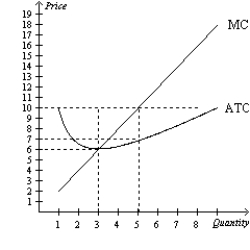 -Refer to Figure 14-3. If the market price is $10, what is the firm's short-run economic profit?
 (Multiple Choice)
5.0/5  (86)
(86) Table 14-12
Bill's Birdhouses 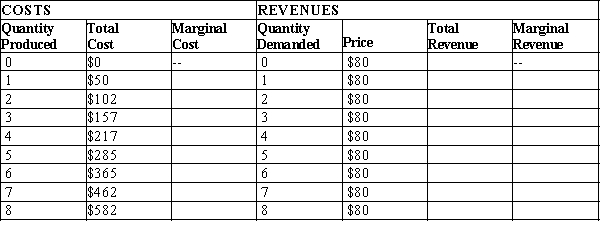 -Refer to Table 14-12. At what quantity does Bill maximize profits?
 (Multiple Choice)
4.8/5 (85)
(85) Which of the following is a characteristic of a competitive market?
(Multiple Choice)
4.9/5 (85)
(85) Kate is a professional opera singer who gives voice lessons. The vocal-music industry is competitive. Kate hires a business consultant to analyze her financial records. The consultant recommends that Kate give fewer voice lessons. The consultant must have concluded that Kate's
(Multiple Choice)
4.7/5 (81)
(81) When a competitive firm produces and sells 600 units of output, its total revenue is $35,970. What is the firm's total revenue when it produces and sells 620 units of output?
(Essay)
5.0/5 (68)
(68) Figure 14-2
Suppose a firm operating in a competitive market has the following cost curves: 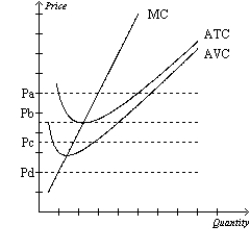 -Refer to Figure 14-2. If the market price is Pd, in the short run the firm will earn
 (Multiple Choice)
4.7/5 (84)
(84) Figure 14-10
In the figure below, panel (a) depicts the linear marginal cost of a firm in a competitive market, and panel (b) depicts the linear market supply curve for a market with a fixed number of identical firms. 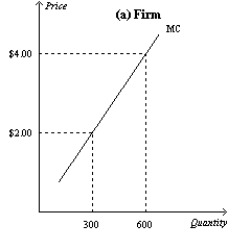
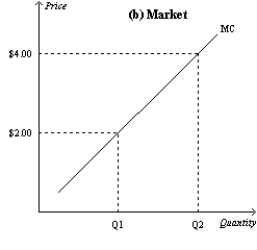 -Refer to Figure 14-10. If there are 500 identical firms in this market, what is the value of Q2?
 (Multiple Choice)
4.7/5 (74)
(74) Figure 14-6
Suppose a firm operating in a competitive market has the following cost curves: 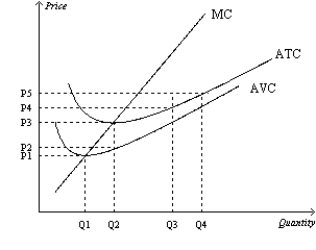 -Refer to Figure 14-6. When market price is P3, a profit-maximizing firm's total costs
 (Multiple Choice)
4.8/5 (74)
(74) If a firm observes that the price of its product is above average variable cost, it would choose to continue to produce the good in the short run, even if that firm experiences economic losses.
(True/False)
4.9/5 (72)
(72) Scenario 14-4
The information below applies to a competitive firm that sells its output for $40 per unit.
• When the firm produces and sells 150 units of output, its average total cost is $24.50.
• When the firm produces and sells 151 units of output, its average total cost is $24.55.
-Refer to Scenario 14-4. When the firm produces 150 units of output, its total cost is
(Multiple Choice)
4.9/5 (85)
(85) The short-run supply curve for a firm in a perfectly competitive market is
(Multiple Choice)
4.8/5 (91)
(91) Suppose that a firm operating in perfectly competitive market sells 300 units of output at a price of $3 each. Which of the following statements is correct? (i)
Marginal revenue equals $3.
(ii)
Average revenue equals $3.
(iii)
Total revenue equals $900.
(Multiple Choice)
4.7/5 (82)
(82) In a perfectly competitive market, the horizontal sum of all the individual firms' supply curves is
(Multiple Choice)
4.8/5 (73)
(73) In the long-run equilibrium of a competitive market with free entry and exit, firms operate at their __________ scale.
(Short Answer)
4.9/5 (77)
(77) In a competitive market, the actions of any single buyer or seller will
(Multiple Choice)
4.9/5 (76)
(76) Scenario 14-4
Victor is the recipient of $1 million from a lawsuit. Victor decides to use the money to purchase a small business in Florida. His business operates in a perfectly competitive industry. If Victor would have invested the $1 million in a risk-free bond fund, he could have earned $100,000 each year. After he bought the small business, Victor quit his job as a market analyst with Research, Inc., where he used to earn $75,000 per year.
-Refer to Scenario 14-4. What is Victor's opportunity costs of operating his new business?
(Multiple Choice)
4.8/5 (72)
(72) When determining whether to shut down in the short run, a competitive firm should ignore (i)
Fixed costs.
(ii)
Variable costs.
(iii)
Sunk costs.
(Multiple Choice)
4.8/5 (62)
(62) If a competitive firm is selling 500 units of its product at a price of $8 per unit and earning a positive profit, then
(Multiple Choice)
4.8/5 (73)
(73) A firm operating in a perfectly competitive industry will shut down in the short run if its economic profits fall to zero because it is likely to be earning negative accounting profits.
(True/False)
4.9/5 (91)
(91) 
Filters
- Essay(0)
- Multiple Choice(0)
- Short Answer(0)
- True False(0)
- Matching(0)