



 Chat with AI
Exam 14: Firms in Competitive Markets

Exam 1: Ten Principles of Economics455 Questions
Exam 2: Thinking Like an Economist645 Questions
Exam 3: Interdependence and the Gains From Trade550 Questions
Exam 4: The Market Forces of Supply and Demand693 Questions
Exam 5: Elasticity and Its Application625 Questions
Exam 6: Supply, Demand, and Government Policies671 Questions
Exam 7: Consumers, Producers, and the Efficiency of Markets547 Questions
Exam 8: Application: The Costs of Taxation507 Questions
Exam 9: Application: International Trade521 Questions
Exam 10: Externalities543 Questions
Exam 11: Public Goods and Common Resources453 Questions
Exam 12: The Design of the Tax System563 Questions
Exam 13: The Costs of Production649 Questions
Exam 14: Firms in Competitive Markets608 Questions
Exam 15: Monopoly662 Questions
Exam 16: Monopolistic Competition649 Questions
Exam 17: Oligopoly522 Questions
Exam 18: The Markets for the Factors of Production592 Questions
Exam 19: Earnings and Discrimination511 Questions
Exam 20: Income Inequality and Poverty478 Questions
Exam 21: The Theory of Consumer Choice568 Questions
Exam 22: Frontiers in Microeconomics461 Questions
Select questions type


A market is competitive if (i)
Firms have the flexibility to price their own product.
(ii)
Each buyer is small compared to the market.
(iii)
Each seller is small compared to the market.
(Multiple Choice)
4.7/5  (64)
(64) Figure 14-7 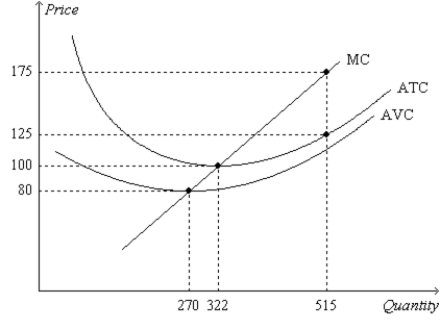 -Refer to Figure 14-7. In the short run, the firm's maximum profit (or minimum loss) is the same at which of the following pairs of prices?
 (Multiple Choice)
4.8/5 (79)
(79) Which of the following statements regarding a competitive market is not correct?
(Multiple Choice)
4.8/5 (75)
(75) When a firm sells 1 million coat hangers, its total revenue is $2 million. When it sells 2 million coat hangers, its total revenue is $3.5 million. Is this firm a price taker? Explain.
(Essay)
5.0/5 (96)
(96) Phil sells duck calls in a perfectly competitive market. If duck calls sell for $10 each and average total cost per unit is $11 at the profit-maximizing output level, then in the long run
(Multiple Choice)
4.8/5 (94)
(94) Robin owns a horse stables and riding academy and gives riding lessons for children at "pony camp." Her business operates in a competitive industry. Robin gives riding lessons to 20 children per month. Her monthly total revenue is $4,000. The marginal cost of pony camp is $100 per child. In order to maximize profits, Robin should
(Multiple Choice)
4.8/5 (76)
(76) Suppose a competitive market has a horizontal long-run supply curve and is in long-run equilibrium. If demand decreases, we can be certain that in the short-run,
(Multiple Choice)
4.7/5 (81)
(81) Robin owns a horse stables and riding academy and gives riding lessons for children at "pony camp." Her business operates in a competitive industry. Robin gives riding lessons to 20 children per month. Her monthly total revenue is $4,000. The marginal cost of pony camp is $250 per child. In order to maximize profits, Robin should
(Multiple Choice)
4.8/5 (79)
(79) Figure 14-1
Suppose that a firm in a competitive market has the following cost curves: 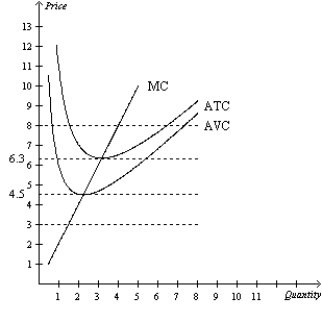 -Refer to Figure 14-1. The firm will earn a negative economic profit but remain in business in the short run if the market price is
 (Multiple Choice)
4.8/5 (79)
(79) The accountants hired by the Brookside Racquet Club have determined total fixed cost to be $75,000, total variable cost to be $130,000, and total revenue to be $145,000. Because of this information, in the short run, the Brookside Racquet Club should
(Multiple Choice)
4.9/5 (82)
(82) When a perfectly competitive firm decides to shut down, it is most likely that
(Multiple Choice)
4.8/5 (83)
(83) When a profit-maximizing firm is earning profits, those profits can be identified by
(Multiple Choice)
4.8/5 (74)
(74) As a general rule, when accountants calculate profit they account for explicit costs but usually ignore
(Multiple Choice)
4.7/5 (85)
(85) For any given price, a firm in a competitive market will maximize profit by selecting the level of output at which price intersects the
(Multiple Choice)
4.8/5 (77)
(77) Explain the difference between the short run and the long run in terms of the number of firms in a competitive market.
(Essay)
4.8/5 (72)
(72) The competitive firm's long-run supply curve is that portion of the marginal cost curve that lies above average
(Multiple Choice)
4.9/5 (76)
(76) A firm in a competitive market currently produces and sells 500 doorknobs for a price of $10 per doorknob. Which of the following events would decrease the firm's average revenue?
(Multiple Choice)
5.0/5 (79)
(79) In a long-run equilibrium where firms have identical costs, it is possible that some firms in a competitive market are making a positive economic profit.
(True/False)
4.8/5 (66)
(66) Which of the following industries is least likely to exhibit the characteristic of free entry?
(Multiple Choice)
4.8/5 (78)
(78) 
Filters
- Essay(0)
- Multiple Choice(0)
- Short Answer(0)
- True False(0)
- Matching(0)