



 Chat with AI
Exam 14: Firms in Competitive Markets

Exam 1: Ten Principles of Economics455 Questions
Exam 2: Thinking Like an Economist645 Questions
Exam 3: Interdependence and the Gains From Trade550 Questions
Exam 4: The Market Forces of Supply and Demand693 Questions
Exam 5: Elasticity and Its Application625 Questions
Exam 6: Supply, Demand, and Government Policies671 Questions
Exam 7: Consumers, Producers, and the Efficiency of Markets547 Questions
Exam 8: Application: The Costs of Taxation507 Questions
Exam 9: Application: International Trade521 Questions
Exam 10: Externalities543 Questions
Exam 11: Public Goods and Common Resources453 Questions
Exam 12: The Design of the Tax System563 Questions
Exam 13: The Costs of Production649 Questions
Exam 14: Firms in Competitive Markets608 Questions
Exam 15: Monopoly662 Questions
Exam 16: Monopolistic Competition649 Questions
Exam 17: Oligopoly522 Questions
Exam 18: The Markets for the Factors of Production592 Questions
Exam 19: Earnings and Discrimination511 Questions
Exam 20: Income Inequality and Poverty478 Questions
Exam 21: The Theory of Consumer Choice568 Questions
Exam 22: Frontiers in Microeconomics461 Questions
Select questions type


When a certain competitive firm produces and sells 40 units of output, its total revenue is $740. If there is no change in price, then what is the amount of the firm's total revenue if it produces and sells 45 units of output?
(Essay)
4.8/5  (81)
(81) Figure 14-10
In the figure below, panel (a) depicts the linear marginal cost of a firm in a competitive market, and panel (b) depicts the linear market supply curve for a market with a fixed number of identical firms. 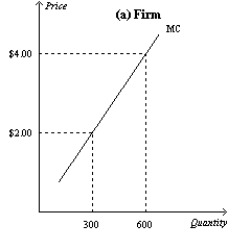
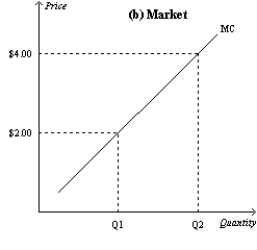 -Refer to Figure 14-10. If there are 700 identical firms in this market, what is the value of Q2?
 (Multiple Choice)
4.9/5 (68)
(68) In calculating accounting profit, accountants typically don't include
(Multiple Choice)
4.8/5 (71)
(71) If identical firms that remain in a competitive market over the long run make zero economic profit, why do these firms choose to remain in the market?
(Essay)
4.9/5 (86)
(86) If a firm in a competitive market doubles its number of units sold, total revenue for the firm will
(Multiple Choice)
4.8/5 (76)
(76) When an individual firm in a competitive market increases its production, it is likely that the market price will fall.
(True/False)
4.9/5 (81)
(81) Which of the following is not a characteristic of a perfectly competitive market?
(Multiple Choice)
4.9/5 (96)
(96) In the long run, a competitive market with 1,000 identical firms will experience an equilibrium price equal to the minimum of each firm's average total cost.
(True/False)
4.9/5 (79)
(79) Figure 14-4
Suppose a firm operating in a competitive market has the following cost curves: 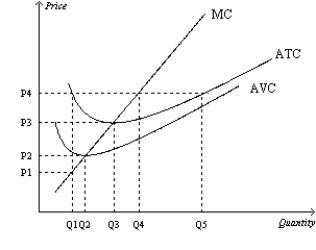 -Refer to Figure 14-4. At which price range will the firm continue to operate in the short run but earn negative profits?
 (Multiple Choice)
4.8/5 (70)
(70) Consider a firm operating in a competitive market. The firm is producing 40 units of output, has an average total cost of production equal to $6, and is earning $240 economic profit in the short run. What is the current market price?
(Multiple Choice)
4.8/5 (88)
(88) When a competitive firm doubles the quantity of output it sells, its
(Multiple Choice)
4.8/5 (71)
(71) The manager of a firm operating in a competitive market can ignore sunk costs when making business decisions.
(True/False)
4.9/5 (82)
(82) Whenever a perfectly competitive firm chooses to change its level of output, its marginal revenue
(Multiple Choice)
4.8/5 (85)
(85) Profit-maximizing firms in a competitive market produce an output level where
(Multiple Choice)
4.9/5 (84)
(84) Table 14-5
The table represents a demand curve faced by a firm in a competitive market. 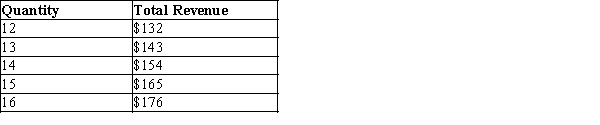 -Refer to Table 14-5. For this firm, the marginal revenue of the 12th unit is
 (Multiple Choice)
4.9/5 (80)
(80) A competitive firm would benefit from charging a price below the market price because the firm would achieve (i)
Higher average revenue.(ii)
Higher profits.
(iii)
Lower total costs.
(Multiple Choice)
4.8/5 (63)
(63) Which of the following represents the firm's long-run condition for exiting a market?
(Multiple Choice)
4.8/5 (80)
(80) A profit-maximizing firm in a competitive market will earn zero accounting profits in the long run.
(True/False)
4.8/5 (68)
(68) Figure 14-2
Suppose a firm operating in a competitive market has the following cost curves: 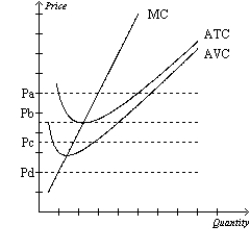 -Refer to Figure 14-2. If the market price is Pa, in the short run the firm will earn
 (Multiple Choice)
4.9/5 (72)
(72) 
Filters
- Essay(0)
- Multiple Choice(0)
- Short Answer(0)
- True False(0)
- Matching(0)