



 Chat with AI
Exam 14: Firms in Competitive Markets

Exam 1: Ten Principles of Economics455 Questions
Exam 2: Thinking Like an Economist645 Questions
Exam 3: Interdependence and the Gains From Trade550 Questions
Exam 4: The Market Forces of Supply and Demand693 Questions
Exam 5: Elasticity and Its Application625 Questions
Exam 6: Supply, Demand, and Government Policies671 Questions
Exam 7: Consumers, Producers, and the Efficiency of Markets547 Questions
Exam 8: Application: The Costs of Taxation507 Questions
Exam 9: Application: International Trade521 Questions
Exam 10: Externalities543 Questions
Exam 11: Public Goods and Common Resources453 Questions
Exam 12: The Design of the Tax System563 Questions
Exam 13: The Costs of Production649 Questions
Exam 14: Firms in Competitive Markets608 Questions
Exam 15: Monopoly662 Questions
Exam 16: Monopolistic Competition649 Questions
Exam 17: Oligopoly522 Questions
Exam 18: The Markets for the Factors of Production592 Questions
Exam 19: Earnings and Discrimination511 Questions
Exam 20: Income Inequality and Poverty478 Questions
Exam 21: The Theory of Consumer Choice568 Questions
Exam 22: Frontiers in Microeconomics461 Questions
Select questions type


A popular resort restaurant will maximize profits if it chooses to stay open during the less-crowded "off season" when its total revenues exceed its fixed costs.
(True/False)
4.9/5  (92)
(92) When managers of firms in a competitive market observe falling profits, they may infer that the market is experiencing
(Multiple Choice)
4.9/5 (72)
(72) A firm's marginal cost has a minimum value of $4, its average variable cost has a minimum value of $6, and its average total cost has a minimum value of $7. Then the firm will shut down in the short run once the price of its product falls below
(Multiple Choice)
4.9/5 (75)
(75) Figure 14-10
In the figure below, panel (a) depicts the linear marginal cost of a firm in a competitive market, and panel (b) depicts the linear market supply curve for a market with a fixed number of identical firms. 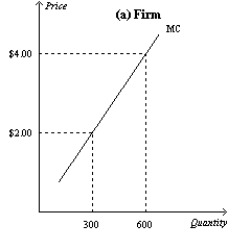
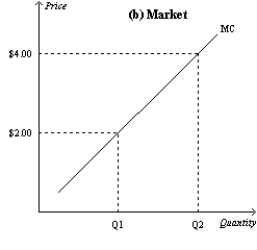 -Refer to Figure 14-10. If there are 700 identical firms in this market, what is the value of Q1?
 (Multiple Choice)
4.8/5 (95)
(95) For a firm operating in a competitive market, both marginal revenue and average revenue exceed the market price.
(True/False)
4.8/5 (75)
(75) If a competitive firm is currently producing a level of output at which marginal cost exceeds marginal revenue, then
(Multiple Choice)
4.9/5 (92)
(92) A firm operating in a perfectly competitive industry will continue to operate if it earns zero economic profits because it is likely to be earning positive accounting profits.
(True/False)
4.8/5 (83)
(83) Figure 14-6
Suppose a firm operating in a competitive market has the following cost curves: 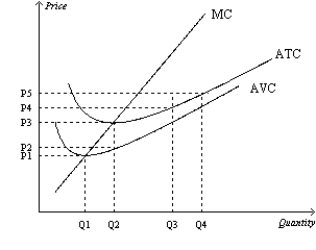 -Refer to Figure 14-6. Firms will shut down in the short run if the market price
 (Multiple Choice)
4.9/5 (68)
(68) Firms operating in a perfectly competitive market have an incentive to advertise their products since this will increase the demand for their products.
(True/False)
4.8/5 (86)
(86) A firm operating in a perfectly competitive industry will continue to operate in the short run but earn losses if the market price is less than that firm's average variable cost.
(True/False)
4.7/5 (73)
(73) A firm's marginal cost has a minimum value of $80, its average variable cost has a minimum value of $90, and its average total cost has a minimum value of $100. Then the firm will shut down in the short run once the price of its product falls below
(Multiple Choice)
4.8/5 (83)
(83) Suppose a firm operates in the short run at a price above its average total cost of production. In the long run the firm should expect
(Multiple Choice)
5.0/5 (74)
(74) Assume a firm in a competitive industry is producing 800 units of output, and it sells each unit for $6. Its average total cost is $4. Its profit is
(Multiple Choice)
4.9/5 (86)
(86) Figure 14-4
Suppose a firm operating in a competitive market has the following cost curves: 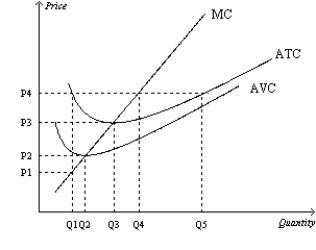 -Refer to Figure 14-4. The firm will earn positive economic profits if the price is (i)
P4)
(ii)
P3)
(iii)
P2)
(iv)
P1)
-Refer to Figure 14-4. The firm will earn positive economic profits if the price is (i)
P4)
(ii)
P3)
(iii)
P2)
(iv)
P1) (Multiple Choice)
4.8/5 (74)
(74) For a firm, marginal revenue minus marginal cost is equal to
(Multiple Choice)
4.7/5 (87)
(87) Scenario 14-3
Suppose a certain competitive firm is producing Q=500 units of output. The marginal cost of the 500th unit is $17, and the average total cost of producing 500 units is $12. The firm sells its output for $20.
-Refer to Scenario 14-3. At Q=499, the firm's total costs equal
(Multiple Choice)
4.7/5 (72)
(72) Profit-maximizing firms enter a competitive market when existing firms in that market have
(Multiple Choice)
4.9/5 (80)
(80) Figure 14-7 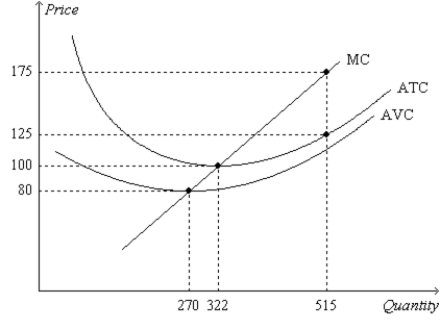 -Refer to Figure 14-7. When the price of the good is $175, the firm's maximum profit is
 (Multiple Choice)
4.8/5 (72)
(72) Table 14-12
Bill's Birdhouses 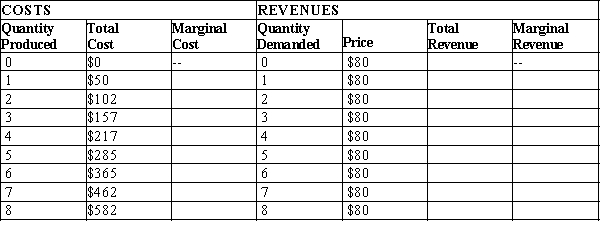 -Refer to Table 14-12. What is the marginal cost of the 8th unit?
 (Multiple Choice)
4.8/5 (98)
(98) 
Filters
- Essay(0)
- Multiple Choice(0)
- Short Answer(0)
- True False(0)
- Matching(0)