



 Chat with AI
Exam 14: Firms in Competitive Markets

Exam 1: Ten Principles of Economics455 Questions
Exam 2: Thinking Like an Economist645 Questions
Exam 3: Interdependence and the Gains From Trade550 Questions
Exam 4: The Market Forces of Supply and Demand693 Questions
Exam 5: Elasticity and Its Application625 Questions
Exam 6: Supply, Demand, and Government Policies671 Questions
Exam 7: Consumers, Producers, and the Efficiency of Markets547 Questions
Exam 8: Application: The Costs of Taxation507 Questions
Exam 9: Application: International Trade521 Questions
Exam 10: Externalities543 Questions
Exam 11: Public Goods and Common Resources453 Questions
Exam 12: The Design of the Tax System563 Questions
Exam 13: The Costs of Production649 Questions
Exam 14: Firms in Competitive Markets608 Questions
Exam 15: Monopoly662 Questions
Exam 16: Monopolistic Competition649 Questions
Exam 17: Oligopoly522 Questions
Exam 18: The Markets for the Factors of Production592 Questions
Exam 19: Earnings and Discrimination511 Questions
Exam 20: Income Inequality and Poverty478 Questions
Exam 21: The Theory of Consumer Choice568 Questions
Exam 22: Frontiers in Microeconomics461 Questions
Select questions type


Scenario 14-2
Assume a certain firm is producing Q = 1,000 units of output. At Q = 1,000, the firm's marginal cost equals $20 and its average total cost equals $25. The firm sells its output for $30 per unit.
-Refer to Scenario 14-2. To maximize its profit, the firm should
(Multiple Choice)
4.9/5  (79)
(79) When some resources used in production are only available in limited quantities, it is likely that the long-run supply curve in a competitive market is
(Multiple Choice)
4.9/5 (69)
(69) If a profit-maximizing firm in a competitive market discovers that, at its current level of production, price is greater than marginal cost, it should
(Multiple Choice)
4.9/5 (89)
(89) Table 14-12
Bill's Birdhouses 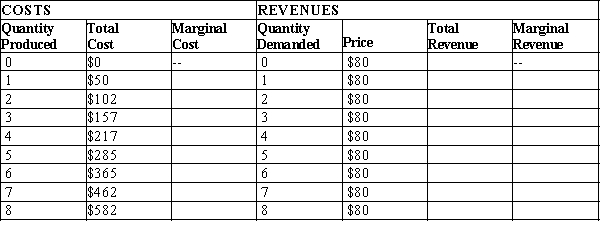 -Refer to Table 14-12. What is the total revenue from selling 4 units?
 (Multiple Choice)
4.9/5 (87)
(87) The intersection of a firm's marginal revenue and marginal cost curves determines the level of output at which
(Multiple Choice)
4.7/5 (80)
(80) A firm's incentive to compare marginal revenue and marginal cost is an application of the principle that rational people think at the margin.
(True/False)
4.8/5 (88)
(88) Figure 14-1
Suppose that a firm in a competitive market has the following cost curves: 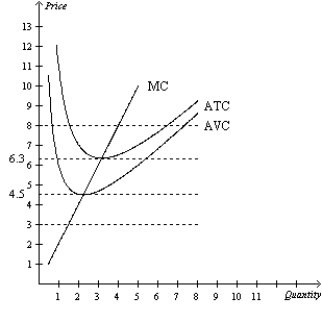 -Refer to Figure 14-1. The firm should shut down if the market price is
 (Multiple Choice)
4.8/5 (78)
(78) The long-run equilibrium in a competitive market characterized by firms with identical costs is generally characterized by firms operating at efficient scale.
(True/False)
4.8/5 (79)
(79) In a competitive market, is the long-run supply curve typically more elastic than the short-run supply curve, or is it less elastic than the short-run supply curve?
(Essay)
4.7/5 (80)
(80) Bill operates a boat rental business in a competitive industry. He owns 10 boats and pays $1,000 per month on the loan that he took out to buy them. He rents each boat for $200 per month. The variable cost for each boat rental is $50. In the off season, Bill should
(Multiple Choice)
4.9/5 (65)
(65) A competitive market is in long-run equilibrium. If demand increases, we can be certain that price will
(Multiple Choice)
4.8/5 (72)
(72) Explain how a firm in a competitive market identifies the profit-maximizing level of production. When should the firm raise production, and when should the firm lower production?
(Essay)
4.8/5 (76)
(76) A firm sells 100 units of output and its total revenue is $800. The firm's average revenue amounts to __________.
(Short Answer)
4.9/5 (76)
(76) If there is an increase in market demand in a perfectly competitive market, then in the short run prices will
(Multiple Choice)
5.0/5 (83)
(83) The textile industry is composed of a large number of small firms. In recent years, these firms have suffered economic losses, and many sellers have left the industry. Economic theory suggests that these conditions will
(Multiple Choice)
4.9/5 (90)
(90) Table 14-13
Diana's Dress Emporium 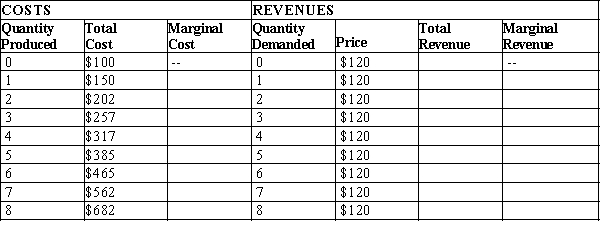 -Refer to Table 14-13. What is the marginal cost of the 8th unit?
 (Multiple Choice)
4.9/5 (87)
(87) When profit-maximizing firms in competitive markets are earning profits,
(Multiple Choice)
4.8/5 (76)
(76) Scenario 14-1
Assume a certain firm in a competitive market is producing Q = 1,000 units of output. At Q = 1,000, the firm's marginal cost equals $15 and its average total cost equals $11. The firm sells its output for $12 per unit.
-Refer to Scenario 14-1. At Q = 999, the firm's profits equal
(Multiple Choice)
4.8/5 (82)
(82) A competitive firm is maximizing its profit by selling 150 units of output. The firm's marginal cost is $8 and its average total cost is $6. The firm's profit amounts to __________.
(Short Answer)
4.8/5 (84)
(84) 
Filters
- Essay(0)
- Multiple Choice(0)
- Short Answer(0)
- True False(0)
- Matching(0)