



 Chat with AI
Exam 14: Firms in Competitive Markets

Exam 1: Ten Principles of Economics455 Questions
Exam 2: Thinking Like an Economist645 Questions
Exam 3: Interdependence and the Gains From Trade550 Questions
Exam 4: The Market Forces of Supply and Demand693 Questions
Exam 5: Elasticity and Its Application625 Questions
Exam 6: Supply, Demand, and Government Policies671 Questions
Exam 7: Consumers, Producers, and the Efficiency of Markets547 Questions
Exam 8: Application: The Costs of Taxation507 Questions
Exam 9: Application: International Trade521 Questions
Exam 10: Externalities543 Questions
Exam 11: Public Goods and Common Resources453 Questions
Exam 12: The Design of the Tax System563 Questions
Exam 13: The Costs of Production649 Questions
Exam 14: Firms in Competitive Markets608 Questions
Exam 15: Monopoly662 Questions
Exam 16: Monopolistic Competition649 Questions
Exam 17: Oligopoly522 Questions
Exam 18: The Markets for the Factors of Production592 Questions
Exam 19: Earnings and Discrimination511 Questions
Exam 20: Income Inequality and Poverty478 Questions
Exam 21: The Theory of Consumer Choice568 Questions
Exam 22: Frontiers in Microeconomics461 Questions
Select questions type


A firm operating in a perfectly competitive industry will shut down in the short run but earn losses if the market price is less than that firm's average variable cost.
(True/False)
4.9/5  (81)
(81) A competitive firm has been selling its output for $20 per unit and has been maximizing its profit, which is positive. Then, the price falls to $18, and the firm makes whatever adjustments are necessary to maximize its profit at the now-lower price. Once the firm has adjusted, its
(Multiple Choice)
4.9/5 (78)
(78) When an individual firm in a competitive market decreases its production, it is likely that the market price will rise.
(True/False)
4.7/5 (76)
(76) Suppose that in a competitive market the equilibrium price is $2.50. What is marginal revenue for the last unit sold by the typical firm in this market?
(Multiple Choice)
4.8/5 (80)
(80) For a firm operating in a perfectly competitive industry, total revenue, marginal revenue, and average revenue are all equal.
(True/False)
4.9/5 (84)
(84) A competitive firm has been selling its output for $20 per unit and has been maximizing its profit, which is positive. Then, the price rises to $25, and the firm makes whatever adjustments are necessary to maximize its profit at the now-higher price. Once the firm has adjusted, its
(Multiple Choice)
4.8/5 (70)
(70) The short-run supply curve in a competitive market must be more elastic than the long-run supply curve.
(True/False)
4.8/5 (71)
(71) Figure 14-13
Suppose a firm in a competitive industry has the following cost curves: 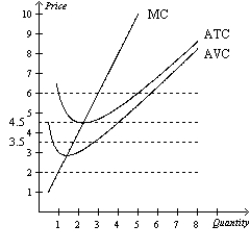 -Refer to Figure 14-13. If the price is $6 in the short run, what will happen in the long run?
 (Multiple Choice)
4.9/5 (74)
(74) A competitive firm sells 100 units of output for $5 per unit. The firm's marginal revenue amounts to __________.
(Short Answer)
4.9/5 (102)
(102) In a market with a fixed number of firms, as long as price is above average
(Multiple Choice)
4.9/5 (73)
(73) When a profit-maximizing firm in a competitive market has zero economic profit, accounting profit
(Multiple Choice)
4.9/5 (79)
(79) Table 14-16
The table represents the demand information for a firm in a competitive market. 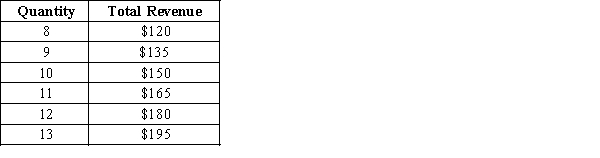
-Refer to Table 14-16. For this firm, when output is equal to 12 units, average revenue is
-Refer to Table 14-16. For this firm, when output is equal to 12 units, average revenue is (Multiple Choice)
4.9/5 (71)
(71) If some resources used in the production of a good are only available in limited quantities, then the long run market supply curve will be perfectly elastic.
(True/False)
4.7/5 (83)
(83) In the short run, a firm should exit the industry if its marginal cost exceeds its marginal revenue.
(True/False)
4.8/5 (74)
(74) Table 14-10
Suppose that a firm in a competitive market faces the following revenues and costs: 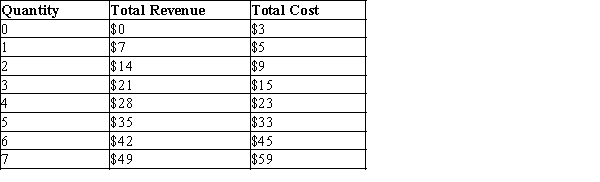 -Refer to Table 14-10. This firm should continue to produce and sell units as long as the marginal cost of production is less than or equal to
 (Multiple Choice)
4.7/5 (78)
(78) When a profit-maximizing firm's fixed costs are considered sunk in the short run, then the firm
(Multiple Choice)
4.9/5 (77)
(77) Table 14-9
Suppose that a firm in a competitive market faces the following revenues and costs: 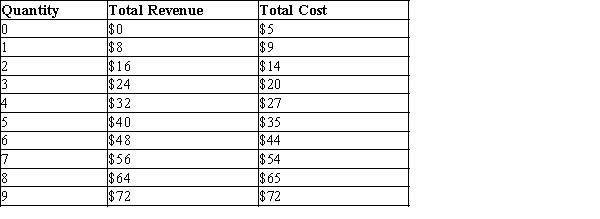 -Refer to Table 14-9. In order to maximize profit, the firm will produce a level of output where marginal cost is equal to
 (Multiple Choice)
4.8/5 (67)
(67) 
Filters
- Essay(0)
- Multiple Choice(0)
- Short Answer(0)
- True False(0)
- Matching(0)