



 Chat with AI
Exam 14: Firms in Competitive Markets

Exam 1: Ten Principles of Economics455 Questions
Exam 2: Thinking Like an Economist645 Questions
Exam 3: Interdependence and the Gains From Trade550 Questions
Exam 4: The Market Forces of Supply and Demand693 Questions
Exam 5: Elasticity and Its Application625 Questions
Exam 6: Supply, Demand, and Government Policies671 Questions
Exam 7: Consumers, Producers, and the Efficiency of Markets547 Questions
Exam 8: Application: The Costs of Taxation507 Questions
Exam 9: Application: International Trade521 Questions
Exam 10: Externalities543 Questions
Exam 11: Public Goods and Common Resources453 Questions
Exam 12: The Design of the Tax System563 Questions
Exam 13: The Costs of Production649 Questions
Exam 14: Firms in Competitive Markets608 Questions
Exam 15: Monopoly662 Questions
Exam 16: Monopolistic Competition649 Questions
Exam 17: Oligopoly522 Questions
Exam 18: The Markets for the Factors of Production592 Questions
Exam 19: Earnings and Discrimination511 Questions
Exam 20: Income Inequality and Poverty478 Questions
Exam 21: The Theory of Consumer Choice568 Questions
Exam 22: Frontiers in Microeconomics461 Questions
Select questions type


Which of the following industries is most likely to exhibit the characteristic of free entry?
(Multiple Choice)
4.8/5  (96)
(96) A firm operating in a perfectly competitive market earns zero economic profit in the long run but remains in business because the firm's revenues cover the business owners' opportunity costs.
(True/False)
4.9/5 (71)
(71) Scenario 14-3
Suppose a certain competitive firm is producing Q=500 units of output. The marginal cost of the 500th unit is $17, and the average total cost of producing 500 units is $12. The firm sells its output for $20.
-Refer to Scenario 14-3. At Q=499, the firm's profits equal
(Multiple Choice)
4.7/5 (97)
(97) Figure 14-12 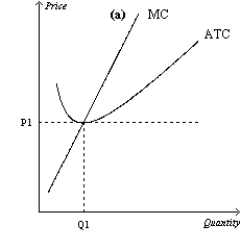
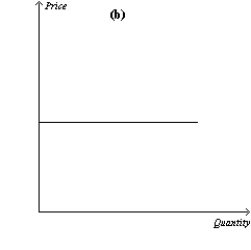 -Refer to Figure 14-12. If the figure in panel (a) reflects the long-run equilibrium of a profit-maximizing firm in a competitive market, the figure in panel (b) most likely reflects
 (Multiple Choice)
4.9/5 (85)
(85) Table 14-15-a 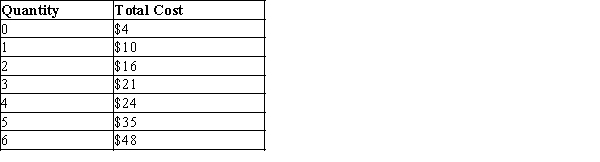 -Refer to Table 14-15-a. What is the lowest price at which this firm would operate in the short run?
 (Multiple Choice)
4.7/5 (77)
(77) A ski resort will choose to remain open in the summer whenever its fixed costs are low enough.
(True/False)
4.9/5 (86)
(86) Figure 14-5
Suppose a firm operating in a competitive market has the following cost curves: 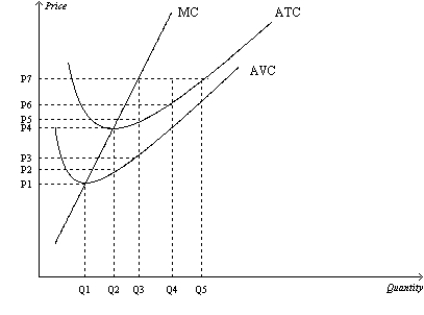 -Refer to Figure 14-5. In the short run,if the market price is higher than P4 but less than P6, individual firms in a competitive industry will earn
 (Multiple Choice)
4.8/5 (81)
(81) A firm will shut down in the short run if revenue is not sufficient to cover its variable costs of production.
(True/False)
4.8/5 (80)
(80) In the long run, a profit-maximizing firm will choose to exit a market when
(Multiple Choice)
4.9/5 (86)
(86) A competitive firm currently produces and sells 800 units of output at a price of $10 per unit. The firm's fixed cost is $4,000 and its variable cost is $8,300. In the short run, should the firm continue to operate?
(Essay)
4.7/5 (77)
(77) If a competitive firm is operating at its efficient scale, then is the firm's profit positive, zero, or negative?
(Essay)
4.8/5 (81)
(81) Figure 14-5
Suppose a firm operating in a competitive market has the following cost curves:
-Refer to Figure 14-5. In the short run, if the market price is higher than P1 but less than P4, individual firms in a competitive industry will earn
-Refer to Figure 14-5. In the short run, if the market price is higher than P1 but less than P4, individual firms in a competitive industry will earn (Multiple Choice)
4.9/5 (86)
(86) In the long run, when price is less than average total cost for all possible levels of production, a firm in a competitive market will choose to exit (or not enter) the market.
(True/False)
4.8/5 (81)
(81) Does a competitive firm have the ability to influence the quantity of output it supplies? Does it have the ability to influence its average revenue?
(Essay)
4.9/5 (82)
(82) Scenario 14-4
The information below applies to a competitive firm that sells its output for $40 per unit.
• When the firm produces and sells 150 units of output, its average total cost is $24.50.
• When the firm produces and sells 151 units of output, its average total cost is $24.55.
-Refer to Scenario 14-4. When the firm produces 150 units of output, its profit is
(Multiple Choice)
4.9/5 (92)
(92) Table 14-11
Suppose that a firm in a competitive market faces the following prices and costs: 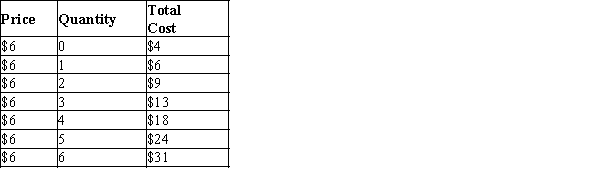 -Refer to Table 14-11. The marginal revenue from producing the 5th unit equals (i) $6.
(ii) the price.(iii) the marginal cost.
-Refer to Table 14-11. The marginal revenue from producing the 5th unit equals (i) $6.
(ii) the price.(iii) the marginal cost. (Multiple Choice)
4.9/5 (73)
(73) Suppose that a firm operating in perfectly competitive market sells 50 units of output. Its total revenues from the sale are $500. Which of the following statements is correct? (i)
Marginal revenue equals $5.
(ii)
Average revenue equals $10.
(iii)
Price equals $15.
(Multiple Choice)
4.8/5 (85)
(85) Which of the following is not a characteristic of a competitive market?
(Multiple Choice)
4.8/5 (87)
(87) In a perfectly competitive market, the process of entry and exit will end when
(Multiple Choice)
4.8/5 (97)
(97) 
Filters
- Essay(0)
- Multiple Choice(0)
- Short Answer(0)
- True False(0)
- Matching(0)