



 Chat with AI
Exam 14: Firms in Competitive Markets

Exam 1: Ten Principles of Economics455 Questions
Exam 2: Thinking Like an Economist645 Questions
Exam 3: Interdependence and the Gains From Trade550 Questions
Exam 4: The Market Forces of Supply and Demand693 Questions
Exam 5: Elasticity and Its Application625 Questions
Exam 6: Supply, Demand, and Government Policies671 Questions
Exam 7: Consumers, Producers, and the Efficiency of Markets547 Questions
Exam 8: Application: The Costs of Taxation507 Questions
Exam 9: Application: International Trade521 Questions
Exam 10: Externalities543 Questions
Exam 11: Public Goods and Common Resources453 Questions
Exam 12: The Design of the Tax System563 Questions
Exam 13: The Costs of Production649 Questions
Exam 14: Firms in Competitive Markets608 Questions
Exam 15: Monopoly662 Questions
Exam 16: Monopolistic Competition649 Questions
Exam 17: Oligopoly522 Questions
Exam 18: The Markets for the Factors of Production592 Questions
Exam 19: Earnings and Discrimination511 Questions
Exam 20: Income Inequality and Poverty478 Questions
Exam 21: The Theory of Consumer Choice568 Questions
Exam 22: Frontiers in Microeconomics461 Questions
Select questions type


Shrimp Galore, a shrimp harvesting business in the Pacific Northwest, has a 30-year loan on its shrimp harvesting boat. The annual loan payment is $25,000 and the boat has a market (salvage) value that exceeds its outstanding loan balance. Prior to the 2010 shrimp harvesting season, Shrimp Galore's accountant predicted that at expected market prices for shrimp, Shrimp Galore would have a net loss of $75,000 dollars after paying all 2010 expenses (including the annual loan payment). In this case, Shrimp Galore should
(Multiple Choice)
4.9/5  (65)
(65) The long-run supply curve for a competitive industry may be upward sloping if
(Multiple Choice)
4.9/5 (78)
(78) Table 14-3
The table represents a demand curve faced by a firm in a competitive market. 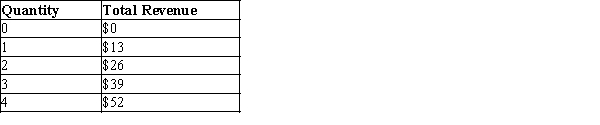 -Refer to Table 14-3. For this firm, the marginal revenue is
 (Multiple Choice)
4.9/5 (89)
(89) If your local gasoline station raised its price by 20 percent, its sales of gasoline would decrease substantially because your local gas station
(Multiple Choice)
4.9/5 (57)
(57) Mrs. Smith operates a business in a competitive market. The current market price is $7.50. At her profit-maximizing level of production, the average variable cost is $8.00, and the average total cost is $8.25. Mrs. Smith should
(Multiple Choice)
4.8/5 (81)
(81) Mrs. Smith operates a business in a competitive market. The current market price is $8.10. At her profit-maximizing level of production, the average variable cost is $8.00, and the average total cost is $8.25. Mrs. Smith should
(Multiple Choice)
4.7/5 (91)
(91) Table 14-9
Suppose that a firm in a competitive market faces the following revenues and costs: 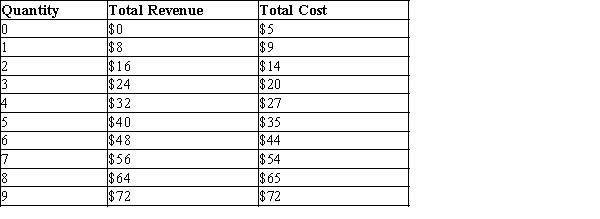 -Refer to Table 14-9. If the firm's marginal cost is $11, it should
 (Multiple Choice)
4.9/5 (80)
(80) Scenario 14-2
Assume a certain firm is producing Q = 1,000 units of output. At Q = 1,000, the firm's marginal cost equals $20 and its average total cost equals $25. The firm sells its output for $30 per unit.
-Refer to Scenario 14-2. At Q = 999, the firm's profits equal
(Multiple Choice)
4.9/5 (83)
(83) Describe the difference between average revenue and marginal revenue. Why are both of these revenue measures important to a profit-maximizing firm?
(Essay)
4.9/5 (77)
(77) A certain competitive firm sells its output for $20 per unit. The 50th unit of output that the firm produces has a marginal cost of $22. Production of the 50th unit of output does not necessarily
(Multiple Choice)
4.9/5 (69)
(69) Suppose a profit-maximizing firm in a competitive market produces rubber bands. When the market price for rubber bands falls below the minimum of its average total cost, but still lies above the minimum of average variable cost, in the short run the firm will
(Multiple Choice)
4.7/5 (66)
(66) Figure 14-6
Suppose a firm operating in a competitive market has the following cost curves: 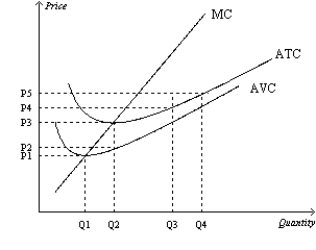 -Refer to Figure 14-6. When market price is P3, a profit-maximizing firm's profit
 (Multiple Choice)
4.8/5 (72)
(72) In a competitive market the current price is $5. The typical firm in the market has ATC = $5.00 and AVC = $4.50.
(Multiple Choice)
4.9/5 (90)
(90) In the short run, there are 500 identical firms in a competitive market. The firms do not use any resources that are available in limited quantities, and each of them has the following cost structure: 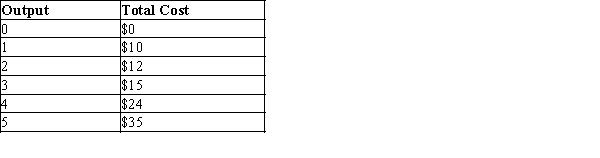 Which of the following is a point on the long-run supply curve?
 (Multiple Choice)
4.8/5 (71)
(71) In the short run, there are 500 identical firms in a competitive market. The firms do not use any resources that are available in limited quantities, and each of them has the following cost structure: 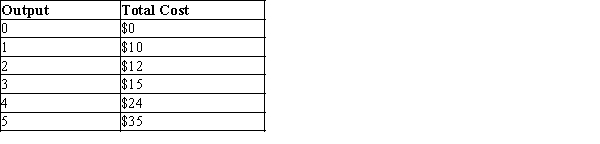 The long-run supply curve for this market is
 (Multiple Choice)
4.8/5 (76)
(76) A competitive market will typically experience entry and exit until accounting profits are zero.
(True/False)
4.9/5 (83)
(83) Figure 14-2
Suppose a firm operating in a competitive market has the following cost curves: 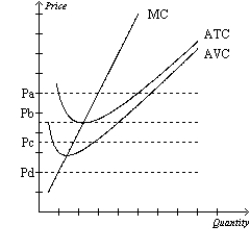 -Refer to Figure 14-2. Which of the four prices corresponds to a firm earning negative economic profits in the short run but trying to remain open?
 (Multiple Choice)
4.9/5 (64)
(64) When price exceeds average variable cost in the short run, a competitive firm's marginal cost curve is regarded as its supply curve because
(Multiple Choice)
4.8/5 (74)
(74) Tom produces commemorative t-shirts in a competitive market. If Tom decides to decrease his output, this will
(Multiple Choice)
4.8/5 (84)
(84) Which of these curves is the competitive firm's short-run supply curve?
(Multiple Choice)
4.8/5 (86)
(86) 
Filters
- Essay(0)
- Multiple Choice(0)
- Short Answer(0)
- True False(0)
- Matching(0)