



 Chat with AI
Exam 14: Firms in Competitive Markets

Exam 1: Ten Principles of Economics455 Questions
Exam 2: Thinking Like an Economist645 Questions
Exam 3: Interdependence and the Gains From Trade550 Questions
Exam 4: The Market Forces of Supply and Demand693 Questions
Exam 5: Elasticity and Its Application625 Questions
Exam 6: Supply, Demand, and Government Policies671 Questions
Exam 7: Consumers, Producers, and the Efficiency of Markets547 Questions
Exam 8: Application: The Costs of Taxation507 Questions
Exam 9: Application: International Trade521 Questions
Exam 10: Externalities543 Questions
Exam 11: Public Goods and Common Resources453 Questions
Exam 12: The Design of the Tax System563 Questions
Exam 13: The Costs of Production649 Questions
Exam 14: Firms in Competitive Markets608 Questions
Exam 15: Monopoly662 Questions
Exam 16: Monopolistic Competition649 Questions
Exam 17: Oligopoly522 Questions
Exam 18: The Markets for the Factors of Production592 Questions
Exam 19: Earnings and Discrimination511 Questions
Exam 20: Income Inequality and Poverty478 Questions
Exam 21: The Theory of Consumer Choice568 Questions
Exam 22: Frontiers in Microeconomics461 Questions
Select questions type


Which of the following statements is correct regarding a firm's decision-making?
(Multiple Choice)
4.8/5  (81)
(81) If a firm can influence the market price of the good it sells, then it is said to have __________.
(Short Answer)
4.8/5 (88)
(88) When buyers in a competitive market take the selling price as given, they are said to be
(Multiple Choice)
4.9/5 (73)
(73) Figure 14-14 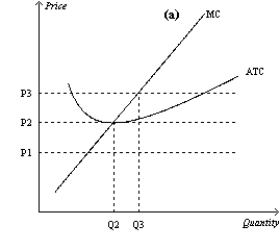
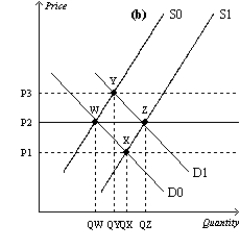 -Refer to Figure 14-14. Assume that the market starts in equilibrium at point W in panel (b). An increase in demand from D0 to D1 will result in
 (Multiple Choice)
4.9/5 (76)
(76) Figure 14-4
Suppose a firm operating in a competitive market has the following cost curves: 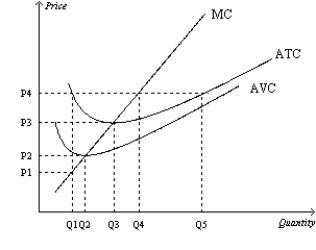 -Refer to Figure 14-4. When price falls from P3 to P1, the firm finds that it
 (Multiple Choice)
4.8/5 (81)
(81) Table 14-14
The following table presents cost and revenue information for Bob's bakery production and sales. 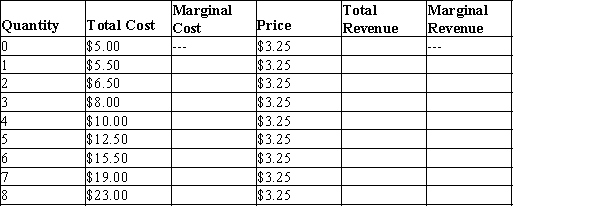 -Refer to Table 14-14. What is the total revenue from selling 5 units?
 (Multiple Choice)
4.9/5 (74)
(74) Suppose a firm in a competitive market produces and sells 150 units of output and earns $1,800 in total revenue from the sales. If the firm increases its output to 200 units, the average revenue of the 200th unit will be
(Multiple Choice)
4.8/5 (74)
(74) A competitive firm's profit will be increasing as long as marginal revenue is greater than marginal cost.
(True/False)
4.9/5 (77)
(77) Roger owns a small health store that sells vitamins in a perfectly competitive market. If vitamins sell for $12 per bottle and the average total cost per bottle is $11.50 at the profit-maximizing output level, then in the long run
(Multiple Choice)
4.7/5 (83)
(83) Table 14-3
The table represents a demand curve faced by a firm in a competitive market. 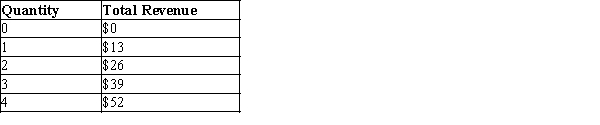 -Refer to Table 14-3. For this firm, the price is
 (Multiple Choice)
4.9/5 (85)
(85) A firm is currently producing 100 units of output per day. The manager reports to the owner that producing the 100th unit costs the firm $5. The firm can sell the 100th unit for $5. The firm should continue to produce 100 units in order to maximize its profits (or minimize its losses).
(True/False)
4.8/5 (82)
(82) Suppose a firm in a competitive market produces and sells 150 units of output and earns $1,800 in total revenue from the sales. If the firm increases its output to 200 units, total revenue will be
(Multiple Choice)
4.8/5 (94)
(94) Suppose that firms in a competitive industry are earning positive economic profits. All else equal, in the long run, we would expect the number of firms in the industry to
(Multiple Choice)
4.9/5 (81)
(81) Figure 14-1
Suppose that a firm in a competitive market has the following cost curves: 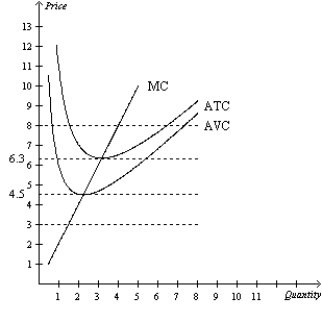 -Refer to Figure 14-1. If the market price falls below $4.50, the firm will earn
 (Multiple Choice)
4.8/5 (72)
(72) In competitive markets, firms that raise their prices are typically rewarded with larger profits.
(True/False)
4.9/5 (82)
(82) A competitive firm is producing 500 units of output and its efficient scale is 400 units of output. Can the market in which this firm operates be in a long-run equilibrium? Briefly explain.
(Essay)
4.8/5 (76)
(76) A long-run supply curve is flatter than a short-run supply curve because
(Multiple Choice)
4.8/5 (77)
(77) The assumption of a fixed number of firms is appropriate for analysis of
(Multiple Choice)
4.9/5 (69)
(69) Figure 14-6
Suppose a firm operating in a competitive market has the following cost curves: 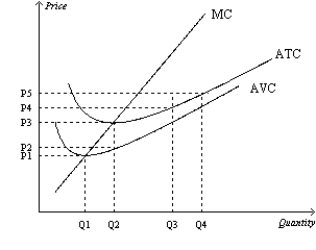 -Refer to Figure 14-6. When market price is P3, a profit-maximizing firm's total revenue
 (Multiple Choice)
4.9/5 (84)
(84) Which of the following statements is not correct about competitive firms?
(Multiple Choice)
4.9/5 (74)
(74) 
Filters
- Essay(0)
- Multiple Choice(0)
- Short Answer(0)
- True False(0)
- Matching(0)