



 Chat with AI
Exam 14: Firms in Competitive Markets

Exam 1: Ten Principles of Economics455 Questions
Exam 2: Thinking Like an Economist645 Questions
Exam 3: Interdependence and the Gains From Trade550 Questions
Exam 4: The Market Forces of Supply and Demand693 Questions
Exam 5: Elasticity and Its Application625 Questions
Exam 6: Supply, Demand, and Government Policies671 Questions
Exam 7: Consumers, Producers, and the Efficiency of Markets547 Questions
Exam 8: Application: The Costs of Taxation507 Questions
Exam 9: Application: International Trade521 Questions
Exam 10: Externalities543 Questions
Exam 11: Public Goods and Common Resources453 Questions
Exam 12: The Design of the Tax System563 Questions
Exam 13: The Costs of Production649 Questions
Exam 14: Firms in Competitive Markets608 Questions
Exam 15: Monopoly662 Questions
Exam 16: Monopolistic Competition649 Questions
Exam 17: Oligopoly522 Questions
Exam 18: The Markets for the Factors of Production592 Questions
Exam 19: Earnings and Discrimination511 Questions
Exam 20: Income Inequality and Poverty478 Questions
Exam 21: The Theory of Consumer Choice568 Questions
Exam 22: Frontiers in Microeconomics461 Questions
Select questions type


A corporation has been steadily losing money on one of its product lines, plastic flamingo lawn ornaments. The firm produces plastic flamingos in a factory that cost $20 million to build 10 years ago. The firm is now considering an offer to buy that factory for $15 million. Which of the following statements about the decision to sell or not to sell is correct?
(Multiple Choice)
4.8/5  (73)
(73) If the profit-maximizing quantity of production for a competitive firm occurs at a point where the firm's average total cost of production is falling as production increases, then the firm
(Multiple Choice)
4.8/5 (90)
(90) When a restaurant stays open for lunch service even though few customers patronize the restaurant for lunch, which of the following principles is (are) best demonstrated? (i)
Fixed costs are sunk in the short run.
(ii)
In the short run, only fixed costs are important to the decision to stay open for lunch.
(iii)
If revenue exceeds variable cost, the restaurant owner is making a smart decision to remain open for lunch.
(Multiple Choice)
4.9/5 (83)
(83) When a competitive market experiences an increase in demand that increases production costs for existing firms and potential new entrants, which of the following is most likely to arise?
(Multiple Choice)
4.8/5 (75)
(75) Scenario 14-2
Assume a certain firm is producing Q = 1,000 units of output. At Q = 1,000, the firm's marginal cost equals $20 and its average total cost equals $25. The firm sells its output for $30 per unit.
-Refer to Scenario 14-2. At Q = 1,000, the firm's profits equal
(Multiple Choice)
4.9/5 (72)
(72) Which of the following statements best expresses a firm's profit-maximizing decision rule?
(Multiple Choice)
4.7/5 (85)
(85) Because nothing can be done about sunk costs, they are irrelevant to decisions about business strategy.
(True/False)
4.9/5 (73)
(73) Table 14-6
The following table presents cost and revenue information for a firm operating in a competitive industry. 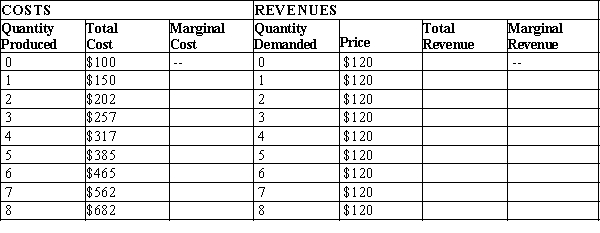 -Refer to Table 14-6. What is the total revenue from selling 4 units?
 (Multiple Choice)
4.8/5 (69)
(69) When total revenue is less than variable costs, a firm in a competitive market will
(Multiple Choice)
4.7/5 (82)
(82) Profit maximizing firms in competitive industries with free entry and exit face a price equal to the lowest possible
(Multiple Choice)
4.8/5 (66)
(66) In a competitive market the price is $8. A typical firm in the market has ATC = $6, AVC = $5, and MC = $8. How much economic profit is the firm earning in the short run?
(Multiple Choice)
4.9/5 (71)
(71) Which of the following statements best expresses a firm's profit-maximizing decision rule?
(Multiple Choice)
4.7/5 (64)
(64) Figure 14-7 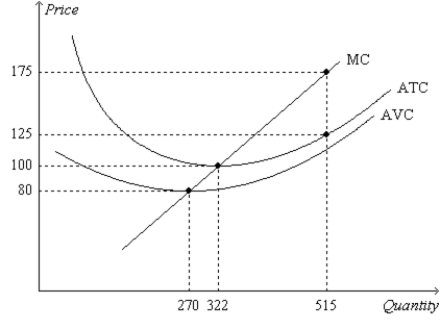 -Refer to Figure 14-7. Suppose the price of the good is $175. If the firm produces and sells 515 units of output, its total revenue is
 (Multiple Choice)
4.7/5 (86)
(86) A firm operating in a perfectly competitive market may earn positive, negative, or zero economic profit in the long run.
(True/False)
4.8/5 (72)
(72) If all firms have the same costs of production, then in long-run equilibrium,
(Multiple Choice)
4.7/5 (87)
(87) Figure 14-8
Suppose a firm operating in a competitive market has the following cost curves: 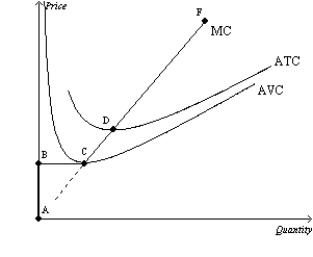 -Refer to Figure 14-8. Which line segment best reflects the short-run supply curve for this firm?
 (Multiple Choice)
4.8/5 (62)
(62) For any competitive market, the supply curve is closely related to the
(Multiple Choice)
4.9/5 (68)
(68) A competitive market has two basic characteristics. What are those two characteristics?
(Essay)
5.0/5 (81)
(81) Figure 14-14 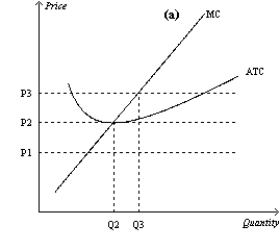
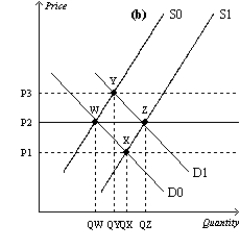 -Refer to Figure 14-14. Assume that the market starts in equilibrium at point W in panel (b) and that panel (a) illustrates the cost curves facing individual firms. Suppose that demand increases from D0 to D1. Which of the following statements is not correct?
 (Multiple Choice)
4.9/5 (76)
(76) Land of Many Lakes (LML) sells butter to a broker in Albert Lea, Minnesota. Because the market for butter is generally considered to be competitive, LML does not choose the
(Multiple Choice)
4.9/5 (78)
(78) 
Filters
- Essay(0)
- Multiple Choice(0)
- Short Answer(0)
- True False(0)
- Matching(0)