



 Chat with AI
Exam 14: Firms in Competitive Markets

Exam 1: Ten Principles of Economics455 Questions
Exam 2: Thinking Like an Economist645 Questions
Exam 3: Interdependence and the Gains From Trade550 Questions
Exam 4: The Market Forces of Supply and Demand693 Questions
Exam 5: Elasticity and Its Application625 Questions
Exam 6: Supply, Demand, and Government Policies671 Questions
Exam 7: Consumers, Producers, and the Efficiency of Markets547 Questions
Exam 8: Application: The Costs of Taxation507 Questions
Exam 9: Application: International Trade521 Questions
Exam 10: Externalities543 Questions
Exam 11: Public Goods and Common Resources453 Questions
Exam 12: The Design of the Tax System563 Questions
Exam 13: The Costs of Production649 Questions
Exam 14: Firms in Competitive Markets608 Questions
Exam 15: Monopoly662 Questions
Exam 16: Monopolistic Competition649 Questions
Exam 17: Oligopoly522 Questions
Exam 18: The Markets for the Factors of Production592 Questions
Exam 19: Earnings and Discrimination511 Questions
Exam 20: Income Inequality and Poverty478 Questions
Exam 21: The Theory of Consumer Choice568 Questions
Exam 22: Frontiers in Microeconomics461 Questions
Select questions type


Table 14-10
Suppose that a firm in a competitive market faces the following revenues and costs: 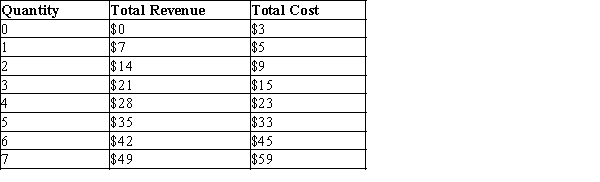 -Refer to Table 14-10. Which level of production in the table has the lowest average variable cost?
 (Multiple Choice)
4.8/5  (88)
(88) Scenario 14-5
A study sponsored by the Food Consumer Safety Board found that consumption of irradiated tomatoes increased the health of laboratory rats. As a result of national press coverage of the report, the demand for irradiated tomatoes increased dramatically. Organic farmers were able to switch from organic production of tomatoes to irradiated production with no additional cost. Assume that the tomato market satisfies all of the assumptions of perfect competition.
-Refer to Scenario 14-5. As a result of the increase in the demand for tomatoes, we would predict that in the short run that the
(Multiple Choice)
4.8/5 (88)
(88) A competitive firm's short-run supply curve intersects its average-total-cost curve at the point  What is the value of marginal cost at Q = 450?
 (Essay)
4.9/5 (84)
(84) Figure 14-5
Suppose a firm operating in a competitive market has the following cost curves: 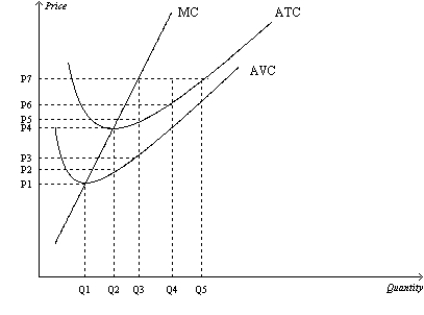 -Refer to Figure 14-5. When market price is P7, a profit-maximizing firm's short-run profits can be represented by the area
 (Multiple Choice)
4.8/5 (78)
(78) Figure 14-9
Suppose a firm operating in a competitive market has the following cost curves: 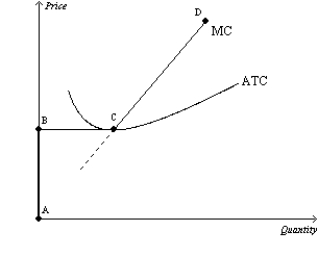 -Refer to Figure 14-9. The firm will exit the market for any price on the line segment
 (Multiple Choice)
4.9/5 (93)
(93) Figure 14-1
Suppose that a firm in a competitive market has the following cost curves: 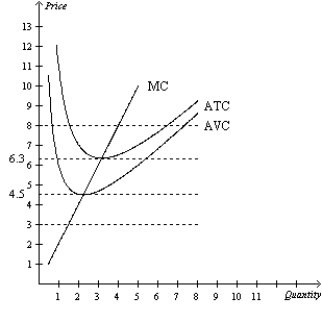 -Refer to Figure 14-1. If the market price rises above $6.30, the firm will earn
 (Multiple Choice)
4.9/5 (81)
(81) Suppose you bought a ticket to a football game for $30 and that you place a $35 value on seeing the game. If you lose the ticket, then what is the maximum price you should pay for another ticket? Assume that losing the ticket does not alter how you value it.
(Multiple Choice)
4.7/5 (84)
(84) Which of these types of costs can be ignored when an individual or a firm is making decisions?
(Multiple Choice)
4.9/5 (69)
(69) When all firms and potential firms in a market have the same cost curves, the long-run equilibrium of a competitive market with free entry and exit will be characterized by firms
(Multiple Choice)
4.8/5 (81)
(81) By comparing marginal revenue and marginal cost, a firm in a competitive market is able to adjust production to the level that achieves its objective, which we assume to be
(Multiple Choice)
4.9/5 (88)
(88) Table 14-4
The table represents a demand curve faced by a firm in a competitive market. 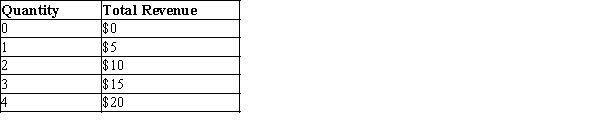 -Refer to Table 14-4. For this firm, the price is
 (Multiple Choice)
4.8/5 (89)
(89) Suppose you value a special watch at $100. You purchase it for $75. On your way home from class one day, you lose the watch. The store is still selling the same watch, but the price has risen to $85. Assume that losing the watch has not altered how you value it. What should you do?
(Multiple Choice)
4.8/5 (94)
(94) When a profit-maximizing firm in a competitive market experiences rising prices, it will respond with an increase in production.
(True/False)
4.8/5 (69)
(69) Susan quit her job as a teacher, which paid her $36,000 per year, in order to start her own catering business. She spent $12,000 of her savings, which had been earning 10 percent interest per year, on equipment for her business. She also borrowed $12,000 from her bank at 10 percent interest, which she also spent on equipment. For the past several months she has spent $1,000 per month on ingredients and other variable costs. Also for the past several months she has earned $4,500 in monthly revenue. In the short run, Susan should
(Multiple Choice)
4.7/5 (78)
(78) Which of the following characteristics of competitive markets is necessary for firms to be price takers? (i)
There are many sellers.
(ii)
Firms can freely enter or exit the market.
(iii)
Goods offered for sale are largely the same.
(Multiple Choice)
4.8/5 (76)
(76) If a competitive firm is currently producing a level of output at which marginal revenue exceeds marginal cost, then
(Multiple Choice)
4.7/5 (71)
(71) In a competitive market the current price is $5. The typical firm in the market has ATC = $5.50 and AVC = $5.15.
(Multiple Choice)
4.7/5 (73)
(73) Figure 14-9
In the figure below, panel (a) depicts the linear marginal cost of a firm in a competitive market, and panel (b) depicts the linear market supply curve for a market with a fixed number of identical firms. 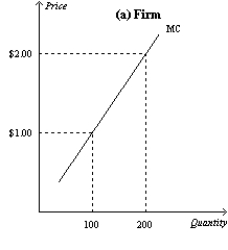
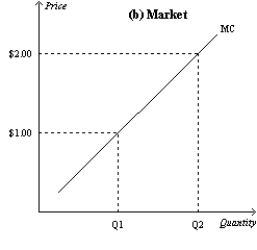 -Refer to Figure 14-9. If there are 300 identical firms in this market, what level of output will be supplied to the market when price is $2.00?
 (Multiple Choice)
4.7/5 (83)
(83) 
Filters
- Essay(0)
- Multiple Choice(0)
- Short Answer(0)
- True False(0)
- Matching(0)