



 Chat with AI
Exam 13: B: Fiscal Policy, Deficits, Surpluses, and Debt

Exam 1: B: Limits, Alternatives, and Choices265 Questions
Exam 1: A: - Limits, Alternatives, and Choices60 Questions
Exam 2: B: The Market System and the Circular Flow119 Questions
Exam 2: A: - The Market System and the Circular Flow42 Questions
Exam 3: B: Demand, Supply, and Market Equilibrium291 Questions
Exam 3: A: - Demand, Supply, and Market Equilibrium51 Questions
Exam 4: B: Market Failures: Public Goods and Externalities133 Questions
Exam 4: A: - Market Failures: Public Goods and Externalities36 Questions
Exam 5: B: Governments Role and Government Failure121 Questions
Exam 5: A: Governments Role and Government Failure1 Questions
Exam 6: B: an Introduction to Macroeconomics65 Questions
Exam 6: A: an Introduction to Macroeconomics31 Questions
Exam 7: B: Measuring the Economys Output191 Questions
Exam 7: A: Measuring the Economys Output30 Questions
Exam 8: B: Economic Growth122 Questions
Exam 8: A: Economic Growth35 Questions
Exam 9: B: Business Cycles, Unemployment, and Inflation193 Questions
Exam 9: A: Business Cycles, Unemployment, and Inflation40 Questions
Exam 10: B: Basic Macroeconomic Relationships200 Questions
Exam 10: A: Basic Macroeconomic Relationships26 Questions
Exam 11: B: The Aggregate Expenditures Model238 Questions
Exam 11: A: The Aggregate Expenditures Model47 Questions
Exam 12: B: Aggregate Demand and Aggregate Supply203 Questions
Exam 12: A: Aggregate Demand and Aggregate Supply35 Questions
Exam 13: B: Fiscal Policy, Deficits, Surpluses, and Debt234 Questions
Exam 13: A: Fiscal Policy, Deficits, Surpluses, and Debt53 Questions
Exam 14: B: Money, Banking, and Money Creation206 Questions
Exam 14: A: Money, Banking, and Money Creation56 Questions
Exam 15: B: Interest Rates and Monetary Policy239 Questions
Exam 15: A: Interest Rates and Monetary Policy47 Questions
Exam 17: C: Financial Economics323 Questions
Exam 16: A: Long-Run Macroeconomic Adjustments28 Questions
Exam 16: B: Long-Run Macroeconomic Adjustments122 Questions
Exam 17: A: International Trade40 Questions
Exam 17: B: International Trade188 Questions
Exam 18: A: The Balance of Payments and Exchange Rates30 Questions
Exam 18: B: The Balance of Payments and Exchange Rates133 Questions
Exam 22: The Economics of Developing Countries254 Questions
Select questions type


Built-in stability is synonymous with discretionary fiscal policy.
(True/False)
4.9/5  (76)
(76) Refer to the diagram below.If the full employment level of GDP for this economy is at H, the: 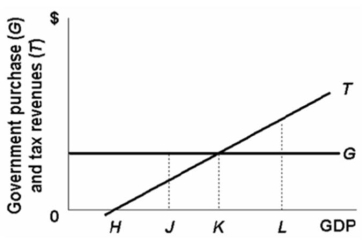
(Multiple Choice)
4.9/5 (81)
(81) The additional taxes needed to pay the interest on the public debt reduce incentives to work, save, invest, and bear risks.
(True/False)
4.7/5 (79)
(79) An increase in the cyclical deficits will automatically increase the full-employment budget deficit.
(True/False)
4.9/5 (82)
(82) In an economy, the government wants to increase aggregate demand by $50 billion at each price level to increase real GDP and reduce unemployment.If the MPS is .4, then it could increase government spending by:
(Multiple Choice)
4.9/5 (71)
(71) It is more meaningful to measure the growth of the public debt relative to the GDP than to measure it in absolute terms.
(True/False)
4.8/5 (67)
(67) Currently, the general agreement about a proposed fiscal policy is that:
(Multiple Choice)
4.8/5 (89)
(89) When government tax revenues change automatically and in a countercyclical direction over the course of the business cycle, this is an example of:
(Multiple Choice)
5.0/5 (85)
(85) 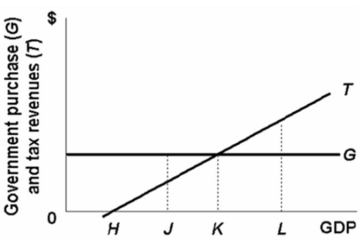 If the full-employment GDP for the above economy is at L, the:
 (Multiple Choice)
4.8/5 (77)
(77) The crowding-out effect may be dampened if the investment-demand curve is shifting to the right.
(True/False)
4.9/5 (89)
(89) Assume that aggregate demand in the economy is excessive, causing an inflationary gap.Which of the following would be most in accord with appropriate government fiscal policy?
(Multiple Choice)
4.9/5 (76)
(76) The table below shows the full-employment budget deficit as a percentage of GDP over a five-year period. 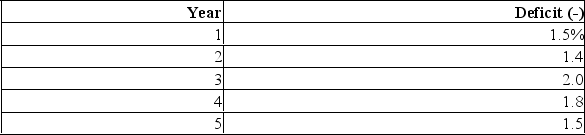 Refer to the above information.In which year was fiscal policy expansionary?
 (Multiple Choice)
4.9/5 (82)
(82) The greatest expansionary impact of a budget deficit will occur when the:
(Multiple Choice)
4.9/5 (70)
(70) Which cause-and-effect chain would best explain the reason for a decline in net exports? An expansionary fiscal policy:
(Multiple Choice)
4.9/5 (74)
(74) The time which elapses between the beginning of a recession or an inflationary episode and the identification of the macroeconomic problem is referred to as a(n):
(Multiple Choice)
4.8/5 (83)
(83) The operational lag of fiscal policy refers to the time which elapses between the beginning of a recession or inflation and the certain awareness that it is actually happening.
(True/False)
4.9/5 (79)
(79) 
Filters
- Essay(0)
- Multiple Choice(0)
- Short Answer(0)
- True False(0)
- Matching(0)