



 Chat with AI
Exam 13: B: Fiscal Policy, Deficits, Surpluses, and Debt

Exam 1: B: Limits, Alternatives, and Choices265 Questions
Exam 1: A: - Limits, Alternatives, and Choices60 Questions
Exam 2: B: The Market System and the Circular Flow119 Questions
Exam 2: A: - The Market System and the Circular Flow42 Questions
Exam 3: B: Demand, Supply, and Market Equilibrium291 Questions
Exam 3: A: - Demand, Supply, and Market Equilibrium51 Questions
Exam 4: B: Market Failures: Public Goods and Externalities133 Questions
Exam 4: A: - Market Failures: Public Goods and Externalities36 Questions
Exam 5: B: Governments Role and Government Failure121 Questions
Exam 5: A: Governments Role and Government Failure1 Questions
Exam 6: B: an Introduction to Macroeconomics65 Questions
Exam 6: A: an Introduction to Macroeconomics31 Questions
Exam 7: B: Measuring the Economys Output191 Questions
Exam 7: A: Measuring the Economys Output30 Questions
Exam 8: B: Economic Growth122 Questions
Exam 8: A: Economic Growth35 Questions
Exam 9: B: Business Cycles, Unemployment, and Inflation193 Questions
Exam 9: A: Business Cycles, Unemployment, and Inflation40 Questions
Exam 10: B: Basic Macroeconomic Relationships200 Questions
Exam 10: A: Basic Macroeconomic Relationships26 Questions
Exam 11: B: The Aggregate Expenditures Model238 Questions
Exam 11: A: The Aggregate Expenditures Model47 Questions
Exam 12: B: Aggregate Demand and Aggregate Supply203 Questions
Exam 12: A: Aggregate Demand and Aggregate Supply35 Questions
Exam 13: B: Fiscal Policy, Deficits, Surpluses, and Debt234 Questions
Exam 13: A: Fiscal Policy, Deficits, Surpluses, and Debt53 Questions
Exam 14: B: Money, Banking, and Money Creation206 Questions
Exam 14: A: Money, Banking, and Money Creation56 Questions
Exam 15: B: Interest Rates and Monetary Policy239 Questions
Exam 15: A: Interest Rates and Monetary Policy47 Questions
Exam 17: C: Financial Economics323 Questions
Exam 16: A: Long-Run Macroeconomic Adjustments28 Questions
Exam 16: B: Long-Run Macroeconomic Adjustments122 Questions
Exam 17: A: International Trade40 Questions
Exam 17: B: International Trade188 Questions
Exam 18: A: The Balance of Payments and Exchange Rates30 Questions
Exam 18: B: The Balance of Payments and Exchange Rates133 Questions
Exam 22: The Economics of Developing Countries254 Questions
Select questions type


During the last decade, the gross federal public debt has:
(Multiple Choice)
4.8/5  (86)
(86) If taxation becomes more progressive, the built-in stability in the economy will increase.
(True/False)
4.9/5 (81)
(81) The following budget information is for a hypothetical economy.All data are in billions of dollars. 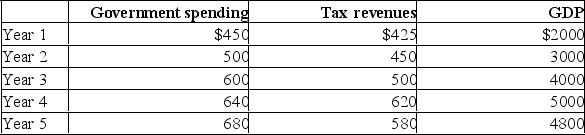 Refer to the above data.The budget deficit in year 3 is:
 (Multiple Choice)
4.8/5 (91)
(91) The crowding-out effect occurs when an expansionary fiscal policy increases the interest rate, decreases investment spending, and weakens fiscal policy.
(True/False)
4.9/5 (89)
(89) 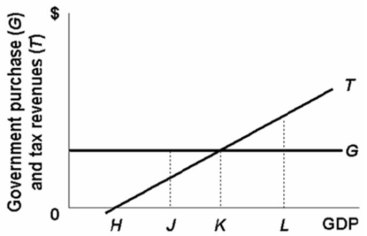 The degree of built-in stability in the above economy could be increased by:
 (Multiple Choice)
4.8/5 (84)
(84) What percentage of the public debt is held by foreign individuals and institutions?
(Multiple Choice)
4.8/5 (89)
(89) 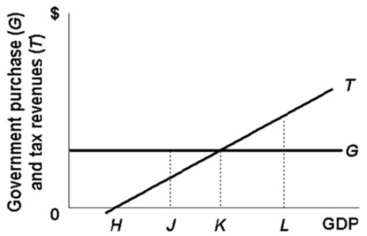 Refer to the above diagram.Automatic stability in this economy could be decreased by:
 (Multiple Choice)
4.9/5 (80)
(80) Which of the following best describes the notion of a "political business cycle"?
(Multiple Choice)
4.8/5 (76)
(76) 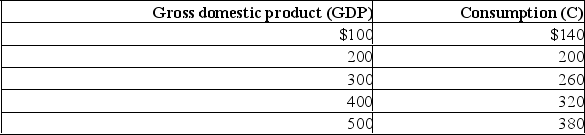 Refer to the above data.A 10 percent proportional tax on income would:
 (Multiple Choice)
4.9/5 (85)
(85) Which one of the following best describes the net export effect associated with an expansionary Canadian fiscal policy?
(Multiple Choice)
4.8/5 (75)
(75) You are given the following information about aggregate demand at the existing price level for an economy: (1) consumption = $400 billion; (2) investment = $40 billion; (3) government purchases = $90 billion; and (4) net export = $25 billion.If the full-employment level of GDP for this economy is $600 billion, then what combination of actions would be most consistent with the goal of achieving full employment?
(Multiple Choice)
4.7/5 (80)
(80) 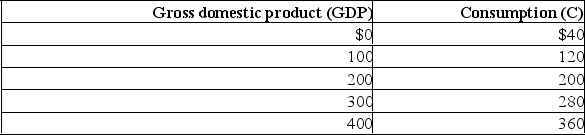 Refer to the above data.If a lump-sum tax (the same tax amount at each level of GDP) of $40 is imposed in this economy, the tax system:
 (Multiple Choice)
4.8/5 (83)
(83) (1) The composite index of leading indicators turns downward for three consecutive months; (2) Economists reach agreement that the economy is moving into a recession; (3) A tax cut is proposed in Parliament; (4) The tax cut is passed by Parliament; (5) Consumption spending begins to rise, aggregate demand increases, and the economy begins to recover.Refer to the above information.The administrative lag of fiscal policy is reflected in events:
(Multiple Choice)
4.8/5 (93)
(93) A decrease in government spending and taxes would be an example of fiscal policies that reinforce each other.
(True/False)
4.8/5 (75)
(75) Suppose that in an economy with an MPC of .8 the government wanted to shift the aggregate demand curve leftward by $40 billion at each price level to remedy demand-pull inflation.It could:
(Multiple Choice)
5.0/5 (68)
(68) Which of the following is not a criticism of the lag effect of fiscal policy?
(Multiple Choice)
4.8/5 (90)
(90) In an economy, the government wants to decrease aggregate demand by $24 billion at each price level to decrease real GDP and control demand-pull inflation.If the MPC is .75, then it could increase taxes by:
(Multiple Choice)
4.8/5 (89)
(89) 
Filters
- Essay(0)
- Multiple Choice(0)
- Short Answer(0)
- True False(0)
- Matching(0)