



 Chat with AI
Exam 17: C: Financial Economics

Exam 1: B: Limits, Alternatives, and Choices265 Questions
Exam 1: A: - Limits, Alternatives, and Choices60 Questions
Exam 2: B: The Market System and the Circular Flow119 Questions
Exam 2: A: - The Market System and the Circular Flow42 Questions
Exam 3: B: Demand, Supply, and Market Equilibrium291 Questions
Exam 3: A: - Demand, Supply, and Market Equilibrium51 Questions
Exam 4: B: Market Failures: Public Goods and Externalities133 Questions
Exam 4: A: - Market Failures: Public Goods and Externalities36 Questions
Exam 5: B: Governments Role and Government Failure121 Questions
Exam 5: A: Governments Role and Government Failure1 Questions
Exam 6: B: an Introduction to Macroeconomics65 Questions
Exam 6: A: an Introduction to Macroeconomics31 Questions
Exam 7: B: Measuring the Economys Output191 Questions
Exam 7: A: Measuring the Economys Output30 Questions
Exam 8: B: Economic Growth122 Questions
Exam 8: A: Economic Growth35 Questions
Exam 9: B: Business Cycles, Unemployment, and Inflation193 Questions
Exam 9: A: Business Cycles, Unemployment, and Inflation40 Questions
Exam 10: B: Basic Macroeconomic Relationships200 Questions
Exam 10: A: Basic Macroeconomic Relationships26 Questions
Exam 11: B: The Aggregate Expenditures Model238 Questions
Exam 11: A: The Aggregate Expenditures Model47 Questions
Exam 12: B: Aggregate Demand and Aggregate Supply203 Questions
Exam 12: A: Aggregate Demand and Aggregate Supply35 Questions
Exam 13: B: Fiscal Policy, Deficits, Surpluses, and Debt234 Questions
Exam 13: A: Fiscal Policy, Deficits, Surpluses, and Debt53 Questions
Exam 14: B: Money, Banking, and Money Creation206 Questions
Exam 14: A: Money, Banking, and Money Creation56 Questions
Exam 15: B: Interest Rates and Monetary Policy239 Questions
Exam 15: A: Interest Rates and Monetary Policy47 Questions
Exam 17: C: Financial Economics323 Questions
Exam 16: A: Long-Run Macroeconomic Adjustments28 Questions
Exam 16: B: Long-Run Macroeconomic Adjustments122 Questions
Exam 17: A: International Trade40 Questions
Exam 17: B: International Trade188 Questions
Exam 18: A: The Balance of Payments and Exchange Rates30 Questions
Exam 18: B: The Balance of Payments and Exchange Rates133 Questions
Exam 22: The Economics of Developing Countries254 Questions
Select questions type


Arbitrage is the process by which investors simultaneously sell

Free
(Multiple Choice)
4.8/5  (91)
(91) Correct Answer: Verified
B
Payments to shareholders from corporate profits are known as
Free
(Multiple Choice)
4.8/5 (80)
(80) Correct Answer:Verified
VerifiedA
Susan recently purchased a home for $150,000.She plans to rent it out for $1,000 per month for a year.Had the house cost $200,000 instead, her expected rate of return would have
Free
(Multiple Choice)
4.9/5 (84)
(84) Correct Answer:Verified
VerifiedB
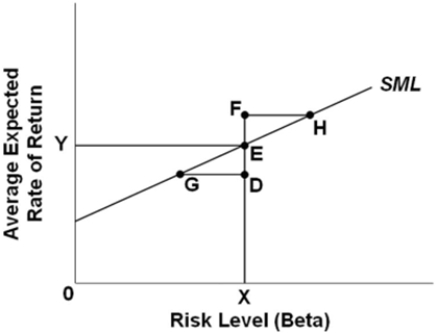 Refer to the graph.If a financial asset's average expected rate of return and beta put it at point F,
 (Multiple Choice)
5.0/5 (72)
(72) The risk-free interest rate is the rate on long-term U.S.government bonds.
(True/False)
4.9/5 (80)
(80) What concept describes how quickly an investment increases in value when interest is paid not only on the original amount invested, but also on the accumulated interest payments?
(Multiple Choice)
4.8/5 (95)
(95) Rick recently purchased a convenience store for $500,000.He expects monthly profits to be $10,000 in the next year.If a recession had struck, Rick had instead paid $300,000, and his monthly profits were reduced to $6,000, his expected rate of return would have
(Multiple Choice)
4.9/5 (79)
(79) If investors started to prefer investing in more ethical companies, then it would be expected that the stock prices for those companies would
(Multiple Choice)
4.8/5 (66)
(66) Burt bought a house for $250,000 and plans to rent it out for $2,000 per month.His expected annual rate of return from renting the house is approximately
(Multiple Choice)
5.0/5 (82)
(82) When shares of stock are sold for more than the price at which they were purchased, the difference received by the seller is referred to as
(Multiple Choice)
4.8/5 (69)
(69) Kelly buys a share of stock for $20 that she sells a year later for $15.Kelly's rate of return is
(Multiple Choice)
4.9/5 (88)
(88) Rates of return on short-term U.S.government bonds are compensation for
(Multiple Choice)
4.8/5 (85)
(85) $800 invested at an annually compounded interest rate of 6 percent will be worth how much at the end of 10 years?
(Multiple Choice)
4.8/5 (95)
(95) Suppose that Betty takes out a loan for $300 at an annually compounded interest rate of 6 percent to be repaid after five years.How much will be required to pay off the loan at the end of the five years?
(Multiple Choice)
4.8/5 (77)
(77) At the end of 2015, U.S.households and nonprofit organizations held approximately in mutual funds.
(Multiple Choice)
5.0/5 (82)
(82) The estimated value of all financial assets held by U.S.households and nonprofit organizations in 2015 was about
(Multiple Choice)
4.8/5 (68)
(68) 
Filters
- Essay(0)
- Multiple Choice(0)
- Short Answer(0)
- True False(0)
- Matching(0)