



 Chat with AI
Exam 3: B: Demand, Supply, and Market Equilibrium

Exam 1: B: Limits, Alternatives, and Choices265 Questions
Exam 1: A: - Limits, Alternatives, and Choices60 Questions
Exam 2: B: The Market System and the Circular Flow119 Questions
Exam 2: A: - The Market System and the Circular Flow42 Questions
Exam 3: B: Demand, Supply, and Market Equilibrium291 Questions
Exam 3: A: - Demand, Supply, and Market Equilibrium51 Questions
Exam 4: B: Market Failures: Public Goods and Externalities133 Questions
Exam 4: A: - Market Failures: Public Goods and Externalities36 Questions
Exam 5: B: Governments Role and Government Failure121 Questions
Exam 5: A: Governments Role and Government Failure1 Questions
Exam 6: B: an Introduction to Macroeconomics65 Questions
Exam 6: A: an Introduction to Macroeconomics31 Questions
Exam 7: B: Measuring the Economys Output191 Questions
Exam 7: A: Measuring the Economys Output30 Questions
Exam 8: B: Economic Growth122 Questions
Exam 8: A: Economic Growth35 Questions
Exam 9: B: Business Cycles, Unemployment, and Inflation193 Questions
Exam 9: A: Business Cycles, Unemployment, and Inflation40 Questions
Exam 10: B: Basic Macroeconomic Relationships200 Questions
Exam 10: A: Basic Macroeconomic Relationships26 Questions
Exam 11: B: The Aggregate Expenditures Model238 Questions
Exam 11: A: The Aggregate Expenditures Model47 Questions
Exam 12: B: Aggregate Demand and Aggregate Supply203 Questions
Exam 12: A: Aggregate Demand and Aggregate Supply35 Questions
Exam 13: B: Fiscal Policy, Deficits, Surpluses, and Debt234 Questions
Exam 13: A: Fiscal Policy, Deficits, Surpluses, and Debt53 Questions
Exam 14: B: Money, Banking, and Money Creation206 Questions
Exam 14: A: Money, Banking, and Money Creation56 Questions
Exam 15: B: Interest Rates and Monetary Policy239 Questions
Exam 15: A: Interest Rates and Monetary Policy47 Questions
Exam 17: C: Financial Economics323 Questions
Exam 16: A: Long-Run Macroeconomic Adjustments28 Questions
Exam 16: B: Long-Run Macroeconomic Adjustments122 Questions
Exam 17: A: International Trade40 Questions
Exam 17: B: International Trade188 Questions
Exam 18: A: The Balance of Payments and Exchange Rates30 Questions
Exam 18: B: The Balance of Payments and Exchange Rates133 Questions
Exam 22: The Economics of Developing Countries254 Questions
Select questions type


The minimum wage imposes a legal floor under the wage of the least skilled worker.

Free
(True/False)
4.8/5  (80)
(80) Correct Answer: Verified
True
For some commodities, purchases tend to decrease as the buyer's income increases.Such commodities are known as:
Free
(Multiple Choice)
4.8/5 (81)
(81) Correct Answer:Verified
VerifiedB
The income and substitution effects account for:
Free
(Multiple Choice)
4.8/5 (83)
(83) Correct Answer:Verified
VerifiedB
The following graph represents a competitive market for a product.where the government now has introduced a price floor of 0C.Which area in the graph represents the producers' revenue after the imposition of the price floor? 
(Multiple Choice)
4.9/5 (83)
(83) A television station reports that the price of orange juice has declined but the quantity sold has increased.This situation would be caused by a(n):
(Multiple Choice)
4.8/5 (75)
(75) Assume the demand curve for product X shifts to the right.This might be caused by:
(Multiple Choice)
4.9/5 (86)
(86) All of the following are held to be constant when the supply curve for a product is drawn, except the:
(Multiple Choice)
4.8/5 (93)
(93) During the 1970s the price of oil rose dramatically, which in turn caused the price of coal to increase.This can best be explained by saying that oil and coal are:
(Multiple Choice)
4.8/5 (79)
(79) What combination of changes in supply and demand would most likely increase the equilibrium price?
(Multiple Choice)
4.8/5 (73)
(73) Assuming an economy has fixed quantities of resources, that economy:
(Multiple Choice)
4.9/5 (67)
(67) A headline reads "Soccer is the new popular sport among youth." In a competitive market, this situation would lead to a(n):
(Multiple Choice)
4.7/5 (74)
(74) If product Y is an inferior good, an increase in consumer incomes will:
(Multiple Choice)
4.8/5 (82)
(82) 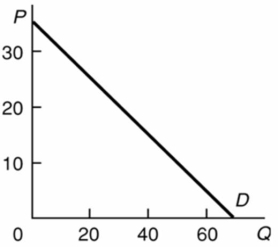 The equation for the supply curve in the above diagram:
Because of their scarcity, the efficient use of resources is:
(Multiple Choice)
4.8/5 (80)
(80) In moving along a stable supply curve which of the following is not held constant?
(Multiple Choice)
4.9/5 (77)
(77) Assuming competitive markets with typical supply and demand curves, which of the following statements is correct?
(Multiple Choice)
4.9/5 (73)
(73) 
Filters
- Essay(0)
- Multiple Choice(0)
- Short Answer(0)
- True False(0)
- Matching(0)