



 Chat with AI
Exam 7: B: Measuring the Economys Output

Exam 1: B: Limits, Alternatives, and Choices265 Questions
Exam 1: A: - Limits, Alternatives, and Choices60 Questions
Exam 2: B: The Market System and the Circular Flow119 Questions
Exam 2: A: - The Market System and the Circular Flow42 Questions
Exam 3: B: Demand, Supply, and Market Equilibrium291 Questions
Exam 3: A: - Demand, Supply, and Market Equilibrium51 Questions
Exam 4: B: Market Failures: Public Goods and Externalities133 Questions
Exam 4: A: - Market Failures: Public Goods and Externalities36 Questions
Exam 5: B: Governments Role and Government Failure121 Questions
Exam 5: A: Governments Role and Government Failure1 Questions
Exam 6: B: an Introduction to Macroeconomics65 Questions
Exam 6: A: an Introduction to Macroeconomics31 Questions
Exam 7: B: Measuring the Economys Output191 Questions
Exam 7: A: Measuring the Economys Output30 Questions
Exam 8: B: Economic Growth122 Questions
Exam 8: A: Economic Growth35 Questions
Exam 9: B: Business Cycles, Unemployment, and Inflation193 Questions
Exam 9: A: Business Cycles, Unemployment, and Inflation40 Questions
Exam 10: B: Basic Macroeconomic Relationships200 Questions
Exam 10: A: Basic Macroeconomic Relationships26 Questions
Exam 11: B: The Aggregate Expenditures Model238 Questions
Exam 11: A: The Aggregate Expenditures Model47 Questions
Exam 12: B: Aggregate Demand and Aggregate Supply203 Questions
Exam 12: A: Aggregate Demand and Aggregate Supply35 Questions
Exam 13: B: Fiscal Policy, Deficits, Surpluses, and Debt234 Questions
Exam 13: A: Fiscal Policy, Deficits, Surpluses, and Debt53 Questions
Exam 14: B: Money, Banking, and Money Creation206 Questions
Exam 14: A: Money, Banking, and Money Creation56 Questions
Exam 15: B: Interest Rates and Monetary Policy239 Questions
Exam 15: A: Interest Rates and Monetary Policy47 Questions
Exam 17: C: Financial Economics323 Questions
Exam 16: A: Long-Run Macroeconomic Adjustments28 Questions
Exam 16: B: Long-Run Macroeconomic Adjustments122 Questions
Exam 17: A: International Trade40 Questions
Exam 17: B: International Trade188 Questions
Exam 18: A: The Balance of Payments and Exchange Rates30 Questions
Exam 18: B: The Balance of Payments and Exchange Rates133 Questions
Exam 22: The Economics of Developing Countries254 Questions
Select questions type


GDP in an economy is $4,600 billion.Consumer expenditures are $3,500 billion, government purchases are $900 billion, and gross investment is $400 billion.Net exports are:

Free
(Multiple Choice)
4.9/5  (93)
(93) Correct Answer: Verified
D
The before-tax income received by resource suppliers is measured by disposable income.
Free
(True/False)
4.8/5 (66)
(66) Correct Answer:Verified
VerifiedFalse
Setup Corporation buys $100,000 of sand, rock, and cement to produce ready-mix concrete.It sells 10,000 cubic yards of concrete at $30 a cubic yard.The value added by Setup Corporation is:
Free
(Multiple Choice)
4.8/5 (82)
(82) Correct Answer:Verified
VerifiedA
Suppose a nation's nominal GDP was $972 billion in 2017 and the general price index was 90 in 2017.To make the value of GDP in 2017 comparable with the value of GDP in the base year, the value of GDP in 2017 must be:
(Multiple Choice)
5.0/5 (84)
(84) By summing the values added at each stage in the production of some good we obtain:
(Multiple Choice)
4.9/5 (79)
(79) An example of a final good in national income accounts would be new:
(Multiple Choice)
4.8/5 (96)
(96) Consider the following data for a hypothetical economy: 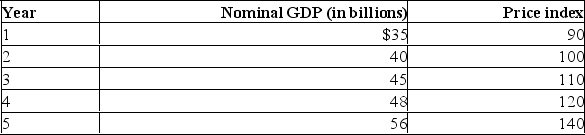 The economy's real GDP has declined between years:
 (Multiple Choice)
4.7/5 (80)
(80) A nation's gross domestic product (GDP) by the expenditure approach:
(Multiple Choice)
4.8/5 (67)
(67) The Chain-weighted index links each year to the previous year through:
(Multiple Choice)
4.8/5 (78)
(78) Assume an economy which is producing only one product.Output and price data for a three-year period are as follows.  Refer to the above data.If year 2 is chosen for the base year, in year 3 nominal GDP and real GDP, respectively, are:
 (Multiple Choice)
4.9/5 (84)
(84) Answer the question(s) based on the following data, using year 1 as the base year.All dollars are in billions.  Refer to the above data.From year 1 to year 4, prices rose by:
 (Multiple Choice)
4.8/5 (81)
(81) Refer to the data below and using year 1 as the base year, the real GDP in year 4 was approximately: 
(Multiple Choice)
4.8/5 (83)
(83) If real GDP in a particular year is $80 billion and nominal GDP is $240 billion, the GDP price index for that year is:
(Multiple Choice)
4.9/5 (75)
(75) Exports are subtracted from imports in calculating Canadian GDP because exports are not available for domestic consumption.
(True/False)
4.8/5 (91)
(91) Refer to the information below.The gross domestic product is: All figures are in billions of dollars. 
(Multiple Choice)
4.9/5 (70)
(70) 
Filters
- Essay(0)
- Multiple Choice(0)
- Short Answer(0)
- True False(0)
- Matching(0)