



 Chat with AI
Exam 14: A: Money, Banking, and Money Creation

Exam 1: B: Limits, Alternatives, and Choices265 Questions
Exam 1: A: - Limits, Alternatives, and Choices60 Questions
Exam 2: B: The Market System and the Circular Flow119 Questions
Exam 2: A: - The Market System and the Circular Flow42 Questions
Exam 3: B: Demand, Supply, and Market Equilibrium291 Questions
Exam 3: A: - Demand, Supply, and Market Equilibrium51 Questions
Exam 4: B: Market Failures: Public Goods and Externalities133 Questions
Exam 4: A: - Market Failures: Public Goods and Externalities36 Questions
Exam 5: B: Governments Role and Government Failure121 Questions
Exam 5: A: Governments Role and Government Failure1 Questions
Exam 6: B: an Introduction to Macroeconomics65 Questions
Exam 6: A: an Introduction to Macroeconomics31 Questions
Exam 7: B: Measuring the Economys Output191 Questions
Exam 7: A: Measuring the Economys Output30 Questions
Exam 8: B: Economic Growth122 Questions
Exam 8: A: Economic Growth35 Questions
Exam 9: B: Business Cycles, Unemployment, and Inflation193 Questions
Exam 9: A: Business Cycles, Unemployment, and Inflation40 Questions
Exam 10: B: Basic Macroeconomic Relationships200 Questions
Exam 10: A: Basic Macroeconomic Relationships26 Questions
Exam 11: B: The Aggregate Expenditures Model238 Questions
Exam 11: A: The Aggregate Expenditures Model47 Questions
Exam 12: B: Aggregate Demand and Aggregate Supply203 Questions
Exam 12: A: Aggregate Demand and Aggregate Supply35 Questions
Exam 13: B: Fiscal Policy, Deficits, Surpluses, and Debt234 Questions
Exam 13: A: Fiscal Policy, Deficits, Surpluses, and Debt53 Questions
Exam 14: B: Money, Banking, and Money Creation206 Questions
Exam 14: A: Money, Banking, and Money Creation56 Questions
Exam 15: B: Interest Rates and Monetary Policy239 Questions
Exam 15: A: Interest Rates and Monetary Policy47 Questions
Exam 17: C: Financial Economics323 Questions
Exam 16: A: Long-Run Macroeconomic Adjustments28 Questions
Exam 16: B: Long-Run Macroeconomic Adjustments122 Questions
Exam 17: A: International Trade40 Questions
Exam 17: B: International Trade188 Questions
Exam 18: A: The Balance of Payments and Exchange Rates30 Questions
Exam 18: B: The Balance of Payments and Exchange Rates133 Questions
Exam 22: The Economics of Developing Countries254 Questions
Select questions type


What is the problem with printing money to pay down national debt?

Free
(Essay)
4.8/5  (75)
(75) Correct Answer: Verified
As more and more money is added to the system, money loses its value and inflation is the result.
Define the desired reserve ratio.
Free
(Essay)
4.7/5 (72)
(72) Correct Answer:Verified
VerifiedThe desired reserve ratio is the specified percentage of deposit liabilities a chartered bank chooses to keep as vault cash.
Determine the purchasing power of $1 at each of the price levels indicated in the table and enter in the spaces provided. 
Free
(Essay)
4.8/5 (83)
(83) Correct Answer:Verified
Verified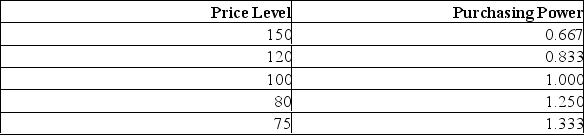
What happens to the money supply when a bank accepts deposits of currency from the public and places it in demand deposits?
(Essay)
4.8/5 (72)
(72) Use the figures in the table below to answer the following questions.  (a) What is the value of M1?
(b) What is the value of M2?
(c) What is the value of M2+?
(d) What is the value of M2++?
(a) What is the value of M1?
(b) What is the value of M2?
(c) What is the value of M2+?
(d) What is the value of M2++? (Essay)
4.8/5 (83)
(83) Suppose the First National Bank has the following simplified balance sheet.The reserve ratio is 20% and all dollar figures are in thousands.  Assume that households and businesses deposit $5 in this bank and that this currency is added to the bank's reserves.(a) In column (1) show the bank's balance sheet after this occurs.Is there a change in the money supply?
(b) In column (2) show what would happen if the bank now loans all of its excess reserves to a depositor.Is there a change in the money supply?
Assume that households and businesses deposit $5 in this bank and that this currency is added to the bank's reserves.(a) In column (1) show the bank's balance sheet after this occurs.Is there a change in the money supply?
(b) In column (2) show what would happen if the bank now loans all of its excess reserves to a depositor.Is there a change in the money supply? (Essay)
4.9/5 (78)
(78) How does the problem of Moral Hazard relate to financial investments?
(Essay)
4.8/5 (86)
(86) The following is the consolidated balance sheet for the chartered banking system.Assume the desired reserve ratio is 10%.Show the new consolidated balance sheet after maximum loan expansion has occurred. 
(Essay)
4.8/5 (89)
(89) In Douglas Adams' The Restaurant at the End of the Universe, the Golgafrinchans' management consultant decided to use leaves (from trees) as legal tender (i.e., as money).What is the problem with this plan?
(Essay)
4.8/5 (76)
(76) Suppose the Second National Bank has the following simplified balance sheet.The reserve ratio is 25% and all dollar figures are in thousands.  Assume that households and businesses deposit $10 in this bank and that this currency is added to the bank's reserves.(a) In column (1) show the bank's balance sheet after this occurs.Is there a change in the money supply?
(b) In column (2) show what would happen if the bank now loans all of its excess reserves to a depositor.Is there a change in the money supply?
Assume that households and businesses deposit $10 in this bank and that this currency is added to the bank's reserves.(a) In column (1) show the bank's balance sheet after this occurs.Is there a change in the money supply?
(b) In column (2) show what would happen if the bank now loans all of its excess reserves to a depositor.Is there a change in the money supply? (Essay)
4.8/5 (82)
(82) What are the two significant characteristics of the fractional reserve banking system?
(Essay)
4.9/5 (77)
(77) Answer the next questions based on the following balance sheet for a chartered bank.Assume the desired reserve ratio is 33%.  (a) What is the amount of excess reserves?
(b) By what amount can this bank safely expand its loans?
(c) By expanding its loans by the amount in part (b), what would its demand deposits equal (if all loans were made to customers holding demand deposits)?
(d) If cheques clear against the bank equal to the amount loaned in (b), how much would remain in reserves and in demand deposits?
(a) What is the amount of excess reserves?
(b) By what amount can this bank safely expand its loans?
(c) By expanding its loans by the amount in part (b), what would its demand deposits equal (if all loans were made to customers holding demand deposits)?
(d) If cheques clear against the bank equal to the amount loaned in (b), how much would remain in reserves and in demand deposits? (Essay)
5.0/5 (73)
(73) What is Securitization and what are its supposed benefits as per government regulators?
(Essay)
4.9/5 (77)
(77) What are the two conflicting goals of bankers? How do these conflicting goals get resolved in the overnight loans market?
(Essay)
4.8/5 (78)
(78) Answer the next question based on the following consolidated balance sheet for the chartered banking system.Assume the desired reserve ratio is 30%.All figures are in millions of dollars.  (a) What is the amount of excess reserves in this chartered banking system?
(b) What is the maximum amount that the money supply can be expanded?
(c) If the reserve ratio fell to 25 percent, what is now the maximum amount that the money supply can be expanded?
(a) What is the amount of excess reserves in this chartered banking system?
(b) What is the maximum amount that the money supply can be expanded?
(c) If the reserve ratio fell to 25 percent, what is now the maximum amount that the money supply can be expanded? (Essay)
4.8/5 (84)
(84) 
Filters
- Essay(0)
- Multiple Choice(0)
- Short Answer(0)
- True False(0)
- Matching(0)