



 Chat with AI
Exam 4: A: - Market Failures: Public Goods and Externalities


What are quasi-public goods and why does the government provide them?

 (74)
 Verified
Quasi-public goods are goods provided by the government that fit the economist's definition of a public good but can be produced in such a way that exclusion would be possible.Such quasi-public goods include education, streets and highways, police and fire protection, libraries and museums, preventive medicine, and sewage disposal.They could all be priced and provided by private firms through the market system.But because they all have substantial positive externalities, they would be underproduced by the market system.Therefore, government often provides them to avoid the underallocation of resources that would otherwise occur.
Assume the atmosphere of an urban area is able to reabsorb 8,000 tonnes of pollutants per year.The schedule below shows the price polluters would be willing to pay for the right to dispose of 1 tonne of pollutants per year and the total quantity of pollutants they would wish to dispose of at each price. 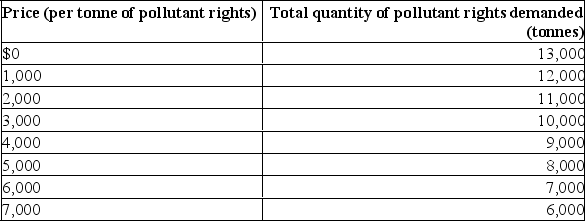 (a) If there were no emission fee, how many tonnes of pollutants would there be and how much greater would this amount be than the capacity for re-absorption?
(b) What pollution fee should the urban authorities charge to solve the problem?
(c) What would happen in this market for pollution rights if quantity demanded increased by 1,000 tonnes at each price?
(a) If there were no emission fee, how many tonnes of pollutants would there be and how much greater would this amount be than the capacity for re-absorption?
(b) What pollution fee should the urban authorities charge to solve the problem?
(c) What would happen in this market for pollution rights if quantity demanded increased by 1,000 tonnes at each price? (81) Verified(a) If there were no emission fee, polluters would put 13,000 tonnes of pollutants in the air each year.This quantity of pollutants would exceed the ability of nature to reabsorb them by 5,000 tonnes.
(b) To reduce pollution to the capacity of the atmosphere to recycle pollutants, an emission fee of $5,000 per tonne should be set and total emission fees would be $40 million [8,000 * $5,000].
(c) If the quantity of pollution rights demanded at each price were to increase by 1,000 tonnes, the emission fee could be increased by $1,000 to $6,000 and total emission fees collected would be $48 million [8,000 * $6,000].
How is consumer surplus derived from a demand curve?
(80) VerifiedConsumer surplus is the area under the demand curve and above the market price.
What resource problem is created by negative externalities and what methods are suggested for dealing with this problem?
(78) Evaluate.Economy in government requires that government minimize its spending.
(75) What resource problem is created by positive externalities and what methods are suggested for dealing with this problem?
(69) The next three questions refer to the below supply and demand graph for a public good. 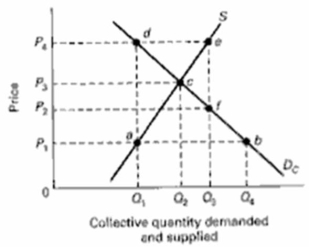 (a) What does point c represent?
(b) What does the line segment ef at output Q3 represent?
(c) At what output level is there an underallocation of resources to the production of this public good?
(a) What does point c represent?
(b) What does the line segment ef at output Q3 represent?
(c) At what output level is there an underallocation of resources to the production of this public good? (91) How does the market demand curve for a public good differ from the market demand curve for a private good?
(80) Draw a market demand curve and indicate the following:
(a) The market price;
(b) The quantity demanded;
(c) The maximum amount that buyers are willing to pay for the quantity demanded;
(d) The actual amount that buyers must pay for the quantity demanded;
(e) The consumer surplus from obtaining the quantity demanded.
(84) What are negative and positive externalities? How do they affect supply and demand curves?
(85) Imagine that a provincial government is considering the construction of a new office building to consolidate its operations.Its estimate of the total costs and the total benefits of building a 4- 6-, 8-, or 10-story building is shown in the table below.(All figures are in millions of dollars.)
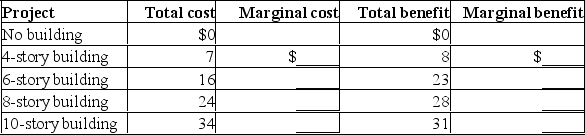 (a) Compute the marginal cost and the marginal benefit of the 4-, 6-, 8-, and 10-story buildings.(b) Should the state build a new office building? If so, what size building and what will be the total benefit, total cost, and net benefit to society?
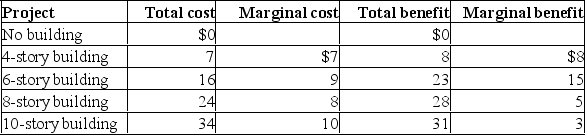
(a) Compute the marginal cost and the marginal benefit of the 4-, 6-, 8-, and 10-story buildings.(b) Should the state build a new office building? If so, what size building and what will be the total benefit, total cost, and net benefit to society?
(71) Draw a market supply curve and indicate the following:
(a) The market price;
(b) The quantity supplied;
(c) The minimum amount that sellers are willing to accept for the quantity supplied;
(d) The actual amount that sellers receive for providing the quantity supplied;
(e) The producer surplus from providing the quantity supplied. 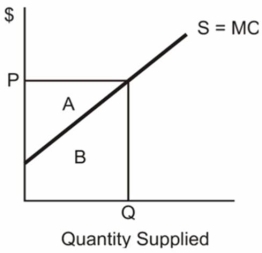
(91) Evaluate: "Pollution is undesirable.Therefore, all pollution should be banned."
(82) Explain the difference between a public and private good.Describe the rationale behind supply and demand analysis for public goods.
(85) Demand in a market is represented by the equation, P = 30 - .5QD.Suppose the market price is $18.(a) How many units do buyers wish to purchase in this market?
(b) What is the maximum amount that the buyers are willing to pay for this quantity of output?
(c) What is the actual amount that buyers have to pay for this quantity of output?
(d) What is the consumer surplus that buyers obtain from purchasing this quantity of output?
(97) How could you use the Coase theorem to predict what would happen when smoke from a factory created dirty air and slightly acid rain for all the residents in the area in a one-kilometre radius of the plant?
(88) Demand in a market is represented by the equation, P = 50 - QD.Suppose the market price is $30.(a) How many units do buyers wish to purchase in this market?
(b) What is the maximum amount that the buyers are willing to pay for this quantity of output?
(c) What is the actual amount that buyers have to pay for this quantity of output?
(d) What is the consumer surplus that buyers obtain from purchasing this quantity of output?
(85) What is the economic rationale for liability rules and lawsuits? What are the limitations with this approach?
(97) 
Filters
- Essay(0)
- Multiple Choice(0)
- Short Answer(0)
- True False(0)
- Matching(0)