



 Chat with AI
Exam 4: B: Market Failures: Public Goods and Externalities

Exam 1: B: Limits, Alternatives, and Choices265 Questions
Exam 1: A: - Limits, Alternatives, and Choices60 Questions
Exam 2: B: The Market System and the Circular Flow119 Questions
Exam 2: A: - The Market System and the Circular Flow42 Questions
Exam 3: B: Demand, Supply, and Market Equilibrium291 Questions
Exam 3: A: - Demand, Supply, and Market Equilibrium51 Questions
Exam 4: B: Market Failures: Public Goods and Externalities133 Questions
Exam 4: A: - Market Failures: Public Goods and Externalities36 Questions
Exam 5: B: Governments Role and Government Failure121 Questions
Exam 5: A: Governments Role and Government Failure1 Questions
Exam 6: B: an Introduction to Macroeconomics65 Questions
Exam 6: A: an Introduction to Macroeconomics31 Questions
Exam 7: B: Measuring the Economys Output191 Questions
Exam 7: A: Measuring the Economys Output30 Questions
Exam 8: B: Economic Growth122 Questions
Exam 8: A: Economic Growth35 Questions
Exam 9: B: Business Cycles, Unemployment, and Inflation193 Questions
Exam 9: A: Business Cycles, Unemployment, and Inflation40 Questions
Exam 10: B: Basic Macroeconomic Relationships200 Questions
Exam 10: A: Basic Macroeconomic Relationships26 Questions
Exam 11: B: The Aggregate Expenditures Model238 Questions
Exam 11: A: The Aggregate Expenditures Model47 Questions
Exam 12: B: Aggregate Demand and Aggregate Supply203 Questions
Exam 12: A: Aggregate Demand and Aggregate Supply35 Questions
Exam 13: B: Fiscal Policy, Deficits, Surpluses, and Debt234 Questions
Exam 13: A: Fiscal Policy, Deficits, Surpluses, and Debt53 Questions
Exam 14: B: Money, Banking, and Money Creation206 Questions
Exam 14: A: Money, Banking, and Money Creation56 Questions
Exam 15: B: Interest Rates and Monetary Policy239 Questions
Exam 15: A: Interest Rates and Monetary Policy47 Questions
Exam 17: C: Financial Economics323 Questions
Exam 16: A: Long-Run Macroeconomic Adjustments28 Questions
Exam 16: B: Long-Run Macroeconomic Adjustments122 Questions
Exam 17: A: International Trade40 Questions
Exam 17: B: International Trade188 Questions
Exam 18: A: The Balance of Payments and Exchange Rates30 Questions
Exam 18: B: The Balance of Payments and Exchange Rates133 Questions
Exam 22: The Economics of Developing Countries254 Questions
Select questions type


The external costs of severe air pollution are usually paid:

Free
(Multiple Choice)
4.8/5  (63)
(63) Correct Answer: Verified
C
Refer to the below diagram of the market for product X.Curve St embodies all costs (including spillovers) and Dt embodies all benefits (including spillovers) associated with the production and consumption of X.Assuming the equilibrium output is Q2, we can conclude that the existence of spillover: 
Free
(Multiple Choice)
4.8/5 (82)
(82) Correct Answer:Verified
VerifiedA
When producing a good generates external or negative externalities, the private market for that good tends to produce too:
Free
(Multiple Choice)
4.9/5 (92)
(92) Correct Answer:Verified
VerifiedA
The optimal quantity of a public good occurs where the marginal benefit of the citizen who has the highest preference for the good just equals the good's marginal cost.
(True/False)
4.8/5 (67)
(67) Suppose that a large tree on Shawn's property is blocking Sam's view of the lake below.Shawn accepts Sam's offer to pay Shawn $100 for the right to cut down the tree.This situation describes:
(Multiple Choice)
4.8/5 (75)
(75) 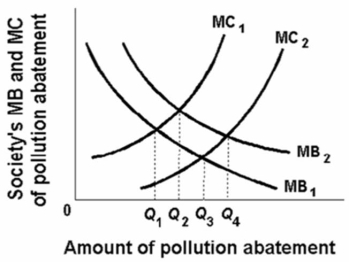
Which one of the following might shift the marginal cost curve from MC1 to MC2? 
(Multiple Choice)
4.8/5 (76)
(76) Answer the next question on the basis of the following information is for public good.Pa and Pb represent the prices that citizens (a) and (b), the only two people in this nation, are willing to pay for additional units of a quantity (Qc) of the public good.Qs represents the quantity of the public good supplied by government at each of the collective prices.In equilibrium, the marginal benefit and cost of the public good will be: 
(Multiple Choice)
4.8/5 (71)
(71) Answer the question based on the following information.Way-Below Normal University has found it necessary to institute a crime-control program on its campus to deal with the high costs of theft and vandalism.The university is now considering several alternative levels of crime control.This table shows the expected annual costs and benefits of these alternatives.The marginal costs of additional levels of crime control are: 
(Multiple Choice)
4.9/5 (79)
(79) The difference between the price consumers are willing to pay and the actual price they do pay is referred to as:
(Multiple Choice)
4.9/5 (73)
(73) There is a positive relationship between equilibrium price and the amount of producer surplus.
(True/False)
4.8/5 (75)
(75) The following information is for four highway programs of increasing scope.All figures are in millions of dollars.The data indicate that: 
(Multiple Choice)
4.7/5 (77)
(77) There is little incentive for an individual firm to voluntarily internalize its negative externalities because to do so would:
(Multiple Choice)
4.9/5 (60)
(60) Market for asparagus.At the market price of $2, area A + B represents: 
(Multiple Choice)
4.9/5 (72)
(72) Refer to the below competitive market diagram for product Z.Assume that the current market demand and supply curves for Z are D2 and S2.If there are substantial negative externalities associated with the production of Z, it can be argued that: 
(Multiple Choice)
4.7/5 (82)
(82) When the full cost of producing a good or service is not reflected in the resultant curve this is referred to as what type of failure?
(Multiple Choice)
4.7/5 (79)
(79) 
Filters
- Essay(0)
- Multiple Choice(0)
- Short Answer(0)
- True False(0)
- Matching(0)