



 Chat with AI
Exam 17: B: International Trade

Exam 1: B: Limits, Alternatives, and Choices265 Questions
Exam 1: A: - Limits, Alternatives, and Choices60 Questions
Exam 2: B: The Market System and the Circular Flow119 Questions
Exam 2: A: - The Market System and the Circular Flow42 Questions
Exam 3: B: Demand, Supply, and Market Equilibrium291 Questions
Exam 3: A: - Demand, Supply, and Market Equilibrium51 Questions
Exam 4: B: Market Failures: Public Goods and Externalities133 Questions
Exam 4: A: - Market Failures: Public Goods and Externalities36 Questions
Exam 5: B: Governments Role and Government Failure121 Questions
Exam 5: A: Governments Role and Government Failure1 Questions
Exam 6: B: an Introduction to Macroeconomics65 Questions
Exam 6: A: an Introduction to Macroeconomics31 Questions
Exam 7: B: Measuring the Economys Output191 Questions
Exam 7: A: Measuring the Economys Output30 Questions
Exam 8: B: Economic Growth122 Questions
Exam 8: A: Economic Growth35 Questions
Exam 9: B: Business Cycles, Unemployment, and Inflation193 Questions
Exam 9: A: Business Cycles, Unemployment, and Inflation40 Questions
Exam 10: B: Basic Macroeconomic Relationships200 Questions
Exam 10: A: Basic Macroeconomic Relationships26 Questions
Exam 11: B: The Aggregate Expenditures Model238 Questions
Exam 11: A: The Aggregate Expenditures Model47 Questions
Exam 12: B: Aggregate Demand and Aggregate Supply203 Questions
Exam 12: A: Aggregate Demand and Aggregate Supply35 Questions
Exam 13: B: Fiscal Policy, Deficits, Surpluses, and Debt234 Questions
Exam 13: A: Fiscal Policy, Deficits, Surpluses, and Debt53 Questions
Exam 14: B: Money, Banking, and Money Creation206 Questions
Exam 14: A: Money, Banking, and Money Creation56 Questions
Exam 15: B: Interest Rates and Monetary Policy239 Questions
Exam 15: A: Interest Rates and Monetary Policy47 Questions
Exam 17: C: Financial Economics323 Questions
Exam 16: A: Long-Run Macroeconomic Adjustments28 Questions
Exam 16: B: Long-Run Macroeconomic Adjustments122 Questions
Exam 17: A: International Trade40 Questions
Exam 17: B: International Trade188 Questions
Exam 18: A: The Balance of Payments and Exchange Rates30 Questions
Exam 18: B: The Balance of Payments and Exchange Rates133 Questions
Exam 22: The Economics of Developing Countries254 Questions
Select questions type


Differences in production efficiencies among nations in producing a particular good result from:

Free
(Multiple Choice)
4.8/5  (75)
(75) Correct Answer: Verified
D
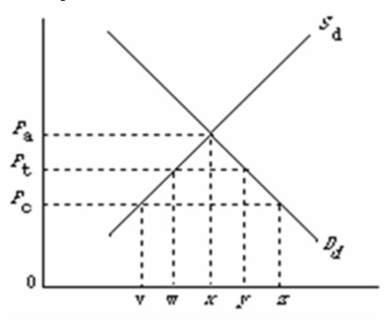 Refer to the above diagram, where Sd and Dd are the domestic supply and demand for a product and Pc is the world price of that product.With free trade, that is, assuming no tariff, the outputs produced by domestic and foreign producers respectively would be:
Free
(Multiple Choice)
4.7/5 (67)
(67) Correct Answer:Verified
VerifiedA
The data embodied in the below diagrams suggest that: 
Free
(Multiple Choice)
4.9/5 (75)
(75) Correct Answer:Verified
VerifiedA
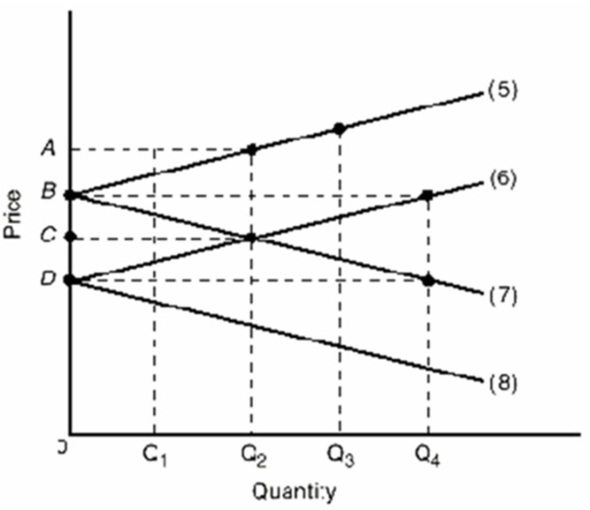 Refer to the above graph which shows the import demand and export supply curves for two nations that produce a product.The export supply curves for the two nations are represented by lines:
 (Multiple Choice)
4.9/5 (81)
(81) Export supply curves are _____________ import demand curves are __________.
(Multiple Choice)
4.9/5 (81)
(81) Which of the following was the most important good traded by Canada in 2016?largest, using Table 17.1 for principal exports/imports of good in 2016?
(Multiple Choice)
4.7/5 (90)
(90) The following data is for the hypothetical nations of Alpha and Beta.Qs is domestic quantity supplied and Qd is domestic quantity demanded. 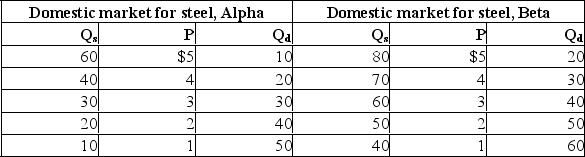 Refer to the above data.At the equilibrium world price:
 (Multiple Choice)
4.8/5 (75)
(75) Assume that by devoting all its resources to the production of X, nation Alpha can produce 40 units of X.By devoting all its resources to Y, Alpha can produce 60Y.Comparable figures for nation Beta are, 60X and 40Y.Refer to the above information.If Alpha had produced 20X and 30Y and Beta had produced 30X and 20Y before specialization and trade, then we can say that the gains from specialization and trade are 10X and 10Y.
(True/False)
4.9/5 (71)
(71) The following data is for the hypothetical nations of Alpha and Beta.Qs is domestic quantity supplied and Qd is domestic quantity demanded. 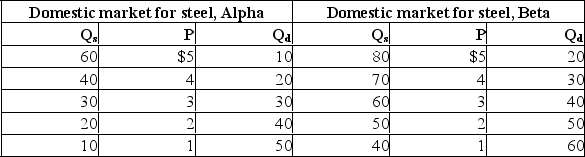 Refer to the above data.The equilibrium world price must be higher than $1 because at $1:
 (Multiple Choice)
4.8/5 (79)
(79) The terms of trade will favour a larger nation over a smaller nation.
(True/False)
4.8/5 (98)
(98) Free trade based on comparative advantage is economically beneficial because:
(Multiple Choice)
4.7/5 (77)
(77) Import quotas produce the same amount of revenue for government as protective tariffs.
(True/False)
4.7/5 (94)
(94) Which is responsible for the major decrease in trade barriers since World War II?
(Multiple Choice)
4.9/5 (80)
(80) An excise tax that is applied to imported products which are not produced domestically is a(n):
(Multiple Choice)
4.8/5 (84)
(84) The basic difference in the economic effects of a tariff compared with a quota is that a:
(Multiple Choice)
4.8/5 (76)
(76) Which one of the following would best describe a protective tariff?
(Multiple Choice)
4.9/5 (76)
(76) A major difficulty with the argument that trade barriers are necessary because foreign workers are paid low wages is that:
(Multiple Choice)
4.8/5 (76)
(76) 
Filters
- Essay(0)
- Multiple Choice(0)
- Short Answer(0)
- True False(0)
- Matching(0)