



 Chat with AI
Exam 17: B: International Trade

Exam 1: B: Limits, Alternatives, and Choices265 Questions
Exam 1: A: - Limits, Alternatives, and Choices60 Questions
Exam 2: B: The Market System and the Circular Flow119 Questions
Exam 2: A: - The Market System and the Circular Flow42 Questions
Exam 3: B: Demand, Supply, and Market Equilibrium291 Questions
Exam 3: A: - Demand, Supply, and Market Equilibrium51 Questions
Exam 4: B: Market Failures: Public Goods and Externalities133 Questions
Exam 4: A: - Market Failures: Public Goods and Externalities36 Questions
Exam 5: B: Governments Role and Government Failure121 Questions
Exam 5: A: Governments Role and Government Failure1 Questions
Exam 6: B: an Introduction to Macroeconomics65 Questions
Exam 6: A: an Introduction to Macroeconomics31 Questions
Exam 7: B: Measuring the Economys Output191 Questions
Exam 7: A: Measuring the Economys Output30 Questions
Exam 8: B: Economic Growth122 Questions
Exam 8: A: Economic Growth35 Questions
Exam 9: B: Business Cycles, Unemployment, and Inflation193 Questions
Exam 9: A: Business Cycles, Unemployment, and Inflation40 Questions
Exam 10: B: Basic Macroeconomic Relationships200 Questions
Exam 10: A: Basic Macroeconomic Relationships26 Questions
Exam 11: B: The Aggregate Expenditures Model238 Questions
Exam 11: A: The Aggregate Expenditures Model47 Questions
Exam 12: B: Aggregate Demand and Aggregate Supply203 Questions
Exam 12: A: Aggregate Demand and Aggregate Supply35 Questions
Exam 13: B: Fiscal Policy, Deficits, Surpluses, and Debt234 Questions
Exam 13: A: Fiscal Policy, Deficits, Surpluses, and Debt53 Questions
Exam 14: B: Money, Banking, and Money Creation206 Questions
Exam 14: A: Money, Banking, and Money Creation56 Questions
Exam 15: B: Interest Rates and Monetary Policy239 Questions
Exam 15: A: Interest Rates and Monetary Policy47 Questions
Exam 17: C: Financial Economics323 Questions
Exam 16: A: Long-Run Macroeconomic Adjustments28 Questions
Exam 16: B: Long-Run Macroeconomic Adjustments122 Questions
Exam 17: A: International Trade40 Questions
Exam 17: B: International Trade188 Questions
Exam 18: A: The Balance of Payments and Exchange Rates30 Questions
Exam 18: B: The Balance of Payments and Exchange Rates133 Questions
Exam 22: The Economics of Developing Countries254 Questions
Select questions type


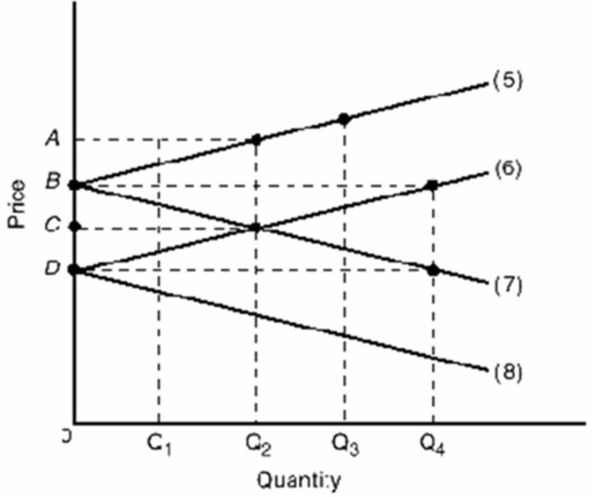 Refer to the above graph which shows the import demand and export supply curves for two nations that produce a product.The import demand curves for the two nations are represented by lines:
 (Multiple Choice)
4.7/5  (95)
(95) Country A limits other nation's exports to Country A to 1,000 tons of coal annually.This is an example of a(n):
(Multiple Choice)
4.8/5 (74)
(74) The statement that "tariffs are needed to protect Canadian firms from foreign producers which sell excess goods in the Canadian market at less than cost" would be most closely associated with which tariff argument?
(Multiple Choice)
4.9/5 (86)
(86) The law of increasing opportunity costs limits international specialization.
(True/False)
4.8/5 (77)
(77) Comparative advantage can result from different climates, natural resource endowments, and capital stocks in various countries.
(True/False)
4.8/5 (90)
(90) Refer to the diagram below in which, line AB is the Canadian production possibility curve and AC is its trading possibilities curve.We can conclude that Canada:
(Multiple Choice)
5.0/5 (76)
(76) Americans will neither export nor import aluminum when its:
(Multiple Choice)
4.8/5 (76)
(76) The proponents of the cheap foreign labour argument mistakenly:
(Multiple Choice)
4.8/5 (78)
(78) 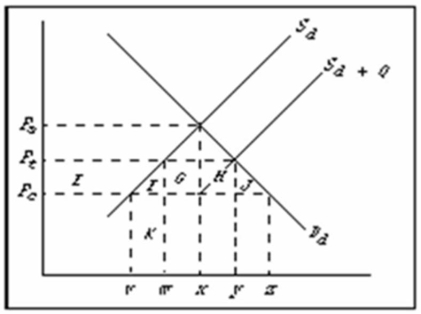 Refer to the above diagram, where Sd and Dd are the domestic supply and demand for a product and Pc is the world price of that product.Sd + Q is the product supply curve after an import quota is imposed.The effect of the import quota on domestic price and domestic consumption is:
 (Multiple Choice)
4.7/5 (63)
(63) 
Which is not commonly offered as a reason to support protectionism and abandon free trade?
(Multiple Choice)
4.9/5 (68)
(68) Refer to the diagram below, where Sd and Dd are the domestic supply and demand for a product and Pc is the world price of that product.Sd + Q is the product supply curve after an import quota is imposed.A quota of wy will: 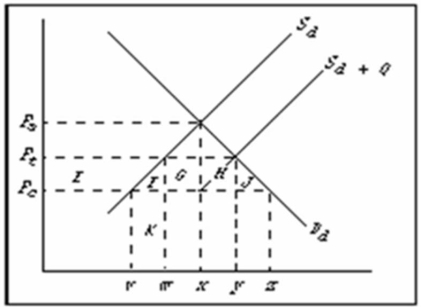
(Multiple Choice)
4.8/5 (75)
(75) Which of the following is an example of a land-intensive commodity?
(Multiple Choice)
5.0/5 (83)
(83) Assume that by devoting all its resources to the production of X, nation Alpha can produce 40 units of X.By devoting all its resources to Y, Alpha can produce 60Y.Comparable figures for nation Beta are, 60X and 40Y.Refer to the above information.Beta would prefer terms of trade at, or close to, 1X = 1 1/2 Y.
(True/False)
4.9/5 (85)
(85) About how many nations belong to the World Trade Organization?
(Multiple Choice)
5.0/5 (87)
(87) 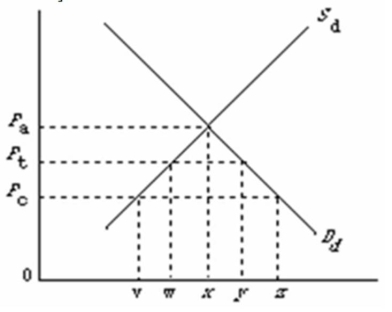 Refer to the above diagram, where Sd and Dd are the domestic supply and demand for a product and Pc is the world price of that product.With a per unit tariff of PcPt, the total amount of tariff revenue collected on this product will be:
 (Multiple Choice)
4.9/5 (74)
(74) 
Filters
- Essay(0)
- Multiple Choice(0)
- Short Answer(0)
- True False(0)
- Matching(0)