



 Chat with AI
Exam 17: B: International Trade

Exam 1: B: Limits, Alternatives, and Choices265 Questions
Exam 1: A: - Limits, Alternatives, and Choices60 Questions
Exam 2: B: The Market System and the Circular Flow119 Questions
Exam 2: A: - The Market System and the Circular Flow42 Questions
Exam 3: B: Demand, Supply, and Market Equilibrium291 Questions
Exam 3: A: - Demand, Supply, and Market Equilibrium51 Questions
Exam 4: B: Market Failures: Public Goods and Externalities133 Questions
Exam 4: A: - Market Failures: Public Goods and Externalities36 Questions
Exam 5: B: Governments Role and Government Failure121 Questions
Exam 5: A: Governments Role and Government Failure1 Questions
Exam 6: B: an Introduction to Macroeconomics65 Questions
Exam 6: A: an Introduction to Macroeconomics31 Questions
Exam 7: B: Measuring the Economys Output191 Questions
Exam 7: A: Measuring the Economys Output30 Questions
Exam 8: B: Economic Growth122 Questions
Exam 8: A: Economic Growth35 Questions
Exam 9: B: Business Cycles, Unemployment, and Inflation193 Questions
Exam 9: A: Business Cycles, Unemployment, and Inflation40 Questions
Exam 10: B: Basic Macroeconomic Relationships200 Questions
Exam 10: A: Basic Macroeconomic Relationships26 Questions
Exam 11: B: The Aggregate Expenditures Model238 Questions
Exam 11: A: The Aggregate Expenditures Model47 Questions
Exam 12: B: Aggregate Demand and Aggregate Supply203 Questions
Exam 12: A: Aggregate Demand and Aggregate Supply35 Questions
Exam 13: B: Fiscal Policy, Deficits, Surpluses, and Debt234 Questions
Exam 13: A: Fiscal Policy, Deficits, Surpluses, and Debt53 Questions
Exam 14: B: Money, Banking, and Money Creation206 Questions
Exam 14: A: Money, Banking, and Money Creation56 Questions
Exam 15: B: Interest Rates and Monetary Policy239 Questions
Exam 15: A: Interest Rates and Monetary Policy47 Questions
Exam 17: C: Financial Economics323 Questions
Exam 16: A: Long-Run Macroeconomic Adjustments28 Questions
Exam 16: B: Long-Run Macroeconomic Adjustments122 Questions
Exam 17: A: International Trade40 Questions
Exam 17: B: International Trade188 Questions
Exam 18: A: The Balance of Payments and Exchange Rates30 Questions
Exam 18: B: The Balance of Payments and Exchange Rates133 Questions
Exam 22: The Economics of Developing Countries254 Questions
Select questions type


Barriers to free trade impair efficiency in the international allocation of resources.
(True/False)
4.7/5  (70)
(70) The impact of increasing, as opposed to constant costs is to:
(Multiple Choice)
4.9/5 (89)
(89) Tariffs and import quotas meant to increase domestic employment also eliminate domestic jobs in export industries.
(True/False)
4.9/5 (78)
(78) A high tariff on imported good X might reduce domestic employment in industry Y if:
(Multiple Choice)
4.8/5 (87)
(87) In the real world, specialization is rarely complete because:
(Multiple Choice)
4.9/5 (74)
(74) Consider two countries which trade with each other.The degree of specialization according to their respective comparative advantages will be greater if the countries face:
(Multiple Choice)
4.8/5 (85)
(85) 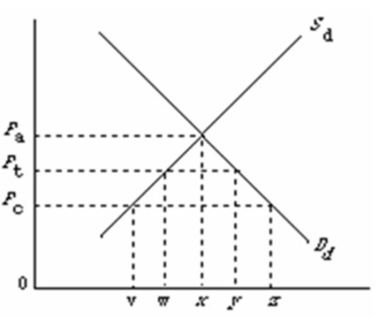 Refer to the above diagram, where Sd and Dd are the domestic supply and demand for a product and Pc is the world price of that product.With a per unit tariff in the amount PcPt, price and total quantity sold will be:
 (Multiple Choice)
4.9/5 (79)
(79) As of 2011, 16 out of 27 members of the EU use the Euro as a common currency.The 3 countries that have opted out of the common currency are:
(Multiple Choice)
4.9/5 (75)
(75) Assume that by devoting all its resources to the production of X, nation Alpha can produce 40 units of X.By devoting all its resources to Y, Alpha can produce 60Y.Comparable figures for nation Beta are, 60X and 40Y.Refer to the above information.The terms of trade will be at or within the 1X = 1 1/2 Y to 1X = 2/3 Y range.
(True/False)
4.8/5 (64)
(64) Which of the following is an example of a capital-intensive commodity?
(Multiple Choice)
4.8/5 (80)
(80) 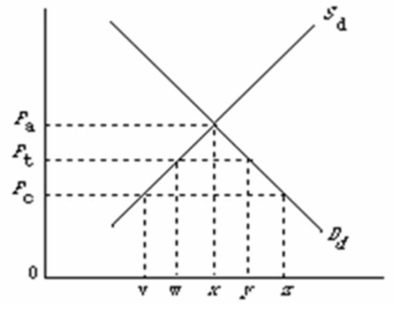 Refer to the above diagram, where Sd and Dd are the domestic supply and demand for a product and Pc is the world price of that product.With a PcPt per unit tariff, per unit revenue received by domestic and foreign producers respectively will be:
 (Multiple Choice)
4.8/5 (74)
(74) 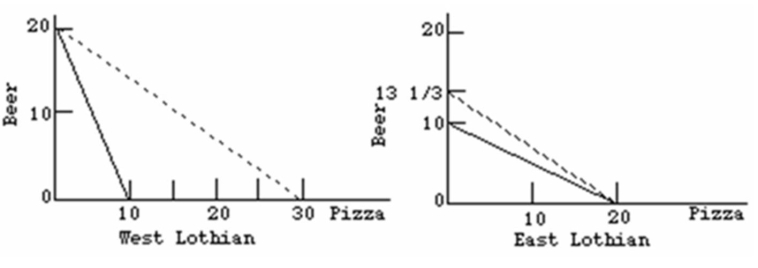 Refer to the above diagrams.The solid lines are production possibilities curves; the dashed lines are trading possibilities curves.The data suggest that:
 (Multiple Choice)
4.9/5 (86)
(86) The following data is for the hypothetical nations of Alpha and Beta.Qs is domestic quantity supplied and Qd is domestic quantity demanded. 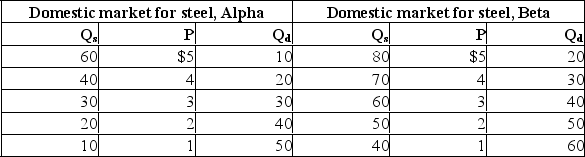 Refer to the above data.At a world price of $2:
 (Multiple Choice)
4.9/5 (84)
(84) When the distribution of resources and technology changes among nations:
(Multiple Choice)
4.8/5 (83)
(83) Since World War II, several factors have contributed to the rapid growth of international trade.These factors are:
(Multiple Choice)
4.8/5 (92)
(92) 
Filters
- Essay(0)
- Multiple Choice(0)
- Short Answer(0)
- True False(0)
- Matching(0)