



 Chat with AI
Exam 17: B: International Trade

Exam 1: B: Limits, Alternatives, and Choices265 Questions
Exam 1: A: - Limits, Alternatives, and Choices60 Questions
Exam 2: B: The Market System and the Circular Flow119 Questions
Exam 2: A: - The Market System and the Circular Flow42 Questions
Exam 3: B: Demand, Supply, and Market Equilibrium291 Questions
Exam 3: A: - Demand, Supply, and Market Equilibrium51 Questions
Exam 4: B: Market Failures: Public Goods and Externalities133 Questions
Exam 4: A: - Market Failures: Public Goods and Externalities36 Questions
Exam 5: B: Governments Role and Government Failure121 Questions
Exam 5: A: Governments Role and Government Failure1 Questions
Exam 6: B: an Introduction to Macroeconomics65 Questions
Exam 6: A: an Introduction to Macroeconomics31 Questions
Exam 7: B: Measuring the Economys Output191 Questions
Exam 7: A: Measuring the Economys Output30 Questions
Exam 8: B: Economic Growth122 Questions
Exam 8: A: Economic Growth35 Questions
Exam 9: B: Business Cycles, Unemployment, and Inflation193 Questions
Exam 9: A: Business Cycles, Unemployment, and Inflation40 Questions
Exam 10: B: Basic Macroeconomic Relationships200 Questions
Exam 10: A: Basic Macroeconomic Relationships26 Questions
Exam 11: B: The Aggregate Expenditures Model238 Questions
Exam 11: A: The Aggregate Expenditures Model47 Questions
Exam 12: B: Aggregate Demand and Aggregate Supply203 Questions
Exam 12: A: Aggregate Demand and Aggregate Supply35 Questions
Exam 13: B: Fiscal Policy, Deficits, Surpluses, and Debt234 Questions
Exam 13: A: Fiscal Policy, Deficits, Surpluses, and Debt53 Questions
Exam 14: B: Money, Banking, and Money Creation206 Questions
Exam 14: A: Money, Banking, and Money Creation56 Questions
Exam 15: B: Interest Rates and Monetary Policy239 Questions
Exam 15: A: Interest Rates and Monetary Policy47 Questions
Exam 17: C: Financial Economics323 Questions
Exam 16: A: Long-Run Macroeconomic Adjustments28 Questions
Exam 16: B: Long-Run Macroeconomic Adjustments122 Questions
Exam 17: A: International Trade40 Questions
Exam 17: B: International Trade188 Questions
Exam 18: A: The Balance of Payments and Exchange Rates30 Questions
Exam 18: B: The Balance of Payments and Exchange Rates133 Questions
Exam 22: The Economics of Developing Countries254 Questions
Select questions type


In a two-nation world, comparative advantage means that one nation can produce:
(Multiple Choice)
4.7/5  (72)
(72) Production possibilities data for two countries, Alpha and Beta, which have populations of equal size. 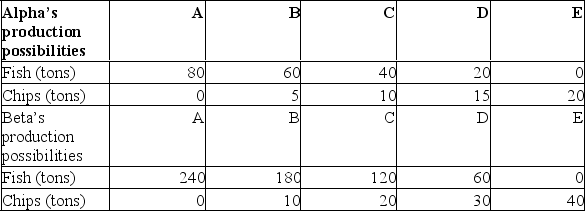 Refer to the above data.Assume the production possibilities in Beta double at alternatives A through E while remaining as shown in the table for Alpha.As a result Beta should:
 (Multiple Choice)
4.9/5 (72)
(72) The following data is for the hypothetical nations of Alpha and Beta.Qs is domestic quantity supplied and Qd is domestic quantity demanded. 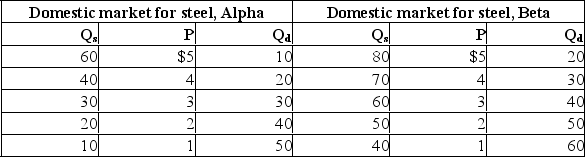 Refer to the above data.The equilibrium prices of steel in Alpha and Beta are:
 (Multiple Choice)
4.8/5 (82)
(82) In the theory of comparative advantage, a good should be produced in that nation where:
(Multiple Choice)
4.9/5 (76)
(76) The interaction of world supply and world demand determines:
(Multiple Choice)
4.8/5 (68)
(68) Under GATT, tariffs on thousands of products were eliminated or reduced, with overall tariffs dropping by:
(Multiple Choice)
4.8/5 (74)
(74) The following table is domestic supply and demand schedules for a product.Suppose that the world price of the product is $1. 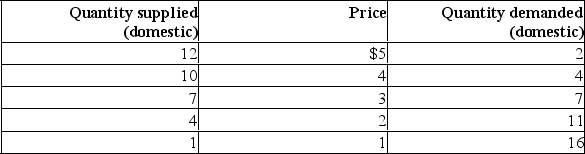 Refer to the above data.With free trade, that is, assuming no tariff, the outputs produced by domestic and foreign producers respectively would be:
 (Multiple Choice)
4.9/5 (86)
(86) Assuming labour forces of equal size, the production possibilities curves below suggest that West Mudsville has: 
(Multiple Choice)
4.9/5 (69)
(69) 
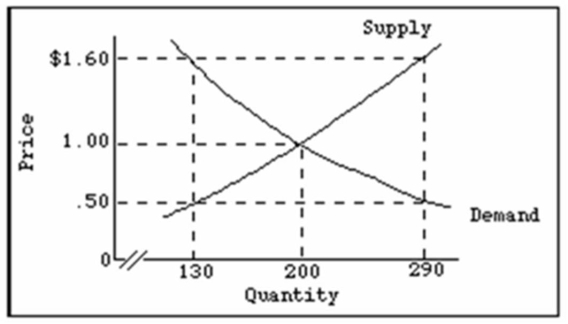 Refer to the above diagram showing the domestic demand and supply curves for a specific standardized product in a particular nation.If the world price for this product is $.50, this nation will experience a domestic:
 (Multiple Choice)
4.8/5 (79)
(79) Which country did Canada sign a free-trade agreement with in 2008?
(Multiple Choice)
5.0/5 (72)
(72) Refer to the diagrams below.Which of the following is a feasible rate at which X and Y might be exchanged? 
(Multiple Choice)
4.9/5 (80)
(80) 
Filters
- Essay(0)
- Multiple Choice(0)
- Short Answer(0)
- True False(0)
- Matching(0)