



 Chat with AI
Exam 15: A: Interest Rates and Monetary Policy


Following are the consolidated balance sheets of the chartered banks.Assume that the desired reserve ratio for banks is 10%.The figures in column 1 show the balance sheets' condition prior to each of the following five transactions.Place the new balance-sheet figures in the appropriate columns and complete A, B, C, D, and E for each column.Start each part (2-4) with the figures in column 1.All figures are in billions of dollars. 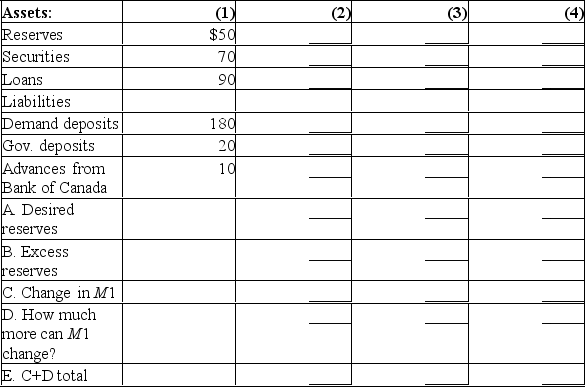

 (86)
 Verified
(a) Show in column 2 the initial results of the Bank of Canada selling $3 billion in securities to the public, which pays by cheques.
(b) Show in column 3 the initial results of the Bank of Canada buying $4 billion in securities from the chartered banks.
(c) Show in column 4 the initial results when the Bank of Canada raises the bank rate, which causes chartered banks to repay $6 billion in advances from the Bank of Canada. 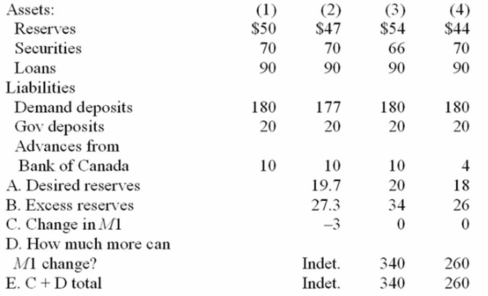
Use the table below to answer the questions.  (a) If the transactions demand for money equals 10% of nominal GDP, nominal GDP is $600 billion, and the money supply is $360 billion, what is the equilibrium interest rate?
(b) If nominal GDP remains constant, and the money supply is increased from $360 to $460 billion, what will the equilibrium rate of interest be?
(a) If the transactions demand for money equals 10% of nominal GDP, nominal GDP is $600 billion, and the money supply is $360 billion, what is the equilibrium interest rate?
(b) If nominal GDP remains constant, and the money supply is increased from $360 to $460 billion, what will the equilibrium rate of interest be? (94) Verified(a) Transactions demand will be $60 billion.Therefore, the asset demand must be $300 billion when total demand equals the money supply of $360 billion.When asset demand is $300 billion, the equilibrium interest rate is 13%.
(b) The equilibrium interest rate will be 12% (where money supply is equal to total demand).
Suppose the economy is experiencing inflation.Describe the transmission mechanism through which monetary policy could address this problem?
(66) VerifiedA tight monetary policy is needed.The Bank of Canada can sell bonds or increase the bank rate.As a consequence of these actions, banks have less reserves than desired and must restrict loans.The smaller money supply that results causes interest rates to rise, investment spending to decrease and aggregate demand to decrease.The end result is a fall in real GDP by a multiple of the decrease in investment.If prices are downward-inflexible, the Bank of Canada must be careful not to decrease the money supply too much otherwise the decline in investment demand - due to higher real interest rates - will result in a recessionary gap.
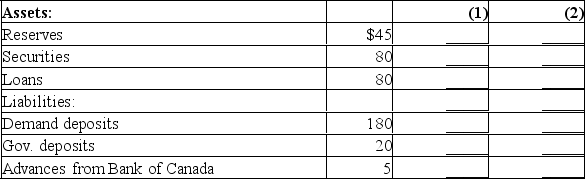
The following are simplified balance sheets for the chartered banking system and the Bank of Canada.Perform the two following transactions, (1) and (2), making appropriate changes in columns (1) and (2) in each balance sheet.Do not cumulate your answers.Also, answer these three questions for each part: (a) What change, if any, took place in the money supply as a direct result of this transaction? (b) What change, if any, occurred in chartered bank reserves? (c) What change occurred in the money-creating potential of the chartered banking system if the reserve ratio is 20%? All figures are in billions of dollars.Consolidated Balance Sheet: Chartered Banking System
 Consolidated Balance Sheet: Bank of Canada
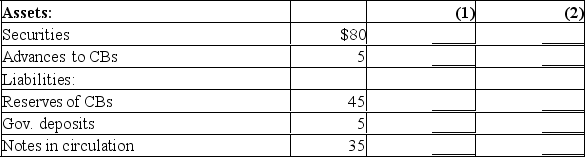 (1) Suppose a drop in the bank rate causes chartered banks to borrow an additional $2 billion from the Bank of Canada.Show the new sheet figures in column 1.(2) The Bank of Canada buys $3 billion of government bonds from the public.Show the new balance sheet figures in column 2.
Consolidated Balance Sheet: Bank of Canada
(1) Suppose a drop in the bank rate causes chartered banks to borrow an additional $2 billion from the Bank of Canada.Show the new sheet figures in column 1.(2) The Bank of Canada buys $3 billion of government bonds from the public.Show the new balance sheet figures in column 2. (78) How does an increase in the price level affect the equilibrium rate of interest?
(87) Describe the links between monetary policy and the international economy due to the net export effect, and its impact on the trade deficit.
(72) Use the table below to answer the questions:
 (a) If the transactions demand for money equals 10% of nominal GDP, nominal GDP is $800 billion, and the money supply is $480 billion, what is the equilibrium interest rate?
(b) If nominal GDP remains constant, and the money supply is decreased from $480 to $380 billion, what will the equilibrium rate of interest be?
(a) If the transactions demand for money equals 10% of nominal GDP, nominal GDP is $800 billion, and the money supply is $480 billion, what is the equilibrium interest rate?
(b) If nominal GDP remains constant, and the money supply is decreased from $480 to $380 billion, what will the equilibrium rate of interest be? (79) The following are simplified balance sheets for the chartered banking system and the Bank of Canada.Perform the two following transactions, (1) and (2), making appropriate changes in columns (1) and (2) in each balance sheet.Do not cumulate your answers.Also, answer these three questions for each part: (a) What change, if any, took place in the money supply as a direct result of this transaction? (b) What change, if any, occurred in chartered bank reserves? (c) What change occurred in the money-creating potential of the chartered banking system if the reserve ratio is 20%? All figures are in billions of dollars.Consolidated Balance Sheet: Chartered Banking System
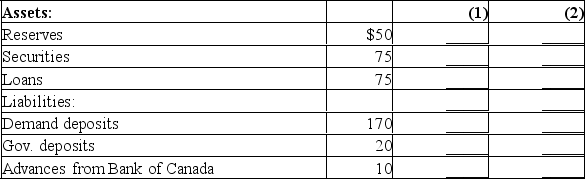 Consolidated Balance Sheet: Bank of Canada
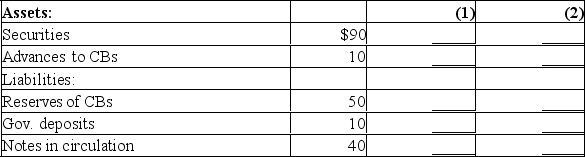 (1) Suppose a drop in the bank rate causes chartered banks to borrow an additional$3 billion from the Bank of Canada.Show the new sheet figures in column 1.(2) The Bank of Canada buys $2 billion of government bonds from the public.Show the new sheet figures in column 2.
Consolidated Balance Sheet: Bank of Canada
(1) Suppose a drop in the bank rate causes chartered banks to borrow an additional$3 billion from the Bank of Canada.Show the new sheet figures in column 1.(2) The Bank of Canada buys $2 billion of government bonds from the public.Show the new sheet figures in column 2. (82) How do the lags associated with monetary policy differ from those associated with fiscal policy?
(76) What are the two reasons that people want to hold money? In other words, what are the two types of demand for money?
(77) The total demand for money is equal to the transactions demand plus the asset demand for money.(a) Assume that each dollar held for transactions purposes is spent on the average five times per year to buy final goods and services.If nominal GDP is $800 billion, what is the transactions demand?
(b) The table below shows the asset demand at certain rates of interest.Using your answer to part (a), complete the table to show the total demand for money at various rates of interest.  (c) If the money supply is $240 billion, what will be the equilibrium rate of interest?
(d) If the money supply rises, will the equilibrium rate of interest rise or fall?
(e) If GDP rises, will the equilibrium rate of interest rise or fall?
(c) If the money supply is $240 billion, what will be the equilibrium rate of interest?
(d) If the money supply rises, will the equilibrium rate of interest rise or fall?
(e) If GDP rises, will the equilibrium rate of interest rise or fall? (85) What are the five functions of the Bank of Canada? Which one is most important?
(95) When does the use of monetary policy create conflicts between the goals of macroeconomic stability and balance of international trade?
(82) What are the political and economic limitations upon (a) fiscal policy and (b) monetary policy?
(74) Explain how nominal GDP and the real interest rate are related to the transactions and asset demands for money.
(82) Differentiate between expansionary and restrictive monetary policies.
(86) 
Filters
- Essay(0)
- Multiple Choice(0)
- Short Answer(0)
- True False(0)
- Matching(0)