



 Chat with AI
Exam 15: B: Interest Rates and Monetary Policy

Exam 1: B: Limits, Alternatives, and Choices265 Questions
Exam 1: A: - Limits, Alternatives, and Choices60 Questions
Exam 2: B: The Market System and the Circular Flow119 Questions
Exam 2: A: - The Market System and the Circular Flow42 Questions
Exam 3: B: Demand, Supply, and Market Equilibrium291 Questions
Exam 3: A: - Demand, Supply, and Market Equilibrium51 Questions
Exam 4: B: Market Failures: Public Goods and Externalities133 Questions
Exam 4: A: - Market Failures: Public Goods and Externalities36 Questions
Exam 5: B: Governments Role and Government Failure121 Questions
Exam 5: A: Governments Role and Government Failure1 Questions
Exam 6: B: an Introduction to Macroeconomics65 Questions
Exam 6: A: an Introduction to Macroeconomics31 Questions
Exam 7: B: Measuring the Economys Output191 Questions
Exam 7: A: Measuring the Economys Output30 Questions
Exam 8: B: Economic Growth122 Questions
Exam 8: A: Economic Growth35 Questions
Exam 9: B: Business Cycles, Unemployment, and Inflation193 Questions
Exam 9: A: Business Cycles, Unemployment, and Inflation40 Questions
Exam 10: B: Basic Macroeconomic Relationships200 Questions
Exam 10: A: Basic Macroeconomic Relationships26 Questions
Exam 11: B: The Aggregate Expenditures Model238 Questions
Exam 11: A: The Aggregate Expenditures Model47 Questions
Exam 12: B: Aggregate Demand and Aggregate Supply203 Questions
Exam 12: A: Aggregate Demand and Aggregate Supply35 Questions
Exam 13: B: Fiscal Policy, Deficits, Surpluses, and Debt234 Questions
Exam 13: A: Fiscal Policy, Deficits, Surpluses, and Debt53 Questions
Exam 14: B: Money, Banking, and Money Creation206 Questions
Exam 14: A: Money, Banking, and Money Creation56 Questions
Exam 15: B: Interest Rates and Monetary Policy239 Questions
Exam 15: A: Interest Rates and Monetary Policy47 Questions
Exam 17: C: Financial Economics323 Questions
Exam 16: A: Long-Run Macroeconomic Adjustments28 Questions
Exam 16: B: Long-Run Macroeconomic Adjustments122 Questions
Exam 17: A: International Trade40 Questions
Exam 17: B: International Trade188 Questions
Exam 18: A: The Balance of Payments and Exchange Rates30 Questions
Exam 18: B: The Balance of Payments and Exchange Rates133 Questions
Exam 22: The Economics of Developing Countries254 Questions
Select questions type


The purpose of an expansionary monetary policy is to:

Free
(Multiple Choice)
4.9/5  (76)
(76) Correct Answer: Verified
A
Columns (1) and (2) indicate the transactions demand (Dt) for money and columns (1) and (3) show the asset demand (Da) for money: Refer to the above information.These data suggest that the amount of money that society wishes to hold as an asset:
Free
(Multiple Choice)
4.8/5 (82)
(82) Correct Answer:Verified
VerifiedB
If the chartered banking system borrows from the Bank of Canada.
Free
(Multiple Choice)
4.8/5 (88)
(88) Correct Answer:Verified
VerifiedA
Because of the liquidity trap, the Bank of Canada's creation of billions of dollars in excess reserves during the great recession had little or no effect on lending by the chartered banks.
(True/False)
4.9/5 (75)
(75) Refer to the graphs below.The first graph shows the money market of an economy, and the second graph shows the market for goods and services in the economy. 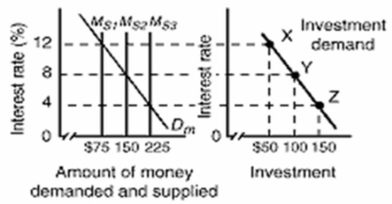
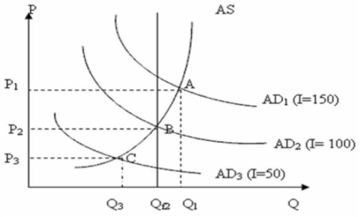 In the above diagrams, the numbers in the parentheses after the AD1, AD2, and AD3 labels indicate the levels of investment spending associated with each AD curve.All figures are in billions.Qf is the full-employment level of real output.The interest rate in the economy is 4 percent.Which of the following should the monetary authorities do to achieve a non-inflationary full-employment level of real GDP?
 (Multiple Choice)
4.9/5 (80)
(80) Suppose the demand for money and the supply of money increase simultaneously.We can:
(Multiple Choice)
4.9/5 (78)
(78) Assume that the Bank of Canada's policy is to keep the price level from either rising or falling.If aggregate supply increases in the economy, the Bank of Canada:
(Multiple Choice)
4.9/5 (92)
(92) If in the market for money the quantity of money demanded exceeds the money supply, we would expect the interest rate to:
(Multiple Choice)
4.9/5 (88)
(88) A consumer holds money to meet spending needs.This would be an example of the:
(Multiple Choice)
4.9/5 (82)
(82) All else equal, when the Bank of Canada engages in an expansionary monetary policy, the interest rate received on government securities tends to:
(Multiple Choice)
4.9/5 (78)
(78) An expansionary monetary policy may be more effective than a restrictive monetary policy because chartered banks may decide to hold a large quantity of excess reserves.
(True/False)
4.8/5 (81)
(81) Under some conditions, proper domestic monetary policy may be at odds with the goal of correcting a trade imbalance because:
(Multiple Choice)
4.8/5 (90)
(90) If the quantity of money demanded exceeds the quantity supplied:
(Multiple Choice)
4.9/5 (93)
(93) The price of a bond having no expiration date is originally $8000 and has a fixed annual interest payment of $800.A fall in the price of the bond by $3,000 will provide a new buyer of the bond an interest rate of:
(Multiple Choice)
4.8/5 (86)
(86) Assume that the desired reserve ratio is 10 percent and there are no excess reserves in the banking system.Also, suppose that the full-employment, non-inflationary level of GDP in this closed, private economy is $1,200. 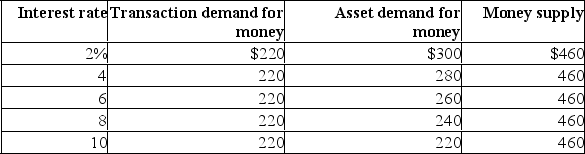 Refer to the above information.The equilibrium interest rate in this economy is:
 (Multiple Choice)
4.9/5 (77)
(77) It is assumed that households and businesses want to hold for transactions purposes an amount of money equal to one-half of the GDP.The table shows the amounts of money that households and businesses want to hold as an asset at various interest rates.  Refer to the information above.If the GDP is $200 and the interest rate is 6, what total amount of money will households and businesses want to hold?
 (Multiple Choice)
4.8/5 (89)
(89) 
Filters
- Essay(0)
- Multiple Choice(0)
- Short Answer(0)
- True False(0)
- Matching(0)