



 Chat with AI
Exam 15: B: Interest Rates and Monetary Policy

Exam 1: B: Limits, Alternatives, and Choices265 Questions
Exam 1: A: - Limits, Alternatives, and Choices60 Questions
Exam 2: B: The Market System and the Circular Flow119 Questions
Exam 2: A: - The Market System and the Circular Flow42 Questions
Exam 3: B: Demand, Supply, and Market Equilibrium291 Questions
Exam 3: A: - Demand, Supply, and Market Equilibrium51 Questions
Exam 4: B: Market Failures: Public Goods and Externalities133 Questions
Exam 4: A: - Market Failures: Public Goods and Externalities36 Questions
Exam 5: B: Governments Role and Government Failure121 Questions
Exam 5: A: Governments Role and Government Failure1 Questions
Exam 6: B: an Introduction to Macroeconomics65 Questions
Exam 6: A: an Introduction to Macroeconomics31 Questions
Exam 7: B: Measuring the Economys Output191 Questions
Exam 7: A: Measuring the Economys Output30 Questions
Exam 8: B: Economic Growth122 Questions
Exam 8: A: Economic Growth35 Questions
Exam 9: B: Business Cycles, Unemployment, and Inflation193 Questions
Exam 9: A: Business Cycles, Unemployment, and Inflation40 Questions
Exam 10: B: Basic Macroeconomic Relationships200 Questions
Exam 10: A: Basic Macroeconomic Relationships26 Questions
Exam 11: B: The Aggregate Expenditures Model238 Questions
Exam 11: A: The Aggregate Expenditures Model47 Questions
Exam 12: B: Aggregate Demand and Aggregate Supply203 Questions
Exam 12: A: Aggregate Demand and Aggregate Supply35 Questions
Exam 13: B: Fiscal Policy, Deficits, Surpluses, and Debt234 Questions
Exam 13: A: Fiscal Policy, Deficits, Surpluses, and Debt53 Questions
Exam 14: B: Money, Banking, and Money Creation206 Questions
Exam 14: A: Money, Banking, and Money Creation56 Questions
Exam 15: B: Interest Rates and Monetary Policy239 Questions
Exam 15: A: Interest Rates and Monetary Policy47 Questions
Exam 17: C: Financial Economics323 Questions
Exam 16: A: Long-Run Macroeconomic Adjustments28 Questions
Exam 16: B: Long-Run Macroeconomic Adjustments122 Questions
Exam 17: A: International Trade40 Questions
Exam 17: B: International Trade188 Questions
Exam 18: A: The Balance of Payments and Exchange Rates30 Questions
Exam 18: B: The Balance of Payments and Exchange Rates133 Questions
Exam 22: The Economics of Developing Countries254 Questions
Select questions type


A restrictive monetary policy invoked to reduce inflation is compatible with the goal of correcting a trade deficit.
(True/False)
4.8/5  (82)
(82) A newspaper headline reads: "Bank of Canada Raises the overnight rate for third time this year." This headline indicates that the Bank of Canada is most likely trying to:
(Multiple Choice)
4.8/5 (79)
(79) A disequilibrium in the market for money is mainly corrected via a change in:
(Multiple Choice)
4.8/5 (77)
(77) If the government pursues an expansionary monetary policy, then it will tend to:
(Multiple Choice)
4.9/5 (87)
(87) In the cause-effect chain, a restrictive monetary policy increases the money supply, decreases the interest rate, increases investment spending, and increases aggregate demand.
(True/False)
4.7/5 (79)
(79) Refer to the diagram below for the market for money.Other things equal, the money demand curve in the diagram would shift leftward if: 
(Multiple Choice)
4.8/5 (85)
(85) The following are simplified consolidated balance sheets for the chartered banking system and the Bank of Canada.Do not cumulate your answers; that is, do return to the data given in the original balance sheets in answering each question.Assume a desired reserve ratio of 5 percent for the chartered banks.All figures are in billions of dollars.CONSOLIDATED BALANCE SHEET: CHARTERED BANKING SYSTEM  BALANCE SHEET: BANK OF CANADA
 Refer to the above information.The chartered banks have excess reserves of:
BALANCE SHEET: BANK OF CANADA
Refer to the above information.The chartered banks have excess reserves of: (Multiple Choice)
4.9/5 (82)
(82) The Bank of Canada often communicates its intentions to tighten or loosen monetary policy by announcing a change in targets for:
(Multiple Choice)
4.8/5 (72)
(72) In recent years, the Bank of Canada has adopted a monetary policy that focuses on:
(Multiple Choice)
4.8/5 (81)
(81) A fundamental policy dilemma facing the monetary authorities is that:
(Multiple Choice)
4.9/5 (78)
(78) Which of the following is the most important function of the Bank of Canada?
(Multiple Choice)
4.7/5 (73)
(73)  Refer to the above table.Suppose the transactions demand for money is $300 billion and the money supply is $700 billion.A decrease in the money supply to $600 billion would cause the interest rate to:
 (Multiple Choice)
4.9/5 (79)
(79) Other things equal, an expansionary monetary policy will shift the economy's aggregate demand curve to the right.
(True/False)
4.7/5 (89)
(89) 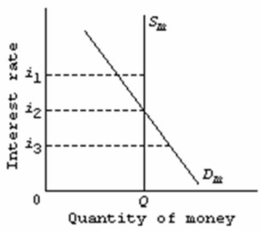 Refer to the above market for money diagram.Given Dm and Sm, an interest rate of i3 is not sustainable because:
 (Multiple Choice)
4.8/5 (74)
(74) 
Filters
- Essay(0)
- Multiple Choice(0)
- Short Answer(0)
- True False(0)
- Matching(0)