



 Chat with AI
Exam 15: B: Interest Rates and Monetary Policy

Exam 1: B: Limits, Alternatives, and Choices265 Questions
Exam 1: A: - Limits, Alternatives, and Choices60 Questions
Exam 2: B: The Market System and the Circular Flow119 Questions
Exam 2: A: - The Market System and the Circular Flow42 Questions
Exam 3: B: Demand, Supply, and Market Equilibrium291 Questions
Exam 3: A: - Demand, Supply, and Market Equilibrium51 Questions
Exam 4: B: Market Failures: Public Goods and Externalities133 Questions
Exam 4: A: - Market Failures: Public Goods and Externalities36 Questions
Exam 5: B: Governments Role and Government Failure121 Questions
Exam 5: A: Governments Role and Government Failure1 Questions
Exam 6: B: an Introduction to Macroeconomics65 Questions
Exam 6: A: an Introduction to Macroeconomics31 Questions
Exam 7: B: Measuring the Economys Output191 Questions
Exam 7: A: Measuring the Economys Output30 Questions
Exam 8: B: Economic Growth122 Questions
Exam 8: A: Economic Growth35 Questions
Exam 9: B: Business Cycles, Unemployment, and Inflation193 Questions
Exam 9: A: Business Cycles, Unemployment, and Inflation40 Questions
Exam 10: B: Basic Macroeconomic Relationships200 Questions
Exam 10: A: Basic Macroeconomic Relationships26 Questions
Exam 11: B: The Aggregate Expenditures Model238 Questions
Exam 11: A: The Aggregate Expenditures Model47 Questions
Exam 12: B: Aggregate Demand and Aggregate Supply203 Questions
Exam 12: A: Aggregate Demand and Aggregate Supply35 Questions
Exam 13: B: Fiscal Policy, Deficits, Surpluses, and Debt234 Questions
Exam 13: A: Fiscal Policy, Deficits, Surpluses, and Debt53 Questions
Exam 14: B: Money, Banking, and Money Creation206 Questions
Exam 14: A: Money, Banking, and Money Creation56 Questions
Exam 15: B: Interest Rates and Monetary Policy239 Questions
Exam 15: A: Interest Rates and Monetary Policy47 Questions
Exam 17: C: Financial Economics323 Questions
Exam 16: A: Long-Run Macroeconomic Adjustments28 Questions
Exam 16: B: Long-Run Macroeconomic Adjustments122 Questions
Exam 17: A: International Trade40 Questions
Exam 17: B: International Trade188 Questions
Exam 18: A: The Balance of Payments and Exchange Rates30 Questions
Exam 18: B: The Balance of Payments and Exchange Rates133 Questions
Exam 22: The Economics of Developing Countries254 Questions
Select questions type


The bank rate is the interest rate at which chartered banks lend to their best corporate customers.
(True/False)
4.9/5  (69)
(69) 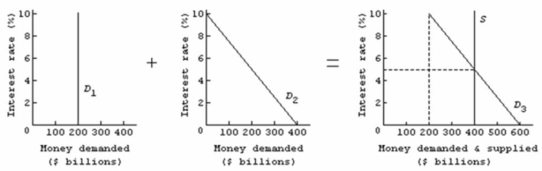 Refer to the above market for money diagram.If the interest rate was at 8 percent, people would:
 (Multiple Choice)
4.9/5 (76)
(76) The purpose of an expansionary monetary policy is to shift the:
(Multiple Choice)
4.9/5 (85)
(85) In terms of the aggregate demand and aggregate supply model, the sale of government bonds by the Bank of Canada to chartered banks will:
(Multiple Choice)
4.8/5 (77)
(77) The strengths of monetary policy compared to fiscal policy are generally thought to include all of the following except greater:
(Multiple Choice)
4.8/5 (79)
(79) A decline in the equilibrium level of GDP is most likely to be caused by:
(Multiple Choice)
4.8/5 (81)
(81) The following information for a bond having no expiration date: bond price = $1,000; bond fixed annual interest payment = $100; bond annual interest rate = 10 percent.Refer to the above information.If the price of this bond increases to $1,250, the interest rate in effect will:
(Multiple Choice)
4.7/5 (90)
(90)  Refer to the above information.All else equal, the transaction demand for money in this table would increase if:
 (Multiple Choice)
4.7/5 (85)
(85) Which of the following best describes the cause-effect chain of a restrictive monetary policy?
(Multiple Choice)
4.8/5 (76)
(76) An expansionary monetary policy is appropriate for the alleviation of domestic:
(Multiple Choice)
5.0/5 (83)
(83) The following are simplified consolidated balance sheets for the chartered banking system and the Bank of Canada.Do not cumulate your answers; that is, do return to the data given in the original balance sheets in answering each question.Assume a desired reserve ratio of 5 percent for the chartered banks.All figures are in billions of dollars.CONSOLIDATED BALANCE SHEET: CHARTERED BANKING SYSTEM  BALANCE SHEET: BANK OF CANADA
 Refer to the above information.Suppose the Bank of Canada buys $2 in securities from the public.As a result of this transaction, the supply of money will:
BALANCE SHEET: BANK OF CANADA
Refer to the above information.Suppose the Bank of Canada buys $2 in securities from the public.As a result of this transaction, the supply of money will: (Multiple Choice)
4.8/5 (70)
(70) Assume that the desired reserve ratio for the chartered banks is 25 percent.If Bank of Canada buys $3 billion in government securities from chartered banks we can say that, as a result of this transaction, the lending ability of the chartered banking system will:
(Multiple Choice)
4.9/5 (81)
(81) In 2018, the Bank of Canada set an annual inflation target range of:
(Multiple Choice)
4.8/5 (78)
(78) If nominal GDP is $2,000 billion and the amount of money demanded for transactions purposes is $500 billion, then on average each dollar will be spent about four times.
(True/False)
4.8/5 (65)
(65) If the Bank of Canada sells government securities to the public, which of the following transactions take place?
(Multiple Choice)
5.0/5 (71)
(71) 
Filters
- Essay(0)
- Multiple Choice(0)
- Short Answer(0)
- True False(0)
- Matching(0)