



 Chat with AI
Exam 15: B: Interest Rates and Monetary Policy

Exam 1: B: Limits, Alternatives, and Choices265 Questions
Exam 1: A: - Limits, Alternatives, and Choices60 Questions
Exam 2: B: The Market System and the Circular Flow119 Questions
Exam 2: A: - The Market System and the Circular Flow42 Questions
Exam 3: B: Demand, Supply, and Market Equilibrium291 Questions
Exam 3: A: - Demand, Supply, and Market Equilibrium51 Questions
Exam 4: B: Market Failures: Public Goods and Externalities133 Questions
Exam 4: A: - Market Failures: Public Goods and Externalities36 Questions
Exam 5: B: Governments Role and Government Failure121 Questions
Exam 5: A: Governments Role and Government Failure1 Questions
Exam 6: B: an Introduction to Macroeconomics65 Questions
Exam 6: A: an Introduction to Macroeconomics31 Questions
Exam 7: B: Measuring the Economys Output191 Questions
Exam 7: A: Measuring the Economys Output30 Questions
Exam 8: B: Economic Growth122 Questions
Exam 8: A: Economic Growth35 Questions
Exam 9: B: Business Cycles, Unemployment, and Inflation193 Questions
Exam 9: A: Business Cycles, Unemployment, and Inflation40 Questions
Exam 10: B: Basic Macroeconomic Relationships200 Questions
Exam 10: A: Basic Macroeconomic Relationships26 Questions
Exam 11: B: The Aggregate Expenditures Model238 Questions
Exam 11: A: The Aggregate Expenditures Model47 Questions
Exam 12: B: Aggregate Demand and Aggregate Supply203 Questions
Exam 12: A: Aggregate Demand and Aggregate Supply35 Questions
Exam 13: B: Fiscal Policy, Deficits, Surpluses, and Debt234 Questions
Exam 13: A: Fiscal Policy, Deficits, Surpluses, and Debt53 Questions
Exam 14: B: Money, Banking, and Money Creation206 Questions
Exam 14: A: Money, Banking, and Money Creation56 Questions
Exam 15: B: Interest Rates and Monetary Policy239 Questions
Exam 15: A: Interest Rates and Monetary Policy47 Questions
Exam 17: C: Financial Economics323 Questions
Exam 16: A: Long-Run Macroeconomic Adjustments28 Questions
Exam 16: B: Long-Run Macroeconomic Adjustments122 Questions
Exam 17: A: International Trade40 Questions
Exam 17: B: International Trade188 Questions
Exam 18: A: The Balance of Payments and Exchange Rates30 Questions
Exam 18: B: The Balance of Payments and Exchange Rates133 Questions
Exam 22: The Economics of Developing Countries254 Questions
Select questions type


Assume that the desired reserve ratio is 10 percent and there are no excess reserves in the banking system.Also, suppose that the full-employment, non-inflationary level of GDP in this closed, private economy is $1,200. 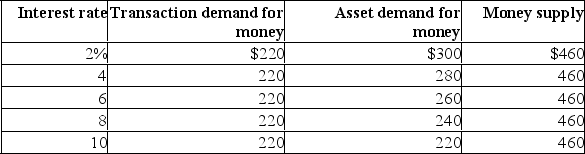 Refer to the above information.An interest rate of 2 percent is not sustainable because:
 (Multiple Choice)
4.8/5  (74)
(74) Which of the following will not happen when the Bank of Canada buys bonds from the public in the open market?
(Multiple Choice)
4.9/5 (77)
(77) All else equal, when the Bank of Canada engages in a restrictive monetary policy, the price of government securities tends to:
(Multiple Choice)
4.8/5 (76)
(76) The major purpose of the Bank of Canada buying and selling government securities in open market operations is to:
(Multiple Choice)
4.8/5 (89)
(89) Assume that a single chartered bank has no excess reserves and that the desired reserve ratio is 20 percent.If this bank sells a bond for $1,000 to the Bank of Canada, it can expand its loans by a maximum of:
(Multiple Choice)
4.9/5 (72)
(72) If in the market for money the money supply exceeds the quantity of money households and businesses want to hold, we would expect the interest rate to:
(Multiple Choice)
4.8/5 (85)
(85) Which of the following is an asset on the balance sheet of the Bank of Canada?
(Multiple Choice)
4.9/5 (83)
(83) It is assumed that households and businesses want to hold for transactions purposes an amount of money equal to one-half of the GDP.The table shows the amounts of money that households and businesses want to hold as an asset at various interest rates.  Refer to the information above.If the GDP is $300 and the supply of money is $230, the equilibrium interest rate will be:
 (Multiple Choice)
4.8/5 (89)
(89) In implementing monetary policy with respect to the Taylor Rule:
(Multiple Choice)
4.8/5 (69)
(69) Which of the following statements best describes the Bank of Canada? It is:
(Multiple Choice)
4.9/5 (91)
(91) The purchase of government securities from the public by the Bank of Canada will cause:
(Multiple Choice)
4.8/5 (86)
(86) The transactions demand for money is most closely related to money functioning as a:
(Multiple Choice)
4.8/5 (75)
(75) Because of the liquidity trap, the Bank of Canada's creation of billions of dollars in excess reserves during the great recession had:
(Multiple Choice)
4.9/5 (75)
(75) Assume the equation for the total demand for money is L = .4Y + 80 - 4i, where L is the amount of money demanded, Y is gross domestic product, and i is the interest rate.If gross domestic product is $200 and the interest rate is 10 (percent), what amount of money will society want to hold?
(Multiple Choice)
4.8/5 (84)
(84) In the Bank of Canada's consolidated balance sheet, the largest asset is:
(Multiple Choice)
4.8/5 (95)
(95) 
Filters
- Essay(0)
- Multiple Choice(0)
- Short Answer(0)
- True False(0)
- Matching(0)