



 Chat with AI
Exam 15: B: Interest Rates and Monetary Policy

Exam 1: B: Limits, Alternatives, and Choices265 Questions
Exam 1: A: - Limits, Alternatives, and Choices60 Questions
Exam 2: B: The Market System and the Circular Flow119 Questions
Exam 2: A: - The Market System and the Circular Flow42 Questions
Exam 3: B: Demand, Supply, and Market Equilibrium291 Questions
Exam 3: A: - Demand, Supply, and Market Equilibrium51 Questions
Exam 4: B: Market Failures: Public Goods and Externalities133 Questions
Exam 4: A: - Market Failures: Public Goods and Externalities36 Questions
Exam 5: B: Governments Role and Government Failure121 Questions
Exam 5: A: Governments Role and Government Failure1 Questions
Exam 6: B: an Introduction to Macroeconomics65 Questions
Exam 6: A: an Introduction to Macroeconomics31 Questions
Exam 7: B: Measuring the Economys Output191 Questions
Exam 7: A: Measuring the Economys Output30 Questions
Exam 8: B: Economic Growth122 Questions
Exam 8: A: Economic Growth35 Questions
Exam 9: B: Business Cycles, Unemployment, and Inflation193 Questions
Exam 9: A: Business Cycles, Unemployment, and Inflation40 Questions
Exam 10: B: Basic Macroeconomic Relationships200 Questions
Exam 10: A: Basic Macroeconomic Relationships26 Questions
Exam 11: B: The Aggregate Expenditures Model238 Questions
Exam 11: A: The Aggregate Expenditures Model47 Questions
Exam 12: B: Aggregate Demand and Aggregate Supply203 Questions
Exam 12: A: Aggregate Demand and Aggregate Supply35 Questions
Exam 13: B: Fiscal Policy, Deficits, Surpluses, and Debt234 Questions
Exam 13: A: Fiscal Policy, Deficits, Surpluses, and Debt53 Questions
Exam 14: B: Money, Banking, and Money Creation206 Questions
Exam 14: A: Money, Banking, and Money Creation56 Questions
Exam 15: B: Interest Rates and Monetary Policy239 Questions
Exam 15: A: Interest Rates and Monetary Policy47 Questions
Exam 17: C: Financial Economics323 Questions
Exam 16: A: Long-Run Macroeconomic Adjustments28 Questions
Exam 16: B: Long-Run Macroeconomic Adjustments122 Questions
Exam 17: A: International Trade40 Questions
Exam 17: B: International Trade188 Questions
Exam 18: A: The Balance of Payments and Exchange Rates30 Questions
Exam 18: B: The Balance of Payments and Exchange Rates133 Questions
Exam 22: The Economics of Developing Countries254 Questions
Select questions type


The equilibrium rate of interest in the market for money is determined by:
(Multiple Choice)
4.7/5  (80)
(80) The impact of monetary policy upon investment spending may be weakened:
(Multiple Choice)
4.8/5 (89)
(89) 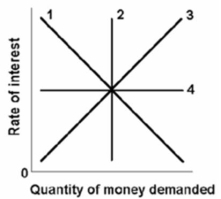 Which line in the above graph would best reflect the slope of the asset demand for money curve?
 (Multiple Choice)
4.8/5 (79)
(79) The asset demand for money is most closely related to money functioning as a:
(Multiple Choice)
4.9/5 (92)
(92) Refer to the market for money diagram below.The downward slope of the money demand curve Dm can best be explained in terms of the: 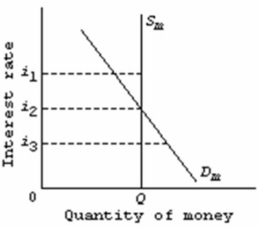
(Multiple Choice)
4.7/5 (77)
(77) When the Bank of Canada wants to see an increase in the interest rates, it:
(Multiple Choice)
4.8/5 (82)
(82) The asset demand for money varies directly with the interest rate.
(True/False)
4.7/5 (83)
(83) Assume the desired reserve ratio is 25 percent and the Winnipeg Bank borrows $10,000 from the Bank of Canada.As a result:
(Multiple Choice)
4.9/5 (85)
(85) There is an asset demand for money because households and business firms use money as a store of value.
(True/False)
4.9/5 (87)
(87) Other things being equal, monetary policy will be more effective the flatter the investment-demand curve.
(True/False)
4.9/5 (89)
(89) The Special Purchase and Resale Agreement (SPRA), is a transaction in which:
(Multiple Choice)
4.9/5 (74)
(74) Which of the following is the "nickname" of the central bank of the United States?, According to Image 15.1 Global Perspective
(Multiple Choice)
4.8/5 (88)
(88) If the demand for money and the supply of money both decrease, we can conclude that at the equilibrium:
(Multiple Choice)
4.8/5 (85)
(85) Suppose the Bank of Canada sells $2 billion of government bonds to the public, which pays for them by drawing cheques.As a result, chartered bank reserves will:
(Multiple Choice)
4.9/5 (81)
(81) If during a certain period the Bank of Canada's policy target was to stabilize the money supply, we would expect:
(Multiple Choice)
4.8/5 (77)
(77) Monetary policy is subject to less political pressure than fiscal policy.
(True/False)
5.0/5 (72)
(72) 
Filters
- Essay(0)
- Multiple Choice(0)
- Short Answer(0)
- True False(0)
- Matching(0)