



 Chat with AI
Exam 15: B: Interest Rates and Monetary Policy

Exam 1: B: Limits, Alternatives, and Choices265 Questions
Exam 1: A: - Limits, Alternatives, and Choices60 Questions
Exam 2: B: The Market System and the Circular Flow119 Questions
Exam 2: A: - The Market System and the Circular Flow42 Questions
Exam 3: B: Demand, Supply, and Market Equilibrium291 Questions
Exam 3: A: - Demand, Supply, and Market Equilibrium51 Questions
Exam 4: B: Market Failures: Public Goods and Externalities133 Questions
Exam 4: A: - Market Failures: Public Goods and Externalities36 Questions
Exam 5: B: Governments Role and Government Failure121 Questions
Exam 5: A: Governments Role and Government Failure1 Questions
Exam 6: B: an Introduction to Macroeconomics65 Questions
Exam 6: A: an Introduction to Macroeconomics31 Questions
Exam 7: B: Measuring the Economys Output191 Questions
Exam 7: A: Measuring the Economys Output30 Questions
Exam 8: B: Economic Growth122 Questions
Exam 8: A: Economic Growth35 Questions
Exam 9: B: Business Cycles, Unemployment, and Inflation193 Questions
Exam 9: A: Business Cycles, Unemployment, and Inflation40 Questions
Exam 10: B: Basic Macroeconomic Relationships200 Questions
Exam 10: A: Basic Macroeconomic Relationships26 Questions
Exam 11: B: The Aggregate Expenditures Model238 Questions
Exam 11: A: The Aggregate Expenditures Model47 Questions
Exam 12: B: Aggregate Demand and Aggregate Supply203 Questions
Exam 12: A: Aggregate Demand and Aggregate Supply35 Questions
Exam 13: B: Fiscal Policy, Deficits, Surpluses, and Debt234 Questions
Exam 13: A: Fiscal Policy, Deficits, Surpluses, and Debt53 Questions
Exam 14: B: Money, Banking, and Money Creation206 Questions
Exam 14: A: Money, Banking, and Money Creation56 Questions
Exam 15: B: Interest Rates and Monetary Policy239 Questions
Exam 15: A: Interest Rates and Monetary Policy47 Questions
Exam 17: C: Financial Economics323 Questions
Exam 16: A: Long-Run Macroeconomic Adjustments28 Questions
Exam 16: B: Long-Run Macroeconomic Adjustments122 Questions
Exam 17: A: International Trade40 Questions
Exam 17: B: International Trade188 Questions
Exam 18: A: The Balance of Payments and Exchange Rates30 Questions
Exam 18: B: The Balance of Payments and Exchange Rates133 Questions
Exam 22: The Economics of Developing Countries254 Questions
Select questions type


Assume the desired reserve ratio is 25 percent and the Bank of Canada buys $4 million of securities from the public.As a result of this transaction the supply of money is:
(Multiple Choice)
4.8/5  (78)
(78) A restrictive monetary policy reduces investment spending and shifts the economy's aggregate demand curve to the right.
(True/False)
4.8/5 (70)
(70) Refer to the graph given below.  In the above graph, Dt is the transactions demand for money, Dm is the total demand for money, and Sm is the supply of money.At an interest rate of 4 percent, the asset demand for money would be:
 (Multiple Choice)
4.9/5 (71)
(71) The monetary authorities can influence the money supply by:
(Multiple Choice)
4.8/5 (80)
(80) A monetary policy-caused reduction in the overnight lending rate will:
(Multiple Choice)
4.8/5 (88)
(88)  Refer to the above market for money diagram.If the interest rate was at 3 percent, people would:
 (Multiple Choice)
5.0/5 (94)
(94) Assume that the desired reserve ratio is 20 percent.Suppose that the Bank of Canada sells $500 of government securities to chartered banks and buys $500 of securities from individuals, who deposit the cash in chequing accounts.Refer to the above information.As a result of these transactions, the supply of money in the economy will:
(Multiple Choice)
4.8/5 (81)
(81) Assume that the desired reserve ratio is 20 percent.Suppose that the Bank of Canada sells $500 of government securities to chartered banks and buys $500 of securities from individuals, who deposit the cash in chequing accounts.Refer to the above information.As a result of these transactions, reserves in the banking system will:
(Multiple Choice)
4.8/5 (77)
(77) The fundamental objective of monetary policy is to assist the economy in achieving:
(Multiple Choice)
4.8/5 (75)
(75) If the Bank of Canada buys government securities from chartered banks and the public:
(Multiple Choice)
4.8/5 (67)
(67) Suppose Canada is experiencing a 12 percent rate of unemployment with stable prices and a trade deficit.All else equal, the use of appropriate monetary policy to reduce unemployment would:
(Multiple Choice)
4.8/5 (83)
(83) A headline reads: "Bank of Canada raises the overnight rate by half a point." This indicates that:
(Multiple Choice)
4.7/5 (87)
(87) A restrictive monetary policy may not be effective if the investment-demand curve shifts to the left.
(True/False)
5.0/5 (80)
(80) In the consolidated balance sheet of the Bank of Canada, chartered bank reserves held by the Bank of Canada are:
(Multiple Choice)
4.8/5 (86)
(86) The largest single liability of the Bank of Canada is its outstanding advances to chartered banks.
(True/False)
4.9/5 (92)
(92) Which is considered a strength of monetary policy compared to fiscal policy?
(Multiple Choice)
4.9/5 (74)
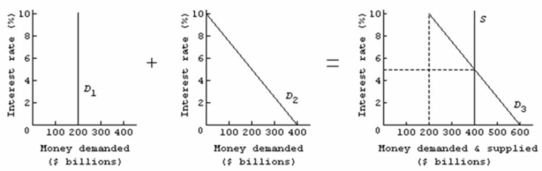
(74)  Refer to the market for money diagram above.Curve D1 represents the:
 (Multiple Choice)
4.9/5 (80)
(80) Assume Canada is experiencing an 8 percent annual rate of inflation and is also incurring a trade deficit.All else equal, the use of appropriate monetary policy to reduce inflation would:
(Multiple Choice)
4.8/5 (78)
(78)  Refer to the above information.At equilibrium in the market for money, the total amount of money demanded is:
 (Multiple Choice)
4.9/5 (94)
(94) 
Filters
- Essay(0)
- Multiple Choice(0)
- Short Answer(0)
- True False(0)
- Matching(0)