



 Chat with AI
Exam 15: B: Interest Rates and Monetary Policy

Exam 1: B: Limits, Alternatives, and Choices265 Questions
Exam 1: A: - Limits, Alternatives, and Choices60 Questions
Exam 2: B: The Market System and the Circular Flow119 Questions
Exam 2: A: - The Market System and the Circular Flow42 Questions
Exam 3: B: Demand, Supply, and Market Equilibrium291 Questions
Exam 3: A: - Demand, Supply, and Market Equilibrium51 Questions
Exam 4: B: Market Failures: Public Goods and Externalities133 Questions
Exam 4: A: - Market Failures: Public Goods and Externalities36 Questions
Exam 5: B: Governments Role and Government Failure121 Questions
Exam 5: A: Governments Role and Government Failure1 Questions
Exam 6: B: an Introduction to Macroeconomics65 Questions
Exam 6: A: an Introduction to Macroeconomics31 Questions
Exam 7: B: Measuring the Economys Output191 Questions
Exam 7: A: Measuring the Economys Output30 Questions
Exam 8: B: Economic Growth122 Questions
Exam 8: A: Economic Growth35 Questions
Exam 9: B: Business Cycles, Unemployment, and Inflation193 Questions
Exam 9: A: Business Cycles, Unemployment, and Inflation40 Questions
Exam 10: B: Basic Macroeconomic Relationships200 Questions
Exam 10: A: Basic Macroeconomic Relationships26 Questions
Exam 11: B: The Aggregate Expenditures Model238 Questions
Exam 11: A: The Aggregate Expenditures Model47 Questions
Exam 12: B: Aggregate Demand and Aggregate Supply203 Questions
Exam 12: A: Aggregate Demand and Aggregate Supply35 Questions
Exam 13: B: Fiscal Policy, Deficits, Surpluses, and Debt234 Questions
Exam 13: A: Fiscal Policy, Deficits, Surpluses, and Debt53 Questions
Exam 14: B: Money, Banking, and Money Creation206 Questions
Exam 14: A: Money, Banking, and Money Creation56 Questions
Exam 15: B: Interest Rates and Monetary Policy239 Questions
Exam 15: A: Interest Rates and Monetary Policy47 Questions
Exam 17: C: Financial Economics323 Questions
Exam 16: A: Long-Run Macroeconomic Adjustments28 Questions
Exam 16: B: Long-Run Macroeconomic Adjustments122 Questions
Exam 17: A: International Trade40 Questions
Exam 17: B: International Trade188 Questions
Exam 18: A: The Balance of Payments and Exchange Rates30 Questions
Exam 18: B: The Balance of Payments and Exchange Rates133 Questions
Exam 22: The Economics of Developing Countries254 Questions
Select questions type


In which of the following instances can we be certain that the quantity of money demanded by the public will decrease?
(Multiple Choice)
4.7/5  (79)
(79) Refer to the graph below, in which Dt is the transactions demand for money, Dm is the total demand for money, and Sm is the supply of money.If the market for money is in equilibrium at a 6 percent rate of interest and the money supply increases, then Sm2 will shift to: 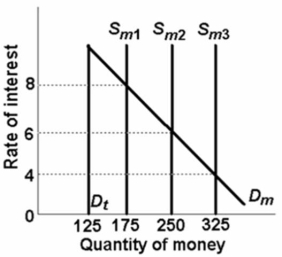
(Multiple Choice)
4.8/5 (82)
(82) The reason for the Bank of Canada to have a range for its inflation targeting is that some of the components of the CPI, fluctuate a lot.
(True/False)
4.8/5 (66)
(66) Assume the Bank of Canada creates excess reserves in the banking system by buying government bonds, but banks do not make more loans because economic conditions are bad.This situation is a problem of:
(Multiple Choice)
4.8/5 (75)
(75) The following information for a bond having no expiration date: bond price = $1,000; bond fixed annual interest payment = $100; bond annual interest rate = 10 percent.Refer to the above information.If the price of this bond falls by $200, the interest rate in effect will:
(Multiple Choice)
4.8/5 (82)
(82) If the monetary authorities want to reduce chartered bank lending they should:
(Multiple Choice)
4.8/5 (71)
(71) The total demand for money will shift to the left as a result of:
(Multiple Choice)
5.0/5 (78)
(78) In the consolidated balance sheet of the Bank of Canada, loans to chartered banks are:
(Multiple Choice)
4.9/5 (89)
(89) Refer to the graph given below.  In the above graph, Dt represents the transactions demand for money, Dm represents the total demand for money, and Sm represents the supply of money.The transactions demand for money in this market is:
 (Multiple Choice)
4.8/5 (80)
(80)  Refer to the above diagram for the market for money.If each dollar held for transactions purposes is spent four times per year on the average, we can infer that the:
 (Multiple Choice)
4.8/5 (76)
(76) An expansionary monetary policy that is used to stimulate economic growth in the domestic economy:
(Multiple Choice)
4.9/5 (85)
(85) Refer to the graphs below.The first graph shows the money market of an economy, and the second graph shows the market for goods and services in the economy. 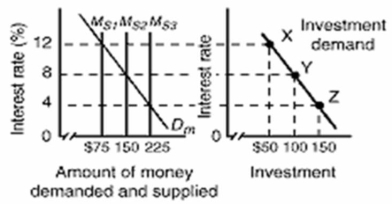
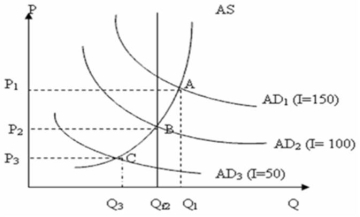 In the above diagrams, the numbers in the parentheses after the AD1, AD2, and AD3 labels indicate the levels of investment spending associated with each AD curve.All figures are in billions.Qf is the full-employment level of real output.Suppose the economy is in equilibrium at point C on the aggregate demand curve.Which of the following should the monetary authorities pursue to achieve a non-inflationary full-employment level of real GDP?
 (Multiple Choice)
4.8/5 (81)
(81) Which of the following is correct? When the Bank of Canada buys bonds on the open market, the money supply:
(Multiple Choice)
4.8/5 (82)
(82) The economy is experiencing high unemployment and a low rate of economic growth and the Bank of Canada decides to pursue an expansionary monetary policy.Which action by the Bank of Canada would be most consistent with this policy?
(Multiple Choice)
5.0/5 (83)
(83) The most important day-to-day monetary instrument that the Bank of Canada uses to achieve the desired interest rate and therefore the price stability is:
(Multiple Choice)
4.8/5 (79)
(79) 
Filters
- Essay(0)
- Multiple Choice(0)
- Short Answer(0)
- True False(0)
- Matching(0)