



 Chat with AI
Exam 15: B: Interest Rates and Monetary Policy

Exam 1: B: Limits, Alternatives, and Choices265 Questions
Exam 1: A: - Limits, Alternatives, and Choices60 Questions
Exam 2: B: The Market System and the Circular Flow119 Questions
Exam 2: A: - The Market System and the Circular Flow42 Questions
Exam 3: B: Demand, Supply, and Market Equilibrium291 Questions
Exam 3: A: - Demand, Supply, and Market Equilibrium51 Questions
Exam 4: B: Market Failures: Public Goods and Externalities133 Questions
Exam 4: A: - Market Failures: Public Goods and Externalities36 Questions
Exam 5: B: Governments Role and Government Failure121 Questions
Exam 5: A: Governments Role and Government Failure1 Questions
Exam 6: B: an Introduction to Macroeconomics65 Questions
Exam 6: A: an Introduction to Macroeconomics31 Questions
Exam 7: B: Measuring the Economys Output191 Questions
Exam 7: A: Measuring the Economys Output30 Questions
Exam 8: B: Economic Growth122 Questions
Exam 8: A: Economic Growth35 Questions
Exam 9: B: Business Cycles, Unemployment, and Inflation193 Questions
Exam 9: A: Business Cycles, Unemployment, and Inflation40 Questions
Exam 10: B: Basic Macroeconomic Relationships200 Questions
Exam 10: A: Basic Macroeconomic Relationships26 Questions
Exam 11: B: The Aggregate Expenditures Model238 Questions
Exam 11: A: The Aggregate Expenditures Model47 Questions
Exam 12: B: Aggregate Demand and Aggregate Supply203 Questions
Exam 12: A: Aggregate Demand and Aggregate Supply35 Questions
Exam 13: B: Fiscal Policy, Deficits, Surpluses, and Debt234 Questions
Exam 13: A: Fiscal Policy, Deficits, Surpluses, and Debt53 Questions
Exam 14: B: Money, Banking, and Money Creation206 Questions
Exam 14: A: Money, Banking, and Money Creation56 Questions
Exam 15: B: Interest Rates and Monetary Policy239 Questions
Exam 15: A: Interest Rates and Monetary Policy47 Questions
Exam 17: C: Financial Economics323 Questions
Exam 16: A: Long-Run Macroeconomic Adjustments28 Questions
Exam 16: B: Long-Run Macroeconomic Adjustments122 Questions
Exam 17: A: International Trade40 Questions
Exam 17: B: International Trade188 Questions
Exam 18: A: The Balance of Payments and Exchange Rates30 Questions
Exam 18: B: The Balance of Payments and Exchange Rates133 Questions
Exam 22: The Economics of Developing Countries254 Questions
Select questions type


Assume that there is a 25 percent desired reserve ratio and that Bank of Canada buys $200 million worth of government securities.If the securities are purchased from the public, then this action has the potential to increase bank lending by a maximum of:
(Multiple Choice)
5.0/5  (84)
(84) To increase the overnight lending rate, the Bank of Canada can:
(Multiple Choice)
4.9/5 (82)
(82) The price of a bond with no expiration date is $10,000 and it has a fixed annual interest payment of $2,000.If the bond is sold to a new owner for a price of $12,500, then the effective interest rate yield on the bond is now:
(Multiple Choice)
4.9/5 (77)
(77) 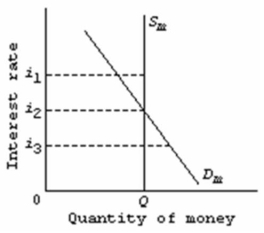 Refer to the above market for money diagram.The equilibrium interest rate is:
 (Multiple Choice)
5.0/5 (88)
(88)  Which line in the above graph would best reflect the slope of the total demand for money curve?
 (Multiple Choice)
4.9/5 (82)
(82) On a diagram wherein the interest rate and the quantity of money demanded are shown on the vertical and horizontal axes respectively, the transactions demand for money can be represented by:
(Multiple Choice)
4.7/5 (76)
(76) The price of a bond with no expiration date is $1,000 and the fixed annual interest payment is $100.If the price of the bond falls to $800, the interest rate to a new buyer of the bond is now 8.5 percent.
(True/False)
4.9/5 (82)
(82) On a diagram wherein the interest rate and the quantity of money demanded are shown on the vertical and horizontal axes respectively, the asset demand for money can be represented by:
(Multiple Choice)
4.7/5 (79)
(79) Most economists feel that changes in the interest rate are more likely to affect investment spending than consumer spending.
(True/False)
4.9/5 (90)
(90)  Refer to the above table.Suppose the transactions demand for money is equal to 20 percent of the nominal GDP, the supply of money is $800 billion, and the asset demand for money is that shown in the table.If the nominal GDP is $2000 billion, the equilibrium interest rate is:
 (Multiple Choice)
4.8/5 (82)
(82) In which case would the quantity of money demanded by the public tend to increase by the greatest amount?
(Multiple Choice)
4.8/5 (84)
(84) A bond with no expiration has an original price of $10,000 and a fixed annual interest payment of $1000.If the price of this bond decreases by $2000, the interest rate in effect will:
(Multiple Choice)
4.9/5 (84)
(84) Monetary policy in Japan during the 1990s and early 2000s was:
(Multiple Choice)
4.9/5 (83)
(83)  Refer to the above diagram for the market for money.The total demand for money is shown by:
 (Multiple Choice)
4.9/5 (80)
(80) 
Filters
- Essay(0)
- Multiple Choice(0)
- Short Answer(0)
- True False(0)
- Matching(0)