



 Chat with AI
Exam 15: B: Interest Rates and Monetary Policy

Exam 1: B: Limits, Alternatives, and Choices265 Questions
Exam 1: A: - Limits, Alternatives, and Choices60 Questions
Exam 2: B: The Market System and the Circular Flow119 Questions
Exam 2: A: - The Market System and the Circular Flow42 Questions
Exam 3: B: Demand, Supply, and Market Equilibrium291 Questions
Exam 3: A: - Demand, Supply, and Market Equilibrium51 Questions
Exam 4: B: Market Failures: Public Goods and Externalities133 Questions
Exam 4: A: - Market Failures: Public Goods and Externalities36 Questions
Exam 5: B: Governments Role and Government Failure121 Questions
Exam 5: A: Governments Role and Government Failure1 Questions
Exam 6: B: an Introduction to Macroeconomics65 Questions
Exam 6: A: an Introduction to Macroeconomics31 Questions
Exam 7: B: Measuring the Economys Output191 Questions
Exam 7: A: Measuring the Economys Output30 Questions
Exam 8: B: Economic Growth122 Questions
Exam 8: A: Economic Growth35 Questions
Exam 9: B: Business Cycles, Unemployment, and Inflation193 Questions
Exam 9: A: Business Cycles, Unemployment, and Inflation40 Questions
Exam 10: B: Basic Macroeconomic Relationships200 Questions
Exam 10: A: Basic Macroeconomic Relationships26 Questions
Exam 11: B: The Aggregate Expenditures Model238 Questions
Exam 11: A: The Aggregate Expenditures Model47 Questions
Exam 12: B: Aggregate Demand and Aggregate Supply203 Questions
Exam 12: A: Aggregate Demand and Aggregate Supply35 Questions
Exam 13: B: Fiscal Policy, Deficits, Surpluses, and Debt234 Questions
Exam 13: A: Fiscal Policy, Deficits, Surpluses, and Debt53 Questions
Exam 14: B: Money, Banking, and Money Creation206 Questions
Exam 14: A: Money, Banking, and Money Creation56 Questions
Exam 15: B: Interest Rates and Monetary Policy239 Questions
Exam 15: A: Interest Rates and Monetary Policy47 Questions
Exam 17: C: Financial Economics323 Questions
Exam 16: A: Long-Run Macroeconomic Adjustments28 Questions
Exam 16: B: Long-Run Macroeconomic Adjustments122 Questions
Exam 17: A: International Trade40 Questions
Exam 17: B: International Trade188 Questions
Exam 18: A: The Balance of Payments and Exchange Rates30 Questions
Exam 18: B: The Balance of Payments and Exchange Rates133 Questions
Exam 22: The Economics of Developing Countries254 Questions
Select questions type


In 2004, the Bank of Canada reduced the overnight rate to as low as:
(Multiple Choice)
4.9/5  (92)
(92) If the amount of money demanded exceeds the amount supplied, it can be expected that the:
(Multiple Choice)
4.8/5 (79)
(79) The Sale and Repurchase Agreement (SRA), is a transaction in which:
(Multiple Choice)
4.7/5 (74)
(74) If the demand for money increases and the monetary authorities want interest rates to remain unchanged, which of the following would be appropriate policy?
(Multiple Choice)
4.8/5 (74)
(74) To reduce the overnight lending rate, the Bank of Canada can:
(Multiple Choice)
4.9/5 (85)
(85) The price of government bonds and the interest rate received by a bond buyer are:
(Multiple Choice)
4.8/5 (72)
(72) When chartered banks borrow from the Bank of Canada, they decrease their excess reserves and their money-creating potential.
(True/False)
4.8/5 (85)
(85) Which one of the following would be most compatible with the goals of the government to both improve economic growth and reduce the trade deficit?
(Multiple Choice)
4.9/5 (88)
(88) A decrease in the nominal GDP, other things remaining the same, will decrease both the total demand for money and the equilibrium rate of interest in the economy.
(True/False)
4.9/5 (74)
(74) 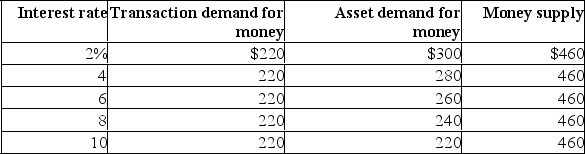 Refer to the above information.The equilibrium interest rate is:
 (Multiple Choice)
4.9/5 (91)
(91) If the money GDP is $600 billion and, on the average, each dollar is spent three times per year, then the amount of money demanded for transactions purposes:
(Multiple Choice)
4.7/5 (81)
(81) The problem of "cyclical asymmetry" refers to the notion that:
(Multiple Choice)
4.8/5 (73)
(73) In the Canadian economy, the money supply is controlled by:
(Multiple Choice)
4.9/5 (81)
(81) If the monetary authority wished to follow a restrictive monetary policy, it would buy government securities in the open market.
(True/False)
4.8/5 (78)
(78) International flows of financial capital in response to interest rate changes in Canada:
(Multiple Choice)
4.8/5 (67)
(67) 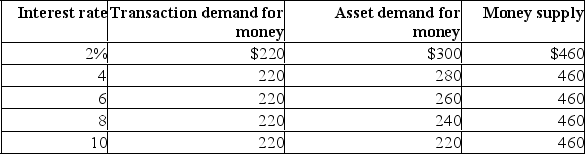 Refer to the above information.An increase in the money supply of $20 billion will cause the equilibrium interest rate to:
 (Multiple Choice)
4.8/5 (85)
(85) Columns (1) and (2) indicate the transactions demand (Dt) for money and columns (1) and (3) show the asset demand (Da) for money: Refer to the above information.These data suggest that the amount of money demanded for transactions purposes:
(Multiple Choice)
4.9/5 (69)
(69) 
Filters
- Essay(0)
- Multiple Choice(0)
- Short Answer(0)
- True False(0)
- Matching(0)