



 Chat with AI
Exam 15: A: Interest Rates and Monetary Policy

Exam 1: B: Limits, Alternatives, and Choices265 Questions
Exam 1: A: - Limits, Alternatives, and Choices60 Questions
Exam 2: B: The Market System and the Circular Flow119 Questions
Exam 2: A: - The Market System and the Circular Flow42 Questions
Exam 3: B: Demand, Supply, and Market Equilibrium291 Questions
Exam 3: A: - Demand, Supply, and Market Equilibrium51 Questions
Exam 4: B: Market Failures: Public Goods and Externalities133 Questions
Exam 4: A: - Market Failures: Public Goods and Externalities36 Questions
Exam 5: B: Governments Role and Government Failure121 Questions
Exam 5: A: Governments Role and Government Failure1 Questions
Exam 6: B: an Introduction to Macroeconomics65 Questions
Exam 6: A: an Introduction to Macroeconomics31 Questions
Exam 7: B: Measuring the Economys Output191 Questions
Exam 7: A: Measuring the Economys Output30 Questions
Exam 8: B: Economic Growth122 Questions
Exam 8: A: Economic Growth35 Questions
Exam 9: B: Business Cycles, Unemployment, and Inflation193 Questions
Exam 9: A: Business Cycles, Unemployment, and Inflation40 Questions
Exam 10: B: Basic Macroeconomic Relationships200 Questions
Exam 10: A: Basic Macroeconomic Relationships26 Questions
Exam 11: B: The Aggregate Expenditures Model238 Questions
Exam 11: A: The Aggregate Expenditures Model47 Questions
Exam 12: B: Aggregate Demand and Aggregate Supply203 Questions
Exam 12: A: Aggregate Demand and Aggregate Supply35 Questions
Exam 13: B: Fiscal Policy, Deficits, Surpluses, and Debt234 Questions
Exam 13: A: Fiscal Policy, Deficits, Surpluses, and Debt53 Questions
Exam 14: B: Money, Banking, and Money Creation206 Questions
Exam 14: A: Money, Banking, and Money Creation56 Questions
Exam 15: B: Interest Rates and Monetary Policy239 Questions
Exam 15: A: Interest Rates and Monetary Policy47 Questions
Exam 17: C: Financial Economics323 Questions
Exam 16: A: Long-Run Macroeconomic Adjustments28 Questions
Exam 16: B: Long-Run Macroeconomic Adjustments122 Questions
Exam 17: A: International Trade40 Questions
Exam 17: B: International Trade188 Questions
Exam 18: A: The Balance of Payments and Exchange Rates30 Questions
Exam 18: B: The Balance of Payments and Exchange Rates133 Questions
Exam 22: The Economics of Developing Countries254 Questions
Select questions type


How is the overnight lending rate established? What role does the Bank of Canada play?
(Essay)
4.9/5  (92)
(92) Identify the major items in the consolidated balance sheet of the Bank of Canada.
(Essay)
4.9/5 (67)
(67) What is the difference between the Bank of Canada's purchases of securities from the chartered banking system and those from the public? Give an example.
(Essay)
4.9/5 (81)
(81) What are the two instruments the Bank of Canada has for influencing the money supply? Which instrument is more important?
(Essay)
4.8/5 (84)
(84) The total demand for money is equal to the transactions demand plus the asset demand for money.(a) Assume that each dollar held for transactions purposes is spent on the average five times per year to buy final goods and services.If nominal GDP is $1,000 billion (or $1 trillion), what is the transactions demand?
(b) The table below shows the asset demand at certain rates of interest.Using your answer to part (a), complete the table to show the total demand for money at various rates of interest.  (c) If the money supply is $260 billion, what will be the equilibrium rate of interest?
(d) If the money supply rises, will the equilibrium rate of interest rise or fall?
(e) If GDP rises, will the equilibrium rate of interest rise or fall?
(c) If the money supply is $260 billion, what will be the equilibrium rate of interest?
(d) If the money supply rises, will the equilibrium rate of interest rise or fall?
(e) If GDP rises, will the equilibrium rate of interest rise or fall? (Essay)
4.9/5 (89)
(89) Discuss the relative effectiveness of monetary policy in dealing with demand-pull inflation or recession.
(Essay)
4.9/5 (75)
(75) Explain the impact of each of the following upon chartered bank reserves: (a) the Bank of Canada sells government bonds in the open market to private buyers; (b) the chartered banks reduce their indebtedness to the Bank of Canada.
(Essay)
4.9/5 (88)
(88) Explain how the net export effect strengthens the effects an easy money and a tight money policy.
(Essay)
4.8/5 (83)
(83) Why is it important for the Bank of Canada to be an independent agency?
(Essay)
4.8/5 (63)
(63) Describe and explain how expansionary monetary policy was used to repair the economy in the United States after the mortgage debt crisis.
(Essay)
4.9/5 (82)
(82) What is the relationship between the overnight lending rate and the prime interest rate? Why doesn't the Bank of Canada target the prime interest rate?
(Essay)
4.8/5 (82)
(82) How does an increase in nominal GDP affect the equilibrium rate of interest?
(Essay)
4.8/5 (77)
(77) Suppose the economy is experiencing a recession and high unemployment.Describe the transmission mechanism through which monetary policy could address these problems?
(Essay)
4.9/5 (75)
(75) Use the graph below to answer the following questions.Dt is the transactions demand for money, Dm is the total demand for money, and Sm is the supply of money. 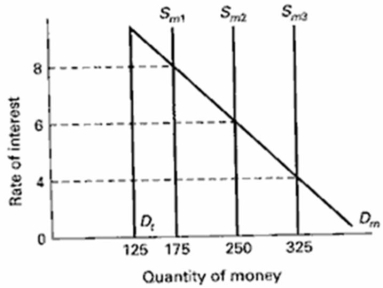 (a) What is the transactions demand for money in this market?
(b) What is the asset demand for money if the interest rate is 4%?
(c) If the money market is in equilibrium at 6%, describe the change that must occur for the equilibrium rate to change to 4%.(d) If the money market is in equilibrium at 6% and the money supply has increased to Sm3, by how much has total demand for money changed?
(a) What is the transactions demand for money in this market?
(b) What is the asset demand for money if the interest rate is 4%?
(c) If the money market is in equilibrium at 6%, describe the change that must occur for the equilibrium rate to change to 4%.(d) If the money market is in equilibrium at 6% and the money supply has increased to Sm3, by how much has total demand for money changed? (Essay)
4.8/5 (78)
(78) 
Filters
- Essay(0)
- Multiple Choice(0)
- Short Answer(0)
- True False(0)
- Matching(0)