



 Chat with AI
Exam 17: B: International Trade

Exam 1: B: Limits, Alternatives, and Choices265 Questions
Exam 1: A: - Limits, Alternatives, and Choices60 Questions
Exam 2: B: The Market System and the Circular Flow119 Questions
Exam 2: A: - The Market System and the Circular Flow42 Questions
Exam 3: B: Demand, Supply, and Market Equilibrium291 Questions
Exam 3: A: - Demand, Supply, and Market Equilibrium51 Questions
Exam 4: B: Market Failures: Public Goods and Externalities133 Questions
Exam 4: A: - Market Failures: Public Goods and Externalities36 Questions
Exam 5: B: Governments Role and Government Failure121 Questions
Exam 5: A: Governments Role and Government Failure1 Questions
Exam 6: B: an Introduction to Macroeconomics65 Questions
Exam 6: A: an Introduction to Macroeconomics31 Questions
Exam 7: B: Measuring the Economys Output191 Questions
Exam 7: A: Measuring the Economys Output30 Questions
Exam 8: B: Economic Growth122 Questions
Exam 8: A: Economic Growth35 Questions
Exam 9: B: Business Cycles, Unemployment, and Inflation193 Questions
Exam 9: A: Business Cycles, Unemployment, and Inflation40 Questions
Exam 10: B: Basic Macroeconomic Relationships200 Questions
Exam 10: A: Basic Macroeconomic Relationships26 Questions
Exam 11: B: The Aggregate Expenditures Model238 Questions
Exam 11: A: The Aggregate Expenditures Model47 Questions
Exam 12: B: Aggregate Demand and Aggregate Supply203 Questions
Exam 12: A: Aggregate Demand and Aggregate Supply35 Questions
Exam 13: B: Fiscal Policy, Deficits, Surpluses, and Debt234 Questions
Exam 13: A: Fiscal Policy, Deficits, Surpluses, and Debt53 Questions
Exam 14: B: Money, Banking, and Money Creation206 Questions
Exam 14: A: Money, Banking, and Money Creation56 Questions
Exam 15: B: Interest Rates and Monetary Policy239 Questions
Exam 15: A: Interest Rates and Monetary Policy47 Questions
Exam 17: C: Financial Economics323 Questions
Exam 16: A: Long-Run Macroeconomic Adjustments28 Questions
Exam 16: B: Long-Run Macroeconomic Adjustments122 Questions
Exam 17: A: International Trade40 Questions
Exam 17: B: International Trade188 Questions
Exam 18: A: The Balance of Payments and Exchange Rates30 Questions
Exam 18: B: The Balance of Payments and Exchange Rates133 Questions
Exam 22: The Economics of Developing Countries254 Questions
Select questions type


The graph below shows the production possibility curves for two hypothetical nations, Orin and Pohl, which each make two hypothetical products, jaxs and keps.Which of the following statements is correct? 
(Multiple Choice)
4.9/5  (80)
(80) Assume that by devoting all its resources to the production of X, nation Alpha can produce 40 units of X.By devoting all its resources to Y, Alpha can produce 60Y.Comparable figures for nation Beta are, 60X and 40Y.Refer to the above information.Alpha should specialize in Y and Beta in X.
(True/False)
4.7/5 (89)
(89) 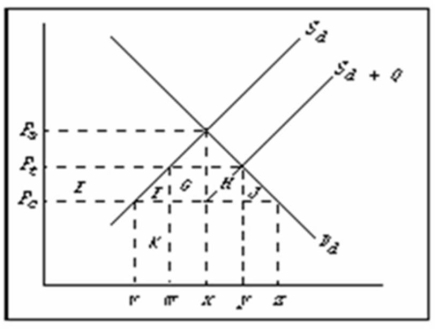 Refer to the above diagram, where Sd and Dd are the domestic supply and demand for a product and Pc is the world price of that product.Sd + Q is the product supply curve after an import quota is imposed.A tariff of PcPt or an import quota of wy will:
 (Multiple Choice)
4.8/5 (72)
(72) According to the principle of comparative advantage, worldwide output and consumption levels will be highest when goods are produced in nations where:
(Multiple Choice)
4.8/5 (86)
(86) International trade based on the principle of comparative advantage creates a more efficient allocation of world economic resources.
(True/False)
4.9/5 (86)
(86) The World Trade Organization was established by Canada to advocate strategic trade policy.
(True/False)
4.8/5 (73)
(73) 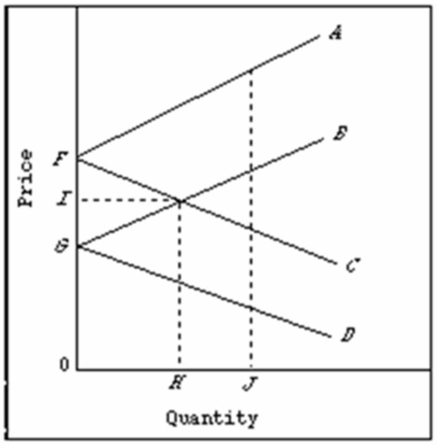 Refer to the above diagram pertaining to two nations and a specific product.In equilibrium, the nation represented by lines FA and FC will:
 (Multiple Choice)
4.8/5 (64)
(64) The principle of comparative advantage is that total output will be greatest when each good is produced by that nation which has the lowest domestic opportunity cost.
(True/False)
4.7/5 (78)
(78) 
Filters
- Essay(0)
- Multiple Choice(0)
- Short Answer(0)
- True False(0)
- Matching(0)