



 Chat with AI
Exam 17: B: International Trade

Exam 1: B: Limits, Alternatives, and Choices265 Questions
Exam 1: A: - Limits, Alternatives, and Choices60 Questions
Exam 2: B: The Market System and the Circular Flow119 Questions
Exam 2: A: - The Market System and the Circular Flow42 Questions
Exam 3: B: Demand, Supply, and Market Equilibrium291 Questions
Exam 3: A: - Demand, Supply, and Market Equilibrium51 Questions
Exam 4: B: Market Failures: Public Goods and Externalities133 Questions
Exam 4: A: - Market Failures: Public Goods and Externalities36 Questions
Exam 5: B: Governments Role and Government Failure121 Questions
Exam 5: A: Governments Role and Government Failure1 Questions
Exam 6: B: an Introduction to Macroeconomics65 Questions
Exam 6: A: an Introduction to Macroeconomics31 Questions
Exam 7: B: Measuring the Economys Output191 Questions
Exam 7: A: Measuring the Economys Output30 Questions
Exam 8: B: Economic Growth122 Questions
Exam 8: A: Economic Growth35 Questions
Exam 9: B: Business Cycles, Unemployment, and Inflation193 Questions
Exam 9: A: Business Cycles, Unemployment, and Inflation40 Questions
Exam 10: B: Basic Macroeconomic Relationships200 Questions
Exam 10: A: Basic Macroeconomic Relationships26 Questions
Exam 11: B: The Aggregate Expenditures Model238 Questions
Exam 11: A: The Aggregate Expenditures Model47 Questions
Exam 12: B: Aggregate Demand and Aggregate Supply203 Questions
Exam 12: A: Aggregate Demand and Aggregate Supply35 Questions
Exam 13: B: Fiscal Policy, Deficits, Surpluses, and Debt234 Questions
Exam 13: A: Fiscal Policy, Deficits, Surpluses, and Debt53 Questions
Exam 14: B: Money, Banking, and Money Creation206 Questions
Exam 14: A: Money, Banking, and Money Creation56 Questions
Exam 15: B: Interest Rates and Monetary Policy239 Questions
Exam 15: A: Interest Rates and Monetary Policy47 Questions
Exam 17: C: Financial Economics323 Questions
Exam 16: A: Long-Run Macroeconomic Adjustments28 Questions
Exam 16: B: Long-Run Macroeconomic Adjustments122 Questions
Exam 17: A: International Trade40 Questions
Exam 17: B: International Trade188 Questions
Exam 18: A: The Balance of Payments and Exchange Rates30 Questions
Exam 18: B: The Balance of Payments and Exchange Rates133 Questions
Exam 22: The Economics of Developing Countries254 Questions
Select questions type


The following data is for the hypothetical nations of Alpha and Beta.Qs is domestic quantity supplied and Qd is domestic quantity demanded. 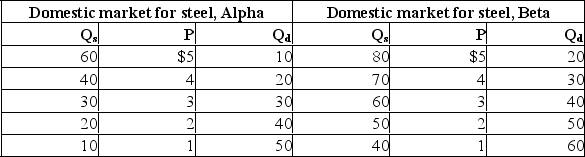 Refer to the above data.Alpha's export supply is represented by:
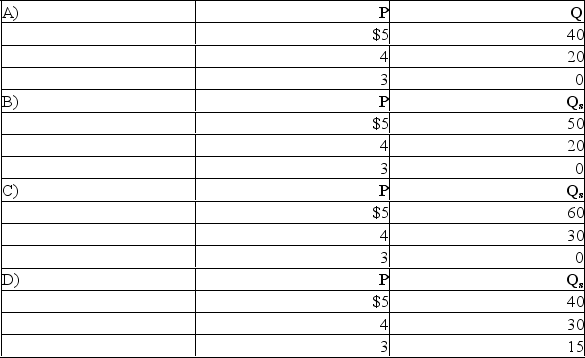
Refer to the above data.Alpha's export supply is represented by: (Multiple Choice)
4.9/5  (72)
(72) Production possibilities data for Gamma and Sigma.All data are in tons.Gamma production possibilities:  Sigma production possibilities:
 Refer to the above data.What are the limits of the terms of trade between Gamma and Sigma?
Sigma production possibilities:
Refer to the above data.What are the limits of the terms of trade between Gamma and Sigma? (Multiple Choice)
4.8/5 (77)
(77) Refer to the diagram below in which line AB is Canadian production possibility curve and AC is its trading possibilities curve.The international exchange ratio between beef and cheese (terms of trade): 
(Multiple Choice)
4.8/5 (80)
(80) 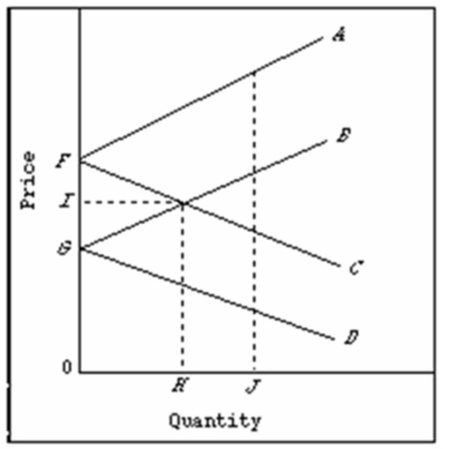 Refer to the above diagram pertaining to two nations and a specific product.Lines FA and GB are:
 (Multiple Choice)
4.8/5 (81)
(81) The following data is for the hypothetical nations of Alpha and Beta.Qs is domestic quantity supplied and Qd is domestic quantity demanded. 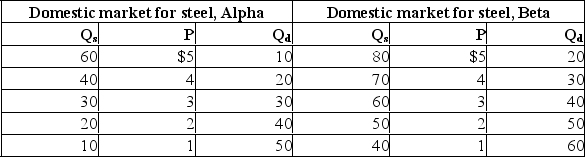 Refer to the above data.The equilibrium world price of steel must be between:
 (Multiple Choice)
4.8/5 (73)
(73) Which is a valid counterargument to the call for higher tariffs to save Canadian jobs?
(Multiple Choice)
4.8/5 (73)
(73) The following information is about the cost ratios for two products-fish (F) and chicken (C)-in Singsong and Harmony.Assume that production occurs under conditions of constant costs and these are the only two nations in the world.If in Singsong: 1F = 2C and, in Harmony: 1F = 4C, which one of the following would not be feasible terms for trade between Singsong and Harmony?
(Multiple Choice)
4.9/5 (75)
(75) The following data is for the hypothetical nations of Alpha and Beta.Qs is domestic quantity supplied and Qd is domestic quantity demanded. 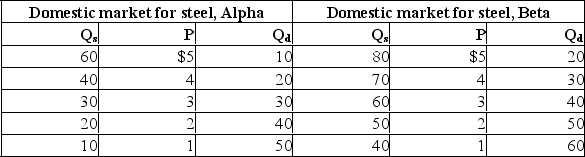 Refer to the above data.At a world price of $5:
 (Multiple Choice)
4.7/5 (75)
(75) The following information is about the cost ratios for two products-fish (F) and chicken (C)-in Singsong and Harmony.Assume that production occurs under conditions of constant costs and these are the only two nations in the world.If in Singsong: 1F = 2C and, in Harmony: 1F = 4C then, in Singsong the domestic real cost of each chicken:
(Multiple Choice)
4.9/5 (77)
(77) The World Trade Organization advocates new protections for intellectual property such as copyrights.
(True/False)
4.8/5 (83)
(83) 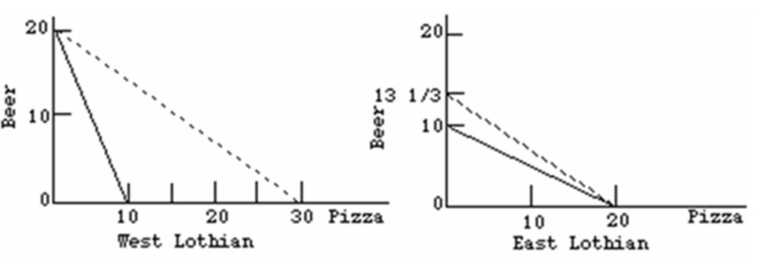 Refer to the above diagrams.The solid lines are production possibilities curves; the dashed lines are trading possibilities curves.The opportunity cost of producing a:
 (Multiple Choice)
4.9/5 (82)
(82) The "increased-domestic-employment" argument for tariff protection holds that:
(Multiple Choice)
4.9/5 (76)
(76) Diversification for stability argument is given as an excuse for imposing tariff and quotas against imports in some countries.This argument is based on:
(Multiple Choice)
4.9/5 (79)
(79) Which of the following is one of the trade liberalizations proposed by the World Trade Organization (WTO)?
(Multiple Choice)
4.8/5 (79)
(79) The following is the Production possibilities data for two countries, Alpha and Beta, which have populations of equal size. 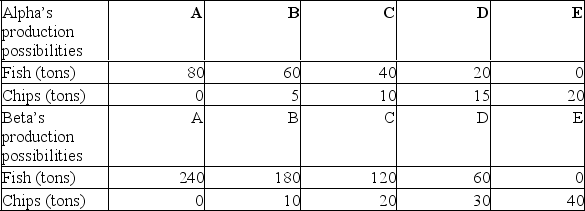 Refer to the above data.The domestic opportunity cost of:
 (Multiple Choice)
4.8/5 (85)
(85) Refer to the diagrams below.The solid lines are production possibilities curves; the dashed lines are trading possibilities curves.The trading possibilities curves suggest that the terms of trade are: 
(Multiple Choice)
4.8/5 (85)
(85) 
Filters
- Essay(0)
- Multiple Choice(0)
- Short Answer(0)
- True False(0)
- Matching(0)