



 Chat with AI
Exam 17: B: International Trade

Exam 1: B: Limits, Alternatives, and Choices265 Questions
Exam 1: A: - Limits, Alternatives, and Choices60 Questions
Exam 2: B: The Market System and the Circular Flow119 Questions
Exam 2: A: - The Market System and the Circular Flow42 Questions
Exam 3: B: Demand, Supply, and Market Equilibrium291 Questions
Exam 3: A: - Demand, Supply, and Market Equilibrium51 Questions
Exam 4: B: Market Failures: Public Goods and Externalities133 Questions
Exam 4: A: - Market Failures: Public Goods and Externalities36 Questions
Exam 5: B: Governments Role and Government Failure121 Questions
Exam 5: A: Governments Role and Government Failure1 Questions
Exam 6: B: an Introduction to Macroeconomics65 Questions
Exam 6: A: an Introduction to Macroeconomics31 Questions
Exam 7: B: Measuring the Economys Output191 Questions
Exam 7: A: Measuring the Economys Output30 Questions
Exam 8: B: Economic Growth122 Questions
Exam 8: A: Economic Growth35 Questions
Exam 9: B: Business Cycles, Unemployment, and Inflation193 Questions
Exam 9: A: Business Cycles, Unemployment, and Inflation40 Questions
Exam 10: B: Basic Macroeconomic Relationships200 Questions
Exam 10: A: Basic Macroeconomic Relationships26 Questions
Exam 11: B: The Aggregate Expenditures Model238 Questions
Exam 11: A: The Aggregate Expenditures Model47 Questions
Exam 12: B: Aggregate Demand and Aggregate Supply203 Questions
Exam 12: A: Aggregate Demand and Aggregate Supply35 Questions
Exam 13: B: Fiscal Policy, Deficits, Surpluses, and Debt234 Questions
Exam 13: A: Fiscal Policy, Deficits, Surpluses, and Debt53 Questions
Exam 14: B: Money, Banking, and Money Creation206 Questions
Exam 14: A: Money, Banking, and Money Creation56 Questions
Exam 15: B: Interest Rates and Monetary Policy239 Questions
Exam 15: A: Interest Rates and Monetary Policy47 Questions
Exam 17: C: Financial Economics323 Questions
Exam 16: A: Long-Run Macroeconomic Adjustments28 Questions
Exam 16: B: Long-Run Macroeconomic Adjustments122 Questions
Exam 17: A: International Trade40 Questions
Exam 17: B: International Trade188 Questions
Exam 18: A: The Balance of Payments and Exchange Rates30 Questions
Exam 18: B: The Balance of Payments and Exchange Rates133 Questions
Exam 22: The Economics of Developing Countries254 Questions
Select questions type


When Sally can paint a house and plant a tree more efficiently than Tom, we can conclude that:
(Multiple Choice)
4.8/5  (86)
(86) A nation will import a particular product if the world price is less than the domestic price.
(True/False)
4.8/5 (74)
(74) Refer to the data below.Assume that before specialization and trade Gamma and Sigma both chose production possibility "C." Now if each specializes according to comparative advantage, the gains from specialization and trade will be: Production possibilities data for Gamma and Sigma.All data are in tons.Gamma production possibilities:  Sigma production possibilities:

Sigma production possibilities:
(Multiple Choice)
4.8/5 (80)
(80) Which of the following held the lowest percentage of Canadian imports industry is the smallest, using Table 17.1 for principal exp in 2016?
(Multiple Choice)
4.9/5 (86)
(86) The following is the Production possibilities data for two countries, Alpha and Beta, which have populations of equal size. 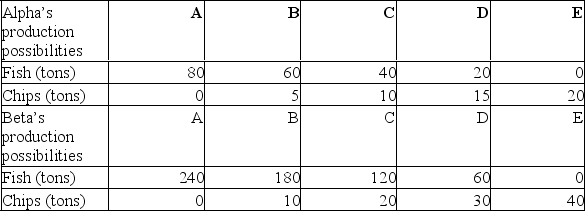 The above data show that:
 (Multiple Choice)
4.8/5 (62)
(62) In 2016, the eight largest export nations accounted for approximately: what percentage of world exports, as of 2016.Use Image 17.1 Global Perspective.
(Multiple Choice)
5.0/5 (85)
(85) Which 1993 economic agreement established a major free-trade zone in the western hemisphere?
(Multiple Choice)
4.8/5 (68)
(68) The following information is about the cost ratios for two products-fish (F) and chicken (C)-in Singsong and Harmony.Assume that production occurs under conditions of constant costs and these are the only two nations in the world.If in Singsong: 1F = 2C and, in Harmony: 1F = 4C:
(Multiple Choice)
4.7/5 (86)
(86) Production possibilities data for Gamma and Sigma.All data are in tons.Gamma production possibilities:  Sigma production possibilities:
 On the basis of the above information:
Sigma production possibilities:
On the basis of the above information: (Multiple Choice)
4.9/5 (88)
(88) 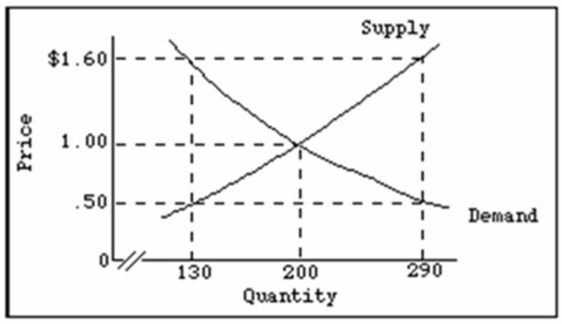 Refer to the above diagram showing the domestic demand and supply curves for a specific standardized product in a particular nation.If the world price for this product is $1.60, this nation will experience a domestic:
 (Multiple Choice)
4.8/5 (76)
(76) The nation which has a comparative advantage in a particular product will be the only world exporter of that product.
(True/False)
5.0/5 (84)
(84) A licensing requirement, or unreasonable standard pertaining to the product quality and safety for a product that is imported into a country, is an example of:
(Multiple Choice)
4.9/5 (79)
(79) 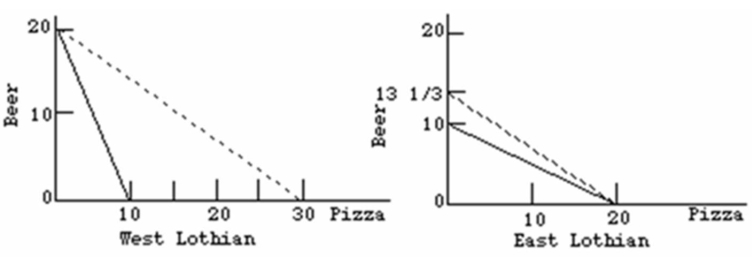 Refer to the above diagrams.The solid lines are production possibilities curves; the dashed lines are trading possibilities curves.The trading possibilities curves imply that:
 (Multiple Choice)
4.9/5 (84)
(84) Which is a valid counterargument to the infant industry argument for protective tariffs?
(Multiple Choice)
4.8/5 (76)
(76) The following table is domestic supply and demand schedules for a product.Suppose that the world price of the product is $1. 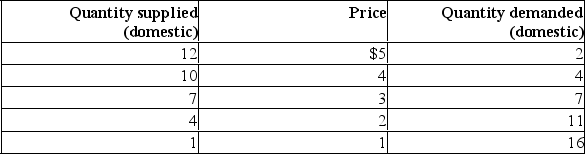 Refer to the above data.With a $1 per unit tariff, prices (revenue per unit) received by domestic and foreign producers respectively will be:
 (Multiple Choice)
4.9/5 (80)
(80) 
Filters
- Essay(0)
- Multiple Choice(0)
- Short Answer(0)
- True False(0)
- Matching(0)