



 Chat with AI
Exam 4: B: Market Failures: Public Goods and Externalities

Exam 1: B: Limits, Alternatives, and Choices265 Questions
Exam 1: A: - Limits, Alternatives, and Choices60 Questions
Exam 2: B: The Market System and the Circular Flow119 Questions
Exam 2: A: - The Market System and the Circular Flow42 Questions
Exam 3: B: Demand, Supply, and Market Equilibrium291 Questions
Exam 3: A: - Demand, Supply, and Market Equilibrium51 Questions
Exam 4: B: Market Failures: Public Goods and Externalities133 Questions
Exam 4: A: - Market Failures: Public Goods and Externalities36 Questions
Exam 5: B: Governments Role and Government Failure121 Questions
Exam 5: A: Governments Role and Government Failure1 Questions
Exam 6: B: an Introduction to Macroeconomics65 Questions
Exam 6: A: an Introduction to Macroeconomics31 Questions
Exam 7: B: Measuring the Economys Output191 Questions
Exam 7: A: Measuring the Economys Output30 Questions
Exam 8: B: Economic Growth122 Questions
Exam 8: A: Economic Growth35 Questions
Exam 9: B: Business Cycles, Unemployment, and Inflation193 Questions
Exam 9: A: Business Cycles, Unemployment, and Inflation40 Questions
Exam 10: B: Basic Macroeconomic Relationships200 Questions
Exam 10: A: Basic Macroeconomic Relationships26 Questions
Exam 11: B: The Aggregate Expenditures Model238 Questions
Exam 11: A: The Aggregate Expenditures Model47 Questions
Exam 12: B: Aggregate Demand and Aggregate Supply203 Questions
Exam 12: A: Aggregate Demand and Aggregate Supply35 Questions
Exam 13: B: Fiscal Policy, Deficits, Surpluses, and Debt234 Questions
Exam 13: A: Fiscal Policy, Deficits, Surpluses, and Debt53 Questions
Exam 14: B: Money, Banking, and Money Creation206 Questions
Exam 14: A: Money, Banking, and Money Creation56 Questions
Exam 15: B: Interest Rates and Monetary Policy239 Questions
Exam 15: A: Interest Rates and Monetary Policy47 Questions
Exam 17: C: Financial Economics323 Questions
Exam 16: A: Long-Run Macroeconomic Adjustments28 Questions
Exam 16: B: Long-Run Macroeconomic Adjustments122 Questions
Exam 17: A: International Trade40 Questions
Exam 17: B: International Trade188 Questions
Exam 18: A: The Balance of Payments and Exchange Rates30 Questions
Exam 18: B: The Balance of Payments and Exchange Rates133 Questions
Exam 22: The Economics of Developing Countries254 Questions
Select questions type


A demand-side market failure occurs when demand curves do not reflect consumers' lack of willingness to pay for a good or service.
(True/False)
4.8/5  (66)
(66) Refer to the below supply and demand graph.Point A represents the current equilibrium level of output of this product and point B represents the optimal level of output from society's perspective.If government decides to correct this externality with a subsidy to consumers, then the: 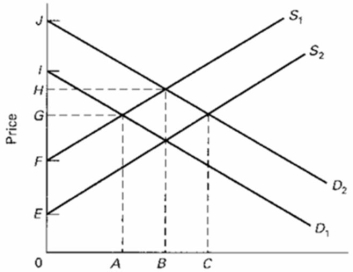
(Multiple Choice)
5.0/5 (78)
(78) The following table presents the demand schedule for product Z:  If the price of product Z increases to $15, what would be the consumer surplus?
 (Multiple Choice)
5.0/5 (79)
(79) The following information is for a public good.Pa and Pb are the prices that individuals A and B are willing to pay for the last unit of a public good, rather than do without it.These people are the only two members of society.Suppose the government has already produced 4 units of this public good.The amount individual B is willing to voluntarily pay for the 4th unit is: 
(Multiple Choice)
4.9/5 (73)
(73) Market for asparagus.At the market price of $2, area A represents: 
(Multiple Choice)
4.8/5 (87)
(87) The principle that private negotiation can resolve potential externalities without resort to government intervention is known as the Coase Theorem.
(True/False)
5.0/5 (70)
(70) Refer to the diagram in which S is the market supply curve and S1 is a supply curve comprising all costs of production, including external costs.Assume that the number of people affected by these external costs is large.Without government interference, this market will result in: 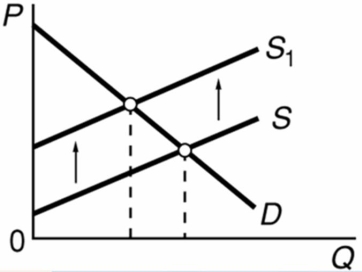
(Multiple Choice)
4.9/5 (68)
(68) A demand curve for a public good is determined by summing horizontally the individual demand curves for the public good.
(True/False)
4.8/5 (85)
(85) For which one of the following would we need to sum individual demand curves vertically to obtain the total demand curve?
(Multiple Choice)
4.7/5 (78)
(78) In a market where there are external or negative externalities associated with consumption and production, the equilibrium will not be efficient because:
(Multiple Choice)
4.9/5 (82)
(82) Refer to the below diagram of the market for product X.Curve St embodies all costs (including spillovers) and Dt embodies all benefits (including spillovers) associated with the production and consumption of X.Assuming the equilibrium output is Q1, we can conclude that the existence of spillover: 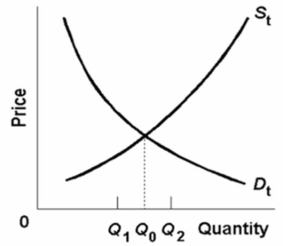
(Multiple Choice)
4.7/5 (81)
(81) Ed, Mike, and Scott are the only three people in a community and Ed is willing to pay $20 for the 5th unit of a public good; Mike, $15; Scott, $25.The government should produce the 5th unit of the public good if the marginal cost is:
(Multiple Choice)
4.9/5 (88)
(88) Near an ocean beach, a high-rise building is being constructed that will block the scenic view of the ocean by the residents of a low-rise building.The Coase Theorem suggests that this type of dispute between the owners of high-rise and low-rise buildings would best be resolved by:
(Multiple Choice)
4.7/5 (87)
(87) Society's optimal amount of pollution moderation is where society's marginal benefit of moderation is zero.
(True/False)
4.9/5 (64)
(64) 
Filters
- Essay(0)
- Multiple Choice(0)
- Short Answer(0)
- True False(0)
- Matching(0)