



 Chat with AI
Exam 4: B: Market Failures: Public Goods and Externalities

Exam 1: B: Limits, Alternatives, and Choices265 Questions
Exam 1: A: - Limits, Alternatives, and Choices60 Questions
Exam 2: B: The Market System and the Circular Flow119 Questions
Exam 2: A: - The Market System and the Circular Flow42 Questions
Exam 3: B: Demand, Supply, and Market Equilibrium291 Questions
Exam 3: A: - Demand, Supply, and Market Equilibrium51 Questions
Exam 4: B: Market Failures: Public Goods and Externalities133 Questions
Exam 4: A: - Market Failures: Public Goods and Externalities36 Questions
Exam 5: B: Governments Role and Government Failure121 Questions
Exam 5: A: Governments Role and Government Failure1 Questions
Exam 6: B: an Introduction to Macroeconomics65 Questions
Exam 6: A: an Introduction to Macroeconomics31 Questions
Exam 7: B: Measuring the Economys Output191 Questions
Exam 7: A: Measuring the Economys Output30 Questions
Exam 8: B: Economic Growth122 Questions
Exam 8: A: Economic Growth35 Questions
Exam 9: B: Business Cycles, Unemployment, and Inflation193 Questions
Exam 9: A: Business Cycles, Unemployment, and Inflation40 Questions
Exam 10: B: Basic Macroeconomic Relationships200 Questions
Exam 10: A: Basic Macroeconomic Relationships26 Questions
Exam 11: B: The Aggregate Expenditures Model238 Questions
Exam 11: A: The Aggregate Expenditures Model47 Questions
Exam 12: B: Aggregate Demand and Aggregate Supply203 Questions
Exam 12: A: Aggregate Demand and Aggregate Supply35 Questions
Exam 13: B: Fiscal Policy, Deficits, Surpluses, and Debt234 Questions
Exam 13: A: Fiscal Policy, Deficits, Surpluses, and Debt53 Questions
Exam 14: B: Money, Banking, and Money Creation206 Questions
Exam 14: A: Money, Banking, and Money Creation56 Questions
Exam 15: B: Interest Rates and Monetary Policy239 Questions
Exam 15: A: Interest Rates and Monetary Policy47 Questions
Exam 17: C: Financial Economics323 Questions
Exam 16: A: Long-Run Macroeconomic Adjustments28 Questions
Exam 16: B: Long-Run Macroeconomic Adjustments122 Questions
Exam 17: A: International Trade40 Questions
Exam 17: B: International Trade188 Questions
Exam 18: A: The Balance of Payments and Exchange Rates30 Questions
Exam 18: B: The Balance of Payments and Exchange Rates133 Questions
Exam 22: The Economics of Developing Countries254 Questions
Select questions type


Answer the next question on the basis of the following information is for public good.Pa and Pb represent the prices that citizens (a) and (b), the only two people in this nation, are willing to pay for additional units of a quantity (Qc) of the public good.Qs represents the quantity of the public good supplied by government at each of the collective prices.If only 1 unit of this public good is produced, then the marginal benefit is: 
(Multiple Choice)
4.8/5  (92)
(92) Refer to the diagrams below in which figures (a) and (b) show demand curves reflecting the prices Alvin and Elmer are willing to pay for a public good, rather than do without it.If the marginal cost of the optimal quantity of this public good is $10, the optimal quantity must be: 
(Multiple Choice)
4.8/5 (76)
(76) Refer to the supply and demand graph for a public good.Line segment ad represents the amount at Q1 by which the: 
(Multiple Choice)
4.9/5 (88)
(88) The following information is for a public good.Pa and Pb are the prices that individuals A and B are willing to pay for the last unit of a public good, rather than do without it.These people are the only two members of society.Refer to the data below.If the marginal cost of this good at the optimal quantity is $4, the optimal quantity must be: 
(Multiple Choice)
4.7/5 (103)
(103) In which of the following ways does the government of a nation estimate the true demand for a public good?
(Multiple Choice)
4.8/5 (88)
(88) With MB1 and MC1, society's optimal amount of pollution moderation is: 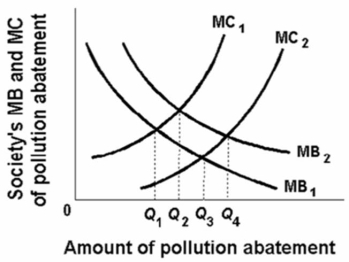
(Multiple Choice)
4.8/5 (76)
(76) Answer the question based on the following information.Way-Below Normal University has found it necessary to institute a crime-control program on its campus to deal with the high costs of theft and vandalism.The university is now considering several alternative levels of crime control.This table shows the expected annual costs and benefits of these alternatives.If Way-Below Normal undertakes Level Three: 
(Multiple Choice)
4.9/5 (86)
(86) The proposition that under some circumstances externalities can get resolved through private negotiation is known as:
(Multiple Choice)
4.8/5 (74)
(74) It has been proposed that a government agency be charged with the responsibility for determining the amount of pollution which the atmosphere or a body of water can safely recycle, and sell these limited rights to polluters.What would be the advantage of such a market for pollution rights?
(Multiple Choice)
4.9/5 (92)
(92) In a purely competitive industry at equilibrium price and quantity
(Multiple Choice)
4.7/5 (73)
(73) The MC curves in the diagram slope upward because of the law of: 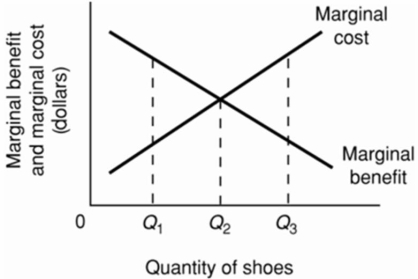
(Multiple Choice)
4.8/5 (89)
(89) The socially optimal amount of pollution moderation occurs where society's marginal:
(Multiple Choice)
4.7/5 (72)
(72) Answer the next question on the basis of the following information for public good.Pa and Pb represent the prices that citizens (a) and (b), the only two people in this nation, are willing to pay for additional units of a quantity (Qc) of the public good.Qs represents the quantity of the public good supplied by government at each of the collective prices.The collective willingness of this nation to pay for the fourth unit of the public good is: 
(Multiple Choice)
4.8/5 (71)
(71) If there are significant external benefits associated with the production or consumption of a good or service, there will be an under-allocation of resources to its production unless some corrective action is taken.
(True/False)
5.0/5 (89)
(89) Society's marginal cost of pollution moderation curve slopes upward because of the law of diminishing marginal utility.
(True/False)
4.8/5 (72)
(72) 
Filters
- Essay(0)
- Multiple Choice(0)
- Short Answer(0)
- True False(0)
- Matching(0)